The Worldbuilder’s Toolkit: Oceans and Seas

Oceans and seas have long captured the human imagination. They are vast, unpredictable, and teeming with mystery, making them the perfect setting for fantasy and science fiction. Whether your story takes place on storm-tossed pirate ships, beneath alien waves, or on islands surrounded by endless sea, these watery realms offer endless possibilities for tension, wonder, and world-shaping lore.
In this guide, I’ll explore how to craft compelling oceanic settings, how seas influence civilizations and technology, and how to use them for plot, theme, and character development.
Understanding the Ocean as a Living World
Before you build a sea-based setting, decide what kind of ocean you’re working with.
Shallow vs. Deep Seas: Shallow coastal waters offer unique ecosystems, challenges, and visuals than vast, open oceans or deep trenches.
Calm vs. Violent Waters: Are the seas navigable, or are they home to raging storms, magical maelstroms, or gravitational rifts?
Saltwater vs. Alien or Magical Seas: Think beyond Earth. Seas of acid, clouds, liquid methane, or magical currents can reshape everything from ecosystems to trade routes.
Consider:
Currents, tides, and dangerous weather patterns
The presence (or absence) of islands, archipelagos, or floating cities
Native marine life. Realistic, mythological, or completely invented?
Hidden realms below the surface: ancient ruins, alien habitats, or living coral empires

Sea-Based Civilizations: Shaped by the Waters
People who live by or on the sea develop to meet its challenges. Maritime cultures may revolve around trade, navigation, sea gods, or survival.
Coastal Empires and Seafaring Nations
Economies depend on fishing, trade, piracy, or resource extraction (e.g., pearls, magical kelp, deep-sea mining). Architecture must withstand wind, salt, and waves. Harbors, piers, canals, and stilt-houses shape daily life. Social structures may revolve around seafaring guilds, naval power, or religious orders devoted to ocean spirits or deities.
Island Cultures
Resources are limited; ingenuity and adaptation are key. Expect strong oral traditions, tight-knit communities, and deep respect for nature. Navigation has become a sacred science. Elders may memorize currents, stars, and migration patterns as part of their cultural legacy. Isolation might preserve unique traditions or make them vulnerable to colonization, invasion, or extinction.
Underwater Civilizations
These might be alien, magical, or transhuman. Consider how underwater physics shape everything from communication to warfare. Cities may be inside domes, grown from coral, or formed in geothermal vents. Societies may have caste systems tied to depth tolerance or bioluminescent markings.
Character Idea: A priest-astronomer of a tide-worshiping coastal people discovers that the moon’s cycle is changing and with it, their future. She must voyage across dangerous seas to uncover the truth.
Ocean Travel and Trade: Routes, Risks, and Rewards
Waterways shape economies and political alliances in powerful ways.
Trade and Exploration
Shipping lanes have become vital arteries for food, wealth, and culture. Control of straits or sea gates may spark a war. Explorers charting the “edge of the world” may find lost continents, floating kingdoms, or tears in reality. Sea charts, tide lore, and magical compasses can be major plot elements.
Piracy and Naval Warfare
Piracy may be a noble rebellion or ruthless terror. Sea bandits, ghost ships, or rebel fleets could serve as protagonists or threats. Naval empires require shipbuilding, cannon tech (or magical equivalents), and command structures. Consider how sea battles differ from land battles . Submarine warfare in a sci-fi setting might use stealth drones, sonar disruption, or alien marine beasts.
Hazards of the Sea
Storms, whirlpools, magical fogs, krakens, sirens, or sea mines. All significant obstacles for tension and plot complications. Long voyages may lead to scurvy, dehydration, mutiny, or cabin fever. Sci-fi dangers such as rogue waves on terraformed planets, sea-borne diseases, or sentient weather systems.
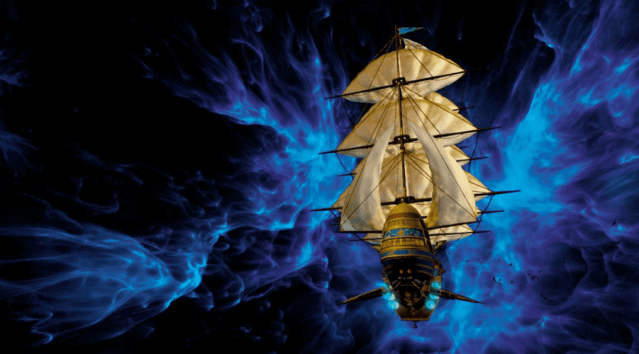
Example: In Treasure Planet, a sci-fi adaptation of Treasure Island, solar-sailing ships navigate the ether like ocean-faring vessels, fusing classical naval tropes with futuristic flair.
Myth and Mystery: The Sea as Legend
The ocean is a natural setting for myth – its depths unknown, its horizons endless.
Legendary Creatures and Beings
Create your own versions of sea monsters, merfolk, leviathans, or god-like beings slumbering in the trenches. Consider ecosystems where smaller predators swarm in deadly schools or where one colossal creature acts as a living island.
Sunken Ruins and Lost Cities
Atlantis-like ruins can hold ancient secrets, magical tech, or cursed relics. Your characters might be salvagers, scholars, or guardians trying to protect or exploit these places.
Religious or Superstitious Beliefs
Fisherfolk may believe in appeasing sea spirits before setting sail. They might interpret storms as divine punishment or messages from the deep. In a sci-fi world, cults may form around ancient alien signals coming from the ocean floor.
Character Idea: A deep-sea diver with enhanced lungs hears songs no one else can. She’s lured deeper, unsure whether it’s madness or a siren’s call to destiny.
Oceans as Thematic Metaphor
Beyond the physical setting, oceans can serve symbolic purposes.
The Unknown: Oceans symbolize mystery, fear, and the vastness of what we don’t understand, perfect for quests or coming-of-age arcs.
Transformation: Water often symbolizes rebirth. Characters may undergo personal evolution tied to a voyage, shipwreck, or plunge into the deep.
Isolation: Characters lost at sea (literally or metaphorically) can experience powerful themes of loneliness, survival, and self-discovery.

Alien or Magical Oceans: Beyond Earthly Waters
Let your imagination drift beyond blue water and coral reefs.
A floating ocean planet with no land, where civilizations live on massive drifting cities or the backs of mega-fauna.
A dead sea, where no life remains except psychic jellyfish that communicate through dreams.
A world where the ocean is sentient, manipulating tides to protect or punish civilizations that worship (or exploit) it.
Inland seas of sand, or liquefied stone, blurring the lines between desert and ocean.
Example: In The Broken Earth trilogy by N. K. Jemisin, a distant ocean hides something ancient and powerful, with seismic implications. The sea is not just a setting; it’s a mystery the characters must solve.
Real-Life Maritime Cultures as Inspiration for Fictional Worlds
Throughout history, civilizations living on coasts and islands or entirely dependent on the sea have developed complex relationships with the ocean. Their innovations, myths, and survival strategies provide rich inspiration for crafting fictional sea-based societies and characters. Here are several real-world maritime cultures and how they can inspire fantasy or science fiction world-building.
The Polynesians (Pacific Ocean)
Among the greatest navigators in history, Polynesian seafarers traveled thousands of miles using only the stars, wave patterns, and bird behavior. Their society was deeply connected to the ocean spiritually and practically, with sophisticated canoe-building and oral traditions.
Inspiration for Fiction
Culture: A star-navigating society that views ocean travel as a sacred duty. They pass navigation down orally, and they view the sea as a living ancestor.
Character Idea: A young navigator who’s forbidden from sailing after a prophetic dream. When their homeland faces ruin, they risk exile to chart a course into uncharted waters where gods are rumored to slumber.

The Vikings (North Atlantic and North Sea)
Norse seafarers known for their longships, raids, and trade across Europe and beyond. Vikings were explorers, warriors, and settlers, navigating harsh northern waters with speed and precision.
Inspiration for Fiction
Culture: A cold-sea civilization that reveres the storm as both a trial and a teacher. Sailors wear tide-blessed pendants before battle, and they enchant their longships with runes.
Character Idea: A cursed raider who hears the ocean whispering in their mind. They must lead their crew across a haunted sea, unsure if the voices are madness or the gods guiding them.
The Minoans (Aegean Sea)
An advanced Bronze Age civilization from Crete, heavily reliant on seafaring and trade. The Minoans built sprawling palace complexes, worshipped nature deities, and created rich artwork reflecting marine life.
Inspiration for Fiction
Culture: A matriarchal island society that lives in harmony with the sea, constructing coral-temples and bio-luminescent mosaics. Priestesses who read the tides and volcanic vents guide their fleets.
Character Idea: A novice tide-reader sees a pattern in the waves that matches an ancient prophecy, one that predicts the return of a long-drowned god.
The Swahili Coast (East Africa)
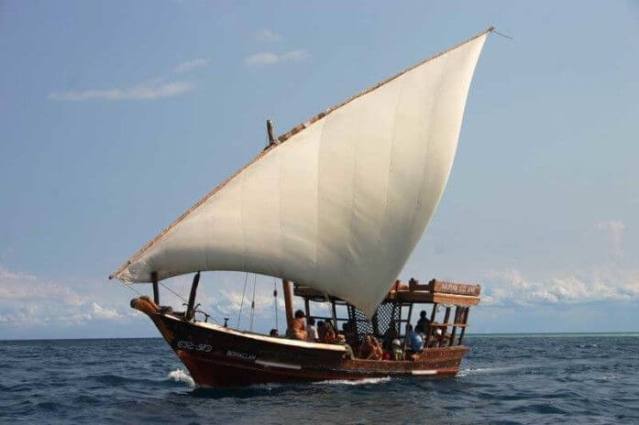
The Swahili city-states were prosperous trading ports along the East African coast, influenced by Arab, Persian, Indian, and African cultures. Their ships (dhows) connected them to distant markets, and their culture was rich in art, poetry, and architecture.
Inspiration for Fiction
Culture: A multicultural port city at the crossroads of magical continents, where sea-caravans carry not only goods but ancient songs and curses. Architecture blends coral stone and cloud-glass.
Character Idea: A multilingual dockmaster turned reluctant diplomat when tensions rise between oceanic traders and land-empire ambassadors. She must navigate shifting political tides while unraveling the truth behind a sunken cargo rumored to hold a god’s breath.
The Bajau (Southeast Asia)
Known as “Sea Nomads,” the Bajau people of Southeast Asia have traditionally lived most of their lives on boats, diving without modern equipment and spending extended periods underwater.
Inspiration for Fiction
Culture: An aquatic-adapted people who live on floating cities and underwater caves, using gill-tech or innate lung control. Their warriors ride manta-beasts and speak in pressure-coded clicks.
Character Idea: A storm that sank part of their flotilla caused people to blame a sea-born hunter with extraordinary breath control. To prove their innocence, they must dive into the Abyss Trench, a place from which no one has returned.
The Phoenicians (Mediterranean Sea)
Masters of ancient maritime trade, the Phoenicians established colonies and routes across the Mediterranean. They were expert shipbuilders and are credited with spreading written language.
Inspiration for Fiction
Culture: A mercantile sea-empire known for “living ships” – vessels grown from reefwood and infused with minor spirits. Every merchant captain is also a bard, trained in negotiation and song-magic.
Character Idea: A traveling scribe who discovers a lost Phoenician-like tongue embedded in sea chants. Deciphering it unlocks not only a map to a forgotten isle, but control over the tides themselves.
The Haida and Tlingit (Pacific Northwest)
Coastal Indigenous peoples known for their expert seafaring canoes, intricate art, and oral histories. Their relationship to the sea is deeply spiritual, with clan totems often tied to marine animals.
Inspiration for Fiction
Culture: A cold-sea culture where each clan bears a bond with a specific marine spirit, passed down in story, song, and carved talismans. War can only be declared with the breaking of a driftwood totem.
Character Idea: A clan-less orphan carves a totem of an unknown sea-creature that begins showing up in the real world. Some see it as a sign of war. Others, of rebirth.

Tips for Using Real Cultures as Inspiration Respectfully
Blend, Don’t Copy: Avoid one-to-one analogues. Use real-world elements as a launching point, then layer your own geography, language, and technology.
Honor Depth: Dig beyond aesthetics. Research the culture’s worldview, social structure, and relationship with nature or the sea.
Avoid Stereotypes: Steer clear of eroticizing or romanticizing. Respect the nuances and dignity of the original culture.
Use Sensitivity Readers: If your story closely resembles a specific culture, a sensitivity reader can help ensure accuracy and respect.
Vast Waters and the Impact on Travel and Trade
Oceans and seas have long served as both highways and hazards. In speculative fiction, these vast waterways can shape entire economies, determine political power, and challenge adventurers at every turn.
Trade Routes and Economic Power
Sea Routes as Lifelines: In most ocean-based or island-heavy worlds, trade by ship is more efficient than land travel. Coastal cities and island ports become economic hubs, cultural melting pots, or diplomatic flashpoints.
Strategic Choke Points: Control of narrow straits, canals, or enchanted reefs can grant vast political power. Wars may erupt over who controls the passage of goods (or the rare leviathan bones that fuel magic).
Trade Goods: Oceans provide fish, salt, coral, rare herbs, sea silk, magical bioluminescent algae, and more. Underwater mining colonies may harvest crystals or alien tech buried in trenches.
Piracy and Naval Control: Trade also draws threats: pirates, sea monsters, and rogue navies. This creates a constant push-and-pull between law, chaos, and those who profit from both.
Travel and Exploration
Navigation: In fantasy, sea travel might involve magic compasses, star readers, or aquatic familiars. In sci-fi, navigation could require interstellar drift mapping, wormhole-tide charts, or AI ocean-current prediction.
Ship Types: Different waters require different vessels. Sleek catamarans for calm seas, heavily armored dreadnoughts for hostile alien waters, flying ships for wind-based magic systems.
The Unknown: The ocean represents the unexplored. Maps end with warnings: “Here Be Monsters.” Your characters may face whirlpools, magnetic storms, or seafloor gates that open to other worlds.
Character Impact
Mariners and Traders: Characters who rely on the sea may be shaped by its danger and unpredictability, pragmatic, weather-worn, superstitious, or adventurous.
Explorers: A protagonist might be the first to cross a forbidden sea, driven by legend, duty, or exile. Their journey could shift the balance of power or uncover long-lost civilizations.
Ship-Bound Societies: Entire cultures could live on the water: on ships, barges, or floating cities. These groups may not understand land ownership and treat the sea as sacred.
Example: In One Piece, the Grand Line is both a deadly travel route and a global trade corridor. Its constant weather shifts, strange islands, and sea beasts make it as much a character as any of the protagonists.

Oceans as Realms of Myth, Legend, and Hidden Mystery
Oceans are rich with symbolism, frequently seen as birthplaces of life, gateways to the unknown, and homes of the divine or monstrous. In both fantasy and science fiction, the sea is a perfect setting for myths and secrets that lurk just out of reach.
The Sea in Myth and Symbolism
Creation Myths: Many cultures envision the world emerging from oceanic chaos or being shaped by sea gods. Your world might have a literal Sea of Origins or a sunken divine body from which life sprang.
Gods and Spirits: Storm gods, tide spirits, and sea monsters are recurring motifs. In your setting, gods may sleep beneath the waves, stirred only by blood or betrayal.
Legendary Locations: Atlantis, Lemuria, Ys, and sunken cities echo across myth. You can create your own sunken empires, floating islands, cursed reefs, or oceans that remember forgotten things.
Mysterious Depths and the Unknown
What Lies Beneath: The deep sea remains one of the least explored regions of Earth. In your story, it might hold: buried civilizations (pre-cataclysmic empires or alien colonies), elder beings (gods or monsters sealed away), forbidden tech (a crashed ship, a sealed AI, a vault of pre-magic knowledge), or organic intelligence (a sentient coral reef, or oceans that think)
The Deep Changes You: Pressure, darkness, isolation. Characters descending into the abyss may not return unchanged – physically, mentally, or spiritually.
Recurring Ocean Myths and Tropes to Reimagine
Sirens: Lure sailors with beauty, music, or memory. In sci-fi, they could be psychic aliens or data-ghosts from sunken shipwrecks.
Ghost Ships: Abandoned vessels haunted by lost crews or acting with strange intelligence. Perhaps the ship sails itself, carrying a prophecy.
Sea Curses: Taboos broken at sea can have long-lasting consequences: drought, famine, haunted weather. A fisherman may awaken something ancient with a forbidden catch.
Character Idea: A sailor marked by the sea (tattoos that change with the tides) dreams of an underwater city she’s never seen. When she sails beyond the last charted island, the sea speaks.
Example: In The Odyssey, the sea is both pathway and punishment, with monsters, storms, and gods controlling Odysseus’s fate. In The Abyss (film), the ocean becomes a mirror of human fear and a place where other intelligence hides in plain sight.
Plot and Character Ideas
The Leviathan Treaty
Genres: Epic Fantasy, Political Intrigue
Plot Idea: A deep-sea leviathan has awoken for the first time in centuries and demands renegotiation of a forgotten pact that protects coastal cities from destruction.
Character Angle: A low-ranking diplomat fluent in ancient sea-tongue is thrust into negotiations with the creature and must uncover what caused the original pact to fray.
Twist(s): The leviathan isn’t the original; it’s a younger sibling avenging a broken peace, and the cities may have committed atrocities long buried beneath the waves.

Ghostwake
Genres: Sci-Fi Horror, Mystery
Plot Idea: A research submarine receives a distress signal from a vessel that vanished 40 years ago in the deep ocean trench “Ghostwake.”
Character Angle: A grieving ex-naval officer joins the recovery team, hoping to find answers about her lost sibling, who was aboard the original vessel.
Twist(s): The missing crew is alive, preserved by a non-linear time anomaly, trapped in an endless loop unless someone breaks the cycle.
Siren’s Anchor
Genres: Fantasy Romance, Dark Fairy Tale
Plot Idea: A siren bound by a curse to one island falls in love with a sailor who visits every year, but she can never leave, and he can never stay.
Character Angle: A cursed immortal, the siren dreams of freedom more than love, but fears losing the only soul who sees her as more than a monster.
Twist(s): The sailor is aging backward, cursed himself, and their last meeting may be his first or final.
The Deep Parliament
Genres: Sci-Fantasy, Political Thriller
Plot Idea: Representatives of surface nations are invited to a mysterious summit hosted by the Deep Parliament, an underwater alliance emerging after millennia of silence.
Character Angle: A jaded human diplomat with a scandalous past is sent to the summit as punishment but discovers political intrigue among the sea-folk that could change everything.
Twist(s): The Parliament is debating whether the surface deserves access to deep-sea energy sources or eradication to prevent further ecological collapse.
Saltwitch
Genres: Dark Fantasy, Coming-of-Age
Plot Idea: A coastal village trains one girl per generation as a Saltwitch to appease the sea spirits. The current candidate refuses.
Character Angle: A rebellious teenage girl uncovers the truth: the Saltwitch isn’t a sacrifice, it’s a guardian. And the next tide brings a threat only she can face.
Twist(s): Interdimensional beings known as “spirits” inhabit a realm connected to the ocean floor, and they are waking up angry.
The Coral Citadel
Genres: Fantasy Adventure, Lost Civilization
Plot Idea: Explorers seek the mythical Coral Citadel, said to appear only during certain celestial alignments deep in the southern sea.
Character Angle: A cartographer’s apprentice with perfect memory is brought along for their mind, not their bravery. But their visions may be the key to unlocking the citadel’s secrets.
Twist(s): The citadel is alive. Its architecture shifts with tides and thought, and it’s selecting a new ruler from among the intruders.
Tideglass
Genres: Urban Fantasy, Mystery
Plot Idea: People along a seaside town go missing, and tidepools are found reflecting places that don’t exist.
Character Angle: A skeptical local diver finds a shard of tideglass that shows glimpses of a mirror world beneath the sea, one where the missing might still be alive.
Twist(s): The reflections aren’t illusions, they’re invitations. But the underwater realm has its own price for entry.
Blue Harvest
Genres: Sci-Fi Thriller, Ecofiction
Plot Idea: A corporate ocean farm harvesting bio-engineered plankton loses contact with its sea-based workers.
Character Angle: A retired biologist returns to the industry she helped create to investigate, haunted by earlier ethical compromises.
Twist(s): The genetically modified plankton has developed sentience and may be forming a hive-mind in the currents.
The Navigator’s Bones
Genres: Nautical Horror, Fantasy
Plot Idea: A legendary shipwreck reappears once every generation. It’s said that whoever claims the Navigator’s Bones gains mastery over the tides.
Character Angle: A reluctant descendant of the ship’s captain is blackmailed into joining a scavenger crew, drawn into their ancestor’s unfinished voyage.
Twist(s): The ship isn’t a ruin. It’s a trap, rebuilding itself from the bones of those who come seeking it.
Beneath the Shellsky
Genres: Science Fantasy, Exploration
Plot Idea: On a waterworld with a reflective, opaque shell-sky, navigators must learn to read the surface’s mirrored stars to explore the planet.
Character Angle: A blind astromancer from an island observatory is the only one who can interpret the shellsky and may hold the key to what lies beyond it.
Twist(s): The shellsky is not atmospheric; it’s the inside of a living organism, and someone is trying to wake it.
Whale-Rider of the Storm Shoals
Genres: Heroic Fantasy, Mythic Adventure
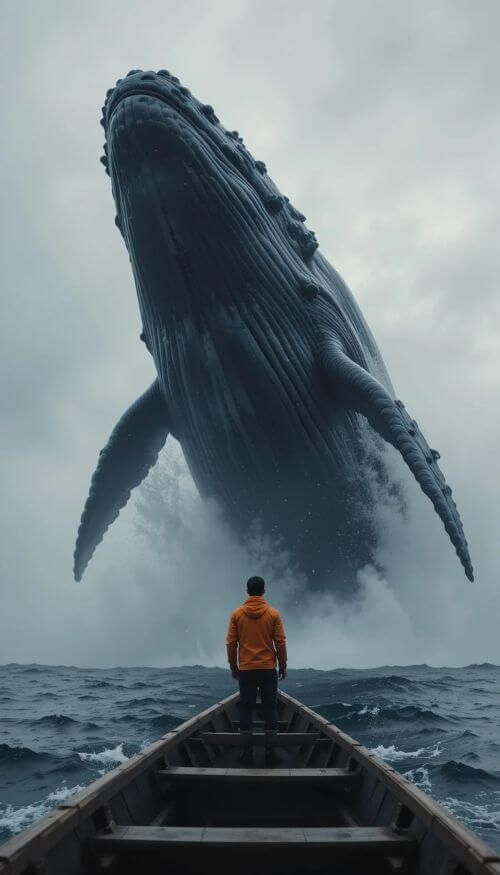
Plot Idea: Once a generation, a great storm whale rises from the depths and chooses a rider to restore a balance between sea and sky.
Character Angle: A shipwrecked orphan raised on a floating junktown is chosen, despite being land-born and forbidden.
Twist(s): The whale is dying, the balance is already lost, and the true task is to carry its last memories to the sea gods.
The Forgotten Tide
Genres: Time Travel, Magical Realism
Plot Idea: A reclusive lighthouse keeper starts seeing ghost ships on the horizon then realizes they’re not ghosts, but vessels from the past caught in a temporal tide.
Character Angle: A war veteran running from his past discovers he’s uniquely attuned to these tides and may be able to rewrite a key moment in history.
Twist(s): Changing the past may prevent a war but will erase the people he’s come to care about in the present.
Oceans and seas are more than just blue backdrops. They are rich, living landscapes that challenge your characters, shape your civilizations, and hold the power to transform your plot in profound ways. Whether your story sails across sci-fi currents or fantasy tides, crafting a well-developed marine world can immerse readers in the raw beauty, danger, and awe of the deep.
So dive in. The sea is waiting. Happy worldbuilding!
I hope this was helpful. Let me know if you have questions or suggestions by using the Contact Me form on my website or by writing a comment. I post every Friday and would be grateful if you would share my content.
If you want my blog delivered straight to your inbox every month along with exclusive content and giveaways, please sign up for my email list here.
Let’s get writing!
Copyright © 2025 Rebecca Shedd. All rights reserved.
 Rebecca Shedd - Author