
Writer’s Deep Dive: Anchors
Posted on January 6, 2023 4 Comments

A ship’s anchor is a critical piece of equipment. It allows the vessel to be secured in place when a dock or pier is unavailable. However, just like the hull and sail shapes, the anchor has a significant amount of technology in its design.
Now, let’s dive in!
Terminology
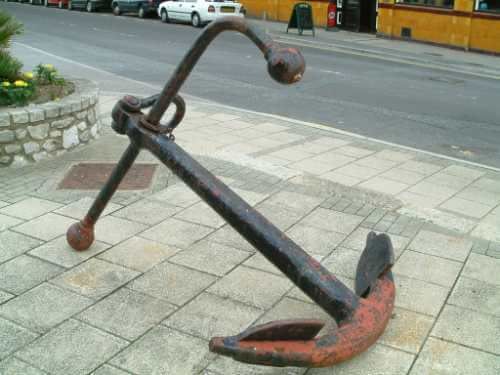
Shank – The long piece of an anchor between the ring and arms.
Arms – The crosspiece at the bottom of the anchor.
Ring or Shackle – The top of the anchor to which the chain is attached.
Fluke – A flange at the end of the arms that digs into the seabed.
Stock – A crossbar at the top of the anchor.
Rode – The chain, rope, or cable that connects the ship to the anchor.
Hawsepipe – A small hole through which the rode passes.

Types of Anchors
The earliest anchors were rocks, and many have been found dating back to the Bronze Age. [1] The most common design comprised a hole bored through the rock with a rope tied through it. The ancient Greeks used baskets of stones, sacks of sand, and wooden logs filled with lead as anchors. All these early types of anchors relied on the weight to hold the ship in place.

The biggest improvement to the anchor design was the introduction of flukes. This is the iconic shape that most people are familiar with. Roman ships from the 1st century have been found with this style of anchor and 10th century Viking vessels. In fact, the Romans added the stock at the top of the anchor early on. Different variations of the fluked anchor have been developed over the centuries, but the basic design has remained the same and is still in use today.

Image source.
The Admiralty Pattern anchor is a common shape that was based on the ancient Roman designs. The stocks are set at ninety-degree angles to the arms. When the anchor has landed on the bottom, strain on the chain will cause the stock to dig into the bottom, canting the anchor until one fluke digs in. Although the design is effective, there is a tendency for the rode to tangle in the stocks as the vessel swings with the wind and currents. This tangling may dislodge the anchor and require it to be reset. Another drawback is the difficulty in storage. Commonly, the ring was secured to a timber sticking out from the bow, known as a cathead, while one fluke was hauled up and hooked over the rail. A variation of the Admiralty Pattern anchor was developed in the mid-19th century, known as the Trotman Anchor, which had folding stocks. [2]
A stockless anchor was patented in England in 1821. [3] Although the Admiralty Pattern anchor had superior holding capabilities, it was unwieldy to handle and store. The stockless anchor could be stowed flat or off the bow of the ship.

Until the mid-20th century, small vessels used either a scaled-down version of the Admiralty Pattern anchor or a simple grapnel anchor, basically a four tined grappling hook.
Early sailors commonly used rope as their rode but it became replaced almost exclusively by chain on large ships. The downside to hemp rope is that it absorbs water and can fray on rocks and coral. Today, small vessels commonly use either chain or nylon rope.
Anchoring Techniques
To anchor a ship, a proper anchorage is determined, the anchor is dropped, the length of the rode is let out, and the fluke is set. The anchorage should be approached from downwind or down current, depending on which is stronger. The ship is stopped, and the anchor lowered to the bottom. Then the ship may drift or else motor back slowly, keeping the rode straight. As the anchor digs in, there will be resistance and the vessel should be maneuvered backward to achieve a good set.
With only one anchor, the ship will swing with the wind and currents. Multiple anchors can minimize the movement of the vessel. A forked moor involves two anchors off the bow set at a 45° angle. A bow and stern moor involves an anchor off the front and back of the ship.
It is important to know the depth before attempting to anchor. It is recommended that the length of the rode should be between four to ten times longer than the water is deep to prevent the anchor from breaking out. [4] The measurement should also include the distance between the surface of the water and the anchor roller or hawsepipe.

Weighing Anchor
An embedded anchor must be broken out of the bottom in order to haul it up. The rode is taken in until the ship is directly above the anchor. This rotates the anchor and is usually enough to free it. If not, the vessel can move around to loosen it. When an anchor is aweigh, it means it is hanging from the rode but not resting on the bottom.
I hope this was helpful. Let me know if you have questions or suggestions by using the Contact Me form on my website or by writing a comment. I post every Friday and would be grateful if you would share my content.
If you want my blog delivered straight to your inbox every month along with exclusive content and giveaways, please sign up for my email list here.
Let’s get writing!
Copyright © 2022 Rebecca Shedd. All rights reserved.
[1] Johnstone, Paul and McGrail, Seán (1989). The sea-craft of prehistory. London: Routledge. ISBN 978-0-415-02635-2, p.82.
[2] https://en.wikipedia.org/wiki/Anchor
[3] "anchor" in The New Encyclopædia Britannica. Chicago: Encyclopædia Britannica Inc., 15th edn., 1992, Vol. 1, pp. 377–8.
[4] Safety in Small Craft. Ch 2. Royal NZ Coastguard Federation. Mike Scanlan. Auckland. 1994


The Writer’s Guide to the Technology of Ships
Posted on December 9, 2022 1 Comment
Most people look at a sailing ship and don’t think of it as a piece of technology. But technology is “the application of scientific knowledge for practical purposes,” according to the dictionary. Ship sails and hulls are the product of millennia of practical scientific application. If a hull has an incorrect shape, the ship won’t be buoyant. If a sail is an incorrect shape, it won’t catch the optimal amount of wind. Here are the basics of the physics of ships.
As always, magic is the exception to the rule. Because magic.
Hull
The shape of the hull is important because it creates enough buoyancy for the ship to float. The earliest boats had simple rounded hulls, such as canoes. But ship builders experimented with different shapes. Most ship hulls throughout history and up to the modern day are wide on the sides before curving down to the keel.
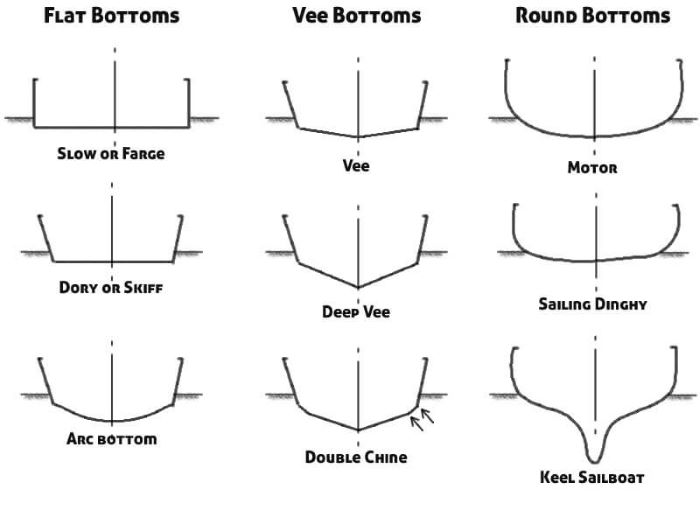
Most hulls taper toward the bow and stern, with the widest section in the center. This reduces drag and allows the hull to slip through the water. The surface is made as smooth as possible to further reduce drag.
Hull shapes break down into several subcategories. Hard chined hulls have flat planes that meet at sharp angles. Moulded, round bilged, or soft chined hulls have smooth curves and are the most common today. [3] Some hulls are designed primarily for displacement, while others are constructed for high speed and planing across the surface of the water.
There are pros and cons to each shape. For example, flat-bottomed hulls are more stable but have high drag, so the vessel is slower. A severely tapered hull can be fast but can also be unstable, leading to the danger of heeling, or leaning far to one size, and capsizing.

Sails
The sails are used to catch the wind coming from the back of the ship and pull the vessel along the surface of the water. The sails act as an airfoil and provide lift, although only to a certain point before drag asserts itself. [2] There is an incredible amount of physics behind a ship’s sail.
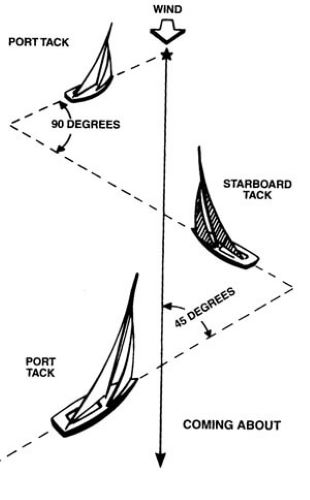
Most ships can adjust the placement of their sails so they can catch wind coming from different directions. This is known as trimming and is achieved by adjusting the running rigging. Sails can use wind coming from the sides and the back. Ships can use wind coming from the front by tacking or zigzagging back and forth to fill the sails from the side.
There are three general sail shapes that have been used throughout history.
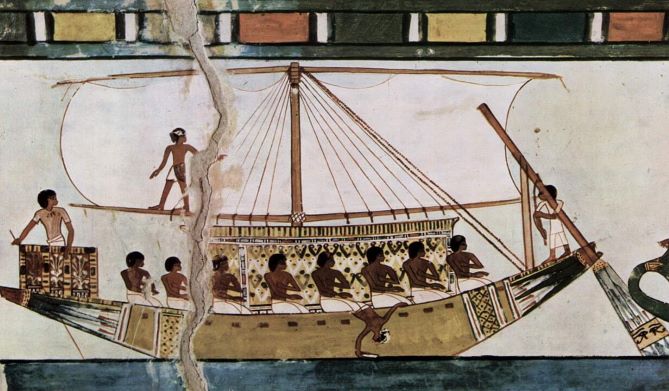
Square sails are exactly what they sound like. This shape is the one that most people think of when they picture a sailing ship. The sails are suspended from a yard attached to the mast. There are paintings of ancient Egyptian ships with square sails from as early as 3200 BCE. [1]
The crab claw rig is a sail spread between two spars which meet at one end. This style of sail was used extensively in the Pacific Ocean by the people of Micronesia, Polynesia, and Madagascar. It enabled them to sail vast distances of open ocean and is mostly used on catamarans and outriggers. [4]
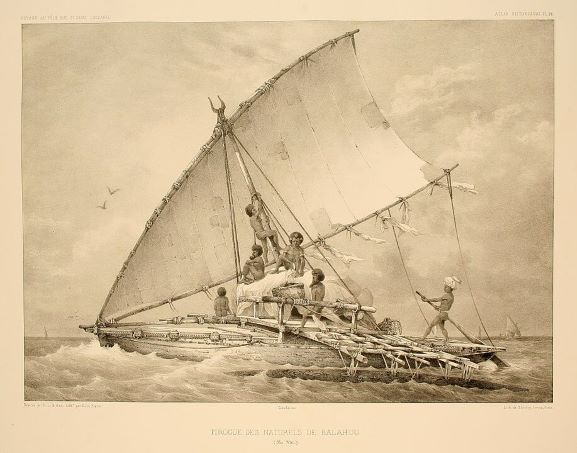
Lateen sails are triangular and suspended from a canted yard. They were used extensively in the Mediterranean, beginning in the 2nd century CE. [5] This style is believed to be a variation of the crab claw sail that developed from contact with Southeast Asian Austronesian trading ships in the Indian Ocean. [6] Lateen sails have better upwind performance than square sails, especially on smaller vessels, and beginning in the 15th century, became the most common for ships sailing rivers and the Mediterranean. [7] However, square sails were still the standard for trans-Atlantic and North Sea sailing.

I hope this was helpful. Let me know if you have questions or suggestions by using the Contact Me form on my website or by writing a comment. I post every Friday and would be grateful if you would share my content.
If you want my blog delivered straight to your inbox every month along with exclusive content and giveaways, please sign up for my email list here.
Let’s get writing!
Copyright © 2022 Rebecca Shedd. All rights reserved.
[1] John Coleman Darnell (2006). “The Wadi of the Horus Qa-a: A Tableau of Royal Ritual Power in the Theban Western Desert”. Yale. Archived from the original on 2011-02-01. Retrieved 2010-08-24.
[2] Batchelor, G.K. (1967), An Introduction to Fluid Dynamics, Cambridge University Press, pp. 14–15, ISBN 978-0-521-66396-0
[3] Zeilen: Van beginner tot gevorderde by Karel Heijnen
[4] Doran, Edwin Jr. (1974). “Outrigger Ages”. The Journal of the Polynesian Society. 83 (2): 130–140.
[5] I. C. Campbell, “The Lateen Sail in World History” Archived 2016-08-04 at the Wayback Machine, Journal of World History (University of Hawaii), 6.1 (Spring 1995), p. 1–23
[6] Hourani, George Fadlo (1951). Arab Seafaring in the Indian Ocean in Ancient and Early Medieval Times. New Jersey: Princeton University Press.
[7] Chatterton, Edward Keble (1912). Fore and aft. London: J. B. Lippincott. p. 203. OCLC 651733391. fore and aft rig schooner.

The Writer’s Guide: Introduction to Sailing Ships
Posted on November 25, 2022 2 Comments

There is something romantic, magical even, about sailing ships. Vessels with motors lack a certain enchantment. It should come as no surprise that writers love to include sailing craft in literature and many an adventure yarn starts with boarding a ship. The vessel can be a vital part of the story, such as the Hispaniola in Robert Louis Stevenson’s Treasure Island, or just an enchanting element like the silver ship that carries Frodo and Bilbo into the West at the end of The Return of the King.
Yet since most people do not have hands-on experience with sailing, the average writer knows little about them. In this series, I will cover a wide sweep of topics, including the technology of the sailing ship, navigation, and the history of sailing. For today, I will go through the basics.
As always, magic is the exception to the rule. Because magic.
Basic Terminology
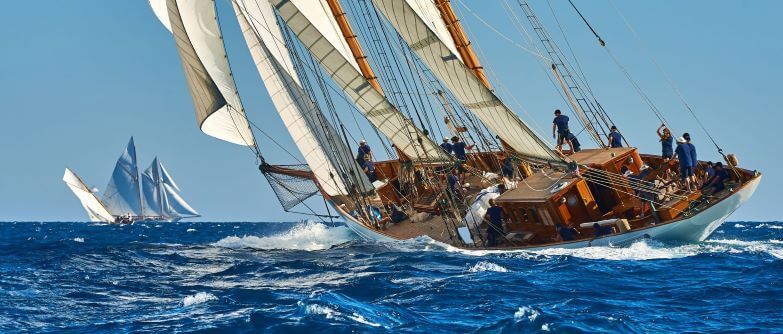
Ships and sailing have their own terminology, which can sound like their own language.
Hull – The outer body of the ship. Hulls come in a variety of shapes and can be made of wood, metal, or fiberglass.
Keel – The bottom structural ridge of the hull. It strengthens the hull and can serve a hydrodynamic or counterbalancing function.
Deck – The top floor and one that forms a ceiling over the compartments and cabins on the decks below. It helps hold the hull together, protects the lower decks from the weather, and is the main working surface for the crew. Not all ships have decks, with those that don’t use the inside of the hull as a deck.
Mast – A vertical spar secured to the deck that supports the sails. They were originally made of wood, commonly entire tree trunks, but have also been made of metal and fiberglass.
Yard – A horizontal spar attached to a mast from which sails are suspended. They are mostly used on square-rigged sails.
Sail – A large sheet of fabric suspended from a mast or yard used to catch the wind.
Rigging – The series of ropes, cables, and chains that secure the sails, yards, and masts. There are two types: standing and running. Standing rigging is fixed in position while running rigging is tightened or loosening to change the shape and position of the sails.
Rudder – A flat fixture on the back of a boat below the waterline that is adjusted to change the direction of the vessel.
Wheel – The device that controls the rudder. It is on the deck at the back of the ship.
Forecastle or Fo’c’s’le – A raised deck at the front of a ship. Forecastles can be only slightly higher than the main deck or significantly taller. Medieval ships had fortified raised front decks that looked like castles. In the following centuries, the name forecastle was shortened to fo’c’s’le.
Quarter Deck – A raised deck behind the mainmast. Traditionally, it was the location from which the captain commanded the vessel.
Poop Deck – A tall deck at the rear of a ship. It was usually taller than the quarterdeck and originally fortified like the forecastle. The name comes from the French word la poupe, which means stern, since it is at the back.
Anchor – A heavy device used to secure a vessel to the bottom of the ocean or other body of water. This prevents the craft from drifting with the wind or current.
Port – The left side of a ship.
Starboard – The right side of a ship.
Bow – The front of a ship.
Stern – The back of a ship.


I hope this was helpful. Let me know if you have questions or suggestions by using the Contact Me form on my website or by writing a comment. I post every Friday and would be grateful if you would share my content.
If you want my blog delivered straight to your inbox every month along with exclusive content and giveaways, please sign up for my email list here.
Let’s get writing!
Copyright © 2022 Rebecca Shedd. All rights reserved.
Writer’s Deep Dive: Toledo Steel
Posted on November 11, 2022 1 Comment

Damascus, Syria was not the only city that became famous for its steel. Toledo, Spain was also producing high quality and highly valued blades from ancient times.
Now, let’s dive in!
What is Toledo Steel?
Toledo steel was famous for being flexible and strong and its production was a closely guarded secret until the 20th century. It started with the metals. An envelope of steel was folded around a wrought iron strip, which gave the metal the strength of the steel and the flexibility of the iron. The combination of metals was heated, and forge welded together. This technique is called san mai by modern bladesmiths and is often used when forging swords and knives. It’s also known as the “taco” method. Because of this technique, Toledo steel was said to have a “soul of iron.” [1]
The second secret was the production with a strict schedule of heating, cooling, and temperature. If the process was not followed exactly, the blade would not be of the highest quality. Originally, prayers and psalms were carefully recited with the same rhythm to keep the timing. This process was long and difficult and the average bladesmith produced two to three weapons per year.
History
Historians are unsure when the peoples of Iberia began making Toledo steel, but the tribes of ancient Hispania were famous for a type of sword known as a falcata. It was thought to be more fatal than other weapons. [1] The steel and style of sword became prized by the 3rd century when Hannibal choose to arm his soldiers with them during the Second Punic War. The Romans were impressed by their quality and later made Toledo the standard source of steel for their legions. [2]
The production of Toledo steel continued under the Muslin occupation of the Iberian Peninsula but reached its peak in the 15th and 16th centuries after the Christians regained control of southern Spain. [3]
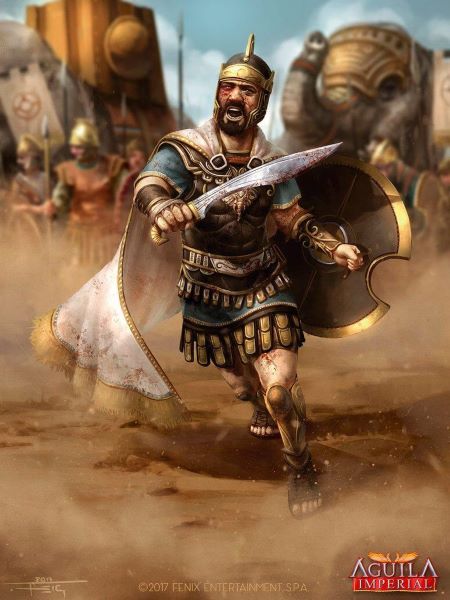
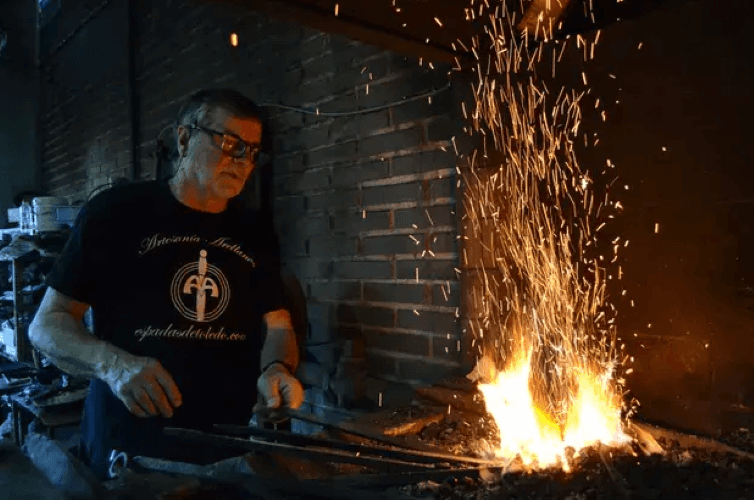
However, as armies replaced their swords with guns, blacksmithing and bladesmithing began to die out. In 1761, King Carlos III of Spain ordered the creation of the Royal Sword Factory in Toledo to preserve the techniques and methods of steel production. [4] Unfortunately, the art has continued to decline and as of 2021, only one master swordsmith remained in Toledo. [5]
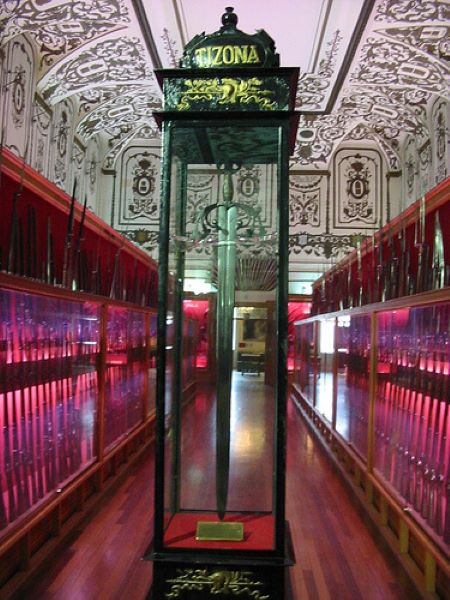
Besides Hannibal and his army, other famous warriors to carry Toledo swords include El Cid with his swords, Tizona and Colada, Emperor Charles V, and Charlemagne. Also, the ceremonial sword of the Catholic monarchs used to knight Christopher Columbus was Toledo steel. [1]
The Write Angle
Sword-making cities can be a fantastic inspiration for fantasy writers. Is there a unique type of metal or weapon in your novel? Is there a famous forge or city of bladesmiths? Does your hero or heroine carry a legendary sword with a name?
I hope this was helpful. Let me know if you have questions or suggestions by using the Contact Me form on my website or by writing a comment. I post every Friday and would be grateful if you would share my content.
If you want my blog delivered straight to your inbox every month along with exclusive content and giveaways, please sign up for my email list here.
Let’s get writing!
Copyright © 2022 Rebecca Shedd. All rights reserved.
[1] https://artesaniamorales.com/en/contenido/6-the-toledo-sword
[2] Diodorus Siculus 5.33.4
[3] “La Real Fábrica de Espadas de Toledo y el mejor acero del mundo”. 17 September 2015.
[4] “The Bite of Spanish Steel: An Introduction to the Metal that Made Toledo”. May 2017.
[5] https://www.theguardian.com/world/2021/aug/24/toledos-last-swordmakers-refuse-to-give-up-on-their-ancient-craft

