

The Writer’s Guide to Besieging a Castle
Posted on December 3, 2021 51 Comments
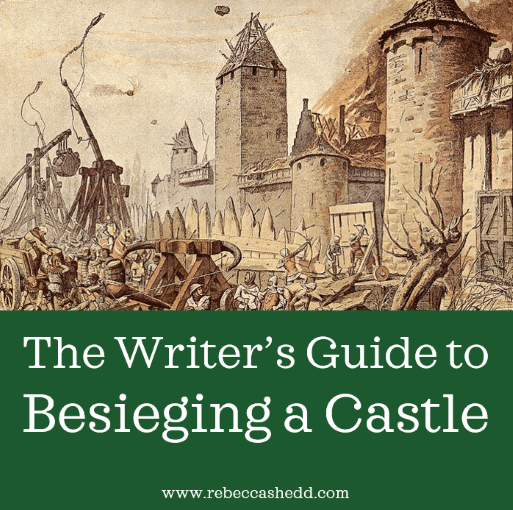

Even though castles could be easily avoided by an invading force, it was often a bad idea. Attacks could be launched from them, with the soldiers retreating to their safety. During much of medieval Europe, if you wanted to take territory you had to deal with the castle of its king or lord. This usually involved a siege. Sieges are popular in books, movies, TV shows, and video games since they are full of drama and tension. Examples include the sieges of Winterfell and King’s Landing in “Game of Thrones,” the siege of Adamant in the game Dragon Age: Inquisition and the siege of Silasta in Sam Hawke’s “City of Lies.”
Today I will be covering the tactics used during a siege. Next week’s article will cover siege engines.
As always, magic is the exception to the rules. Because magic.
Fire
Since early castles were made of wood, setting fire to them was an effective means of neutralizing them. Unfortunately, we don’t have a lot of documentation of this method. The most prominent example is a section of the Bayeaux Tapestry in which two men with torches are attempting to set fire to Chateau de Dinan. [1] However, from the artwork of the period, it appears that most timber castles were not bare wood but had a layer of plaster applied to them.

Assault
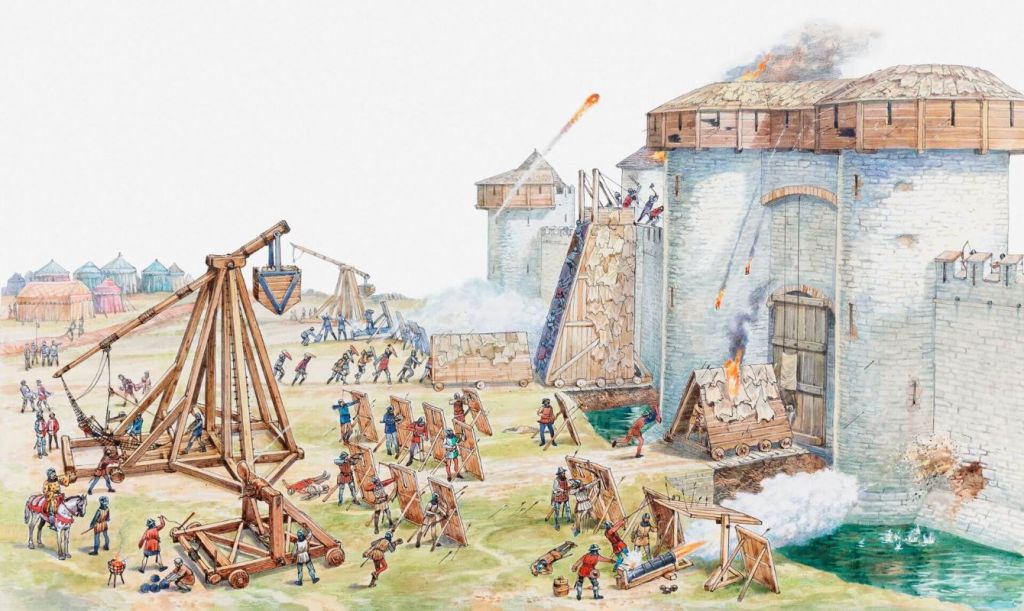
The most direct route of taking a castle was to assault the gates and/or walls. This is where siege engines were used. Some, such as the siege tower, were designed to get soldiers onto the tops of the walls. From there, they could fight down to the gates and open them for the rest of the army. Others, such as battering rams, catapults, and trebuchets were designed to go through a castle’s defenses.
A direct assault was usually the quickest way of taking a castle or for that matter, a fortified city or town. [3] But it was also the riskiest and the most likely to result in high casualties. Because of the defensive features of castles, a small garrison could hold out for a long time. For example, in 1403, thirty-seven archers defended Caernarfon Castle against two assaults by allies of Owain Glyndŵr. [2]
Sapping or Mining
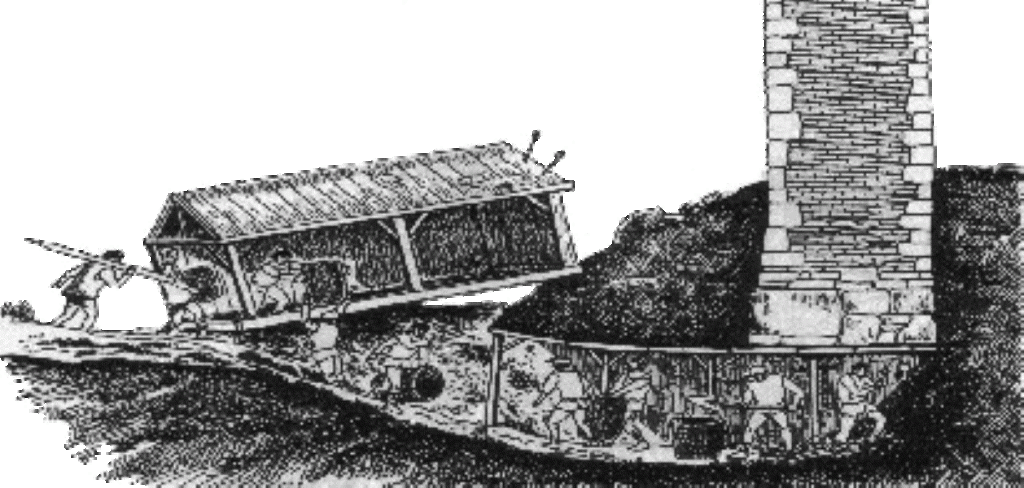
Sapping involved tunneling under the walls. People who performed these tasks were known as sappers. Either the miners would tunnel under the walls completely, coming up instead them, or they would collapse the walls. To do that, a void would be dug underneath them, stabilized by props and/or beams. Once complete, the beams would be removed, collapsing the void and the walls above it. [5] The easiest way to remove the supports was to set a fire in the void. There were some accounts that pigs were also trapped in the void before it was set on fire. It was thought that the pig fat helped the fire to burn hotter and faster.
If the defenders realized a tunnel was being dug, they could dig one of their own and try to intercept the sappers. Sapping was so feared that some castles surrendered as soon as they learned the sappers were at work, such as the castle of Margat in 1285. [6]
Once gunpowder became available, explosive charges were used to collapse the walls and gates. One example is the Siege of Godesberg in 1583. [4] A literary example is the battle of Helm’s Deep in “The Two Towers.”
Writer’s Tip: Sappers are rarely used in novels. I would love to see a siege in a book that was ended using sappers.

Starving Out
The safest way to take a castle or fortified city or town, was to cut them off from being resupplied and starve them out. However, this was the most time-consuming method. There are accounts of besieged castles lasting weeks, months, and in a few cases, years, if they were well supplied. Some besieging armies tried to speed up the process by using siege engines to fling corpses over the walls, hoping they would spread disease.
The danger to the besieging force was that they were stuck in one place for an extended length of time, leaving them vulnerable to attack by another enemy force.
Betrayal
Betrayal rarely makes the list of besieging methods, but it ended several sieges during the Middle Ages. A person inside the castle would open the gates to the attackers. They could either be someone who had been convinced to betray the castle or a member of the enemy force that infiltrated it.
I hope this was helpful. Let me know if you have any questions or suggestions by using the Contact Me form on my website or writing a comment. I post every Friday and would be grateful if you would share my content.
If you want my blog delivered straight to your inbox every month along with exclusive content and giveaways please sign up for my email list here.
Let’s get writing!
Copyright © 2021 Rebecca Shedd. All rights reserved.
[1] Allen Brown, Reginald (1976) [1954]. Allen Brown's English Castles. Woodbridge, UK: The Boydell Press. ISBN 1-84383-069-8.
[2] Friar, Stephen (2003). The Sutton Companion to Castles. Stroud, UK: Sutton Publishing. ISBN 978-0-7509-3994-2.
[3] Friar, Stephen (2003). The Sutton Companion to Castles. Stroud, UK: Sutton Publishing. ISBN 978-0-7509-3994-2.
[4] (in German) Ernst Weyden. Godesberg, das Siebengebirge, und ihre Umgebung. Bonn: T. Habicht Verlag, 1864, p. 43.
[5] Friar, Stephen (2003). The Sutton Companion to Castles. Stroud, UK: Sutton Publishing. ISBN 978-0-7509-3994-2.
[6] Allen Brown, Reginald (1976) [1954]. Allen Brown's English Castles. Woodbridge, UK: The Boydell Press. ISBN 1-84383-069-8.
The Writer’s Guide to Castle Construction
Posted on November 19, 2021 2 Comments
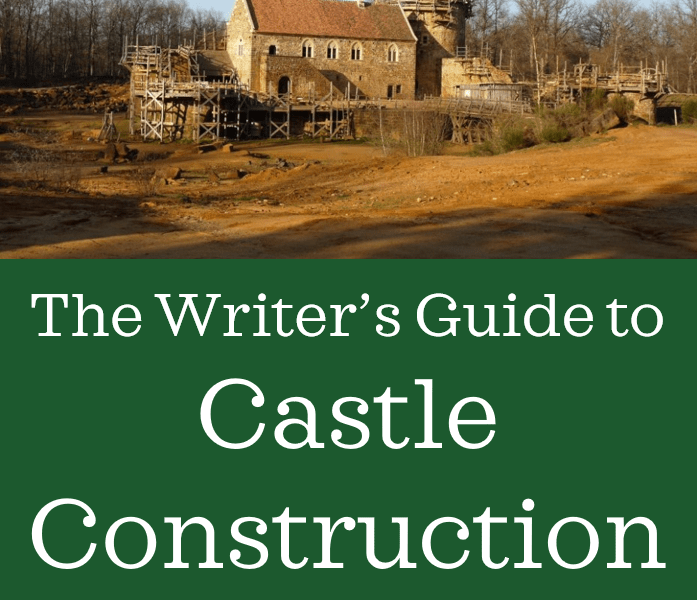
If you’ve read my previous posts, The Writer’s Guide to Castles and The Writer’s Guide to Castle Defenses, you have probably realized that there were many types of castles throughout European history. As a result, the cost and time involved in castle construction varied widely.
If you are planning to have a castle under construction in your novel, I recommend you first decide on the type of castle, the location, and the budget of the builder.
As always, magic is the exception to the rules. Because magic.
Materials
Wood and earth were the cheapest materials for building castles. They were also plentiful and easy to transport. Most people did not need specialized training to work with them, meaning that a lord could call up his unskilled vassals and serfs to build his castle.
Stone was more expensive and harder to transport. It was also not as available as timber and earth. The blocks had to be cut out from a quarry then moved to the site. Some castles, such as Chinon, Château de Coucy, and Château Gaillard were constructed from stone quarried on the site. [1]
As a result of the high cost and difficulty of using stone, many castles throughout medieval Europe were made of a hybrid of the two. [2] It was also common for a country to have a mixture of timber, stone, and hybrid castles.
Another building material that is often forgotten is brick. [3] A brick castle is almost as strong as a stone one and there are castles that appeared to have been deliberately made of brick even when stone was available, such as Tattershall Castle in Lincolnshire, England.
It appears that both timber and stone (and possibly brick) castles were coated with a layer of plaster. This coating would protect them from the weather and make it difficult for attackers to know what they are up against. If you want to learn more, I recommend this video by Shadiversity.

Cost
Most of the surviving records of the cost of building castles are for royal castles, which were quite a bit more expensive than a country lord’s castle. [4] However, we do have some figures. For example, a small tower at Peveril Castle in Derbyshire, England would have cost around $137 USD. Château Gaillard in France, which was built between 1196 and 1198, cost between $20,600 and $27,500 USD. Much of the money went to paying for labor, especially skilled craftsmen, and materials. Master James of Saint George, who oversaw the construction of Beaumaris in Wales, explained it this way:
“In case you should wonder where so much money could go in a week, we would have you know that we have needed – and shall continue to need 400 masons, both cutters and layers, together with 2,000 less-skilled workmen, 100 carts, 60 wagons, and 30 boats bringing stone and sea coal; 200 quarrymen; 30 smiths; and carpenters for putting in the joists and floor boards and other necessary jobs. All this takes no account of the garrison … nor of purchases of material. Of which there will have to be a great quantity … The men’s pay has been and still is very much in arrears, and we are having the greatest difficulty in keeping them because they have simply nothing to live on.” [5]

Time
The early castles could be constructed in a relatively short amount of time. It’s estimated an average-sized motte would have taken fifty people about 40 days to construct. However, it was common for stone castles to take a decade or more to complete. For example, Tattershall Castle took 20 years (1430 and 1450) and Beaumaris Castle was constructed between 1295 and 1330, 35 years. [6]

Construction Techniques
Timber and earth castles required only simple tools and techniques to build. However, more advanced techniques were needed as castles became more complex and stones was increasingly used. Scaffolding was employed and improved from it’s use by the Greeks and Romans. [7] The treadwheel crane was vital for raising and lowering large loads. I recommend this video of a reproduction treadwheel crane lifting a car.


Upkeep
Castles were not only expensive to build but also to maintain. Since the timber used in their construction was unseasoned, it often needed to be replaced. To give you an idea of the cost, Exeter and Gloucester Castles recorded repair cost of $27 and $68 USD annually in the 12th century. [8]
I hope this was helpful. Let me know if you have any questions or suggestions by using the Contact Me form on my website or writing a comment. I post every Friday and would be grateful if you would share my content.
If you want my blog delivered straight to your inbox every month along with exclusive content and giveaways please sign up for my email list here.
Let’s get writing!
Copyright © 2021 Rebecca Shedd. All rights reserved.
[1] Erlande-Brandenburg, Alain (1995). The Cathedral Builders of the Middle Ages. Découvertes Gallimard ("New Horizons") series. London, UK: Thames & Hudson Ltd. ISBN 978-0-500-30052-7.
[2] Higham, Robert; Barker, Philip (1992). Timber Castles. London, UK: B.T. Batsford. ISBN 0-7134-2189-4.
[3] Cathcart King, David James (1988). The Castle in England and Wales: An interpretative history. London, UK: Croom Helm. ISBN 0-918400-08-2.
[4] McNeill, Tom (1992). English Heritage Book of Castles. London, UK: English Heritage [via] B.T. Batsford. ISBN 0-7134-7025-9.
[5] McNeill, Tom (1992). English Heritage Book of Castles. London, UK: English Heritage [via] B.T. Batsford. ISBN 0-7134-7025-9.
[6] https://en.wikipedia.org/wiki/Beaumaris_Castle
[7] Erlande-Brandenburg, Alain (1995). The Cathedral Builders of the Middle Ages. Découvertes Gallimard ("New Horizons") series. London, UK: Thames & Hudson Ltd. ISBN 978-0-500-30052-7.
[8] McNeill, Tom (1992). English Heritage Book of Castles. London, UK: English Heritage [via] B.T. Batsford. ISBN 0-7134-7025-9.
The Writer’s Guide to Castle Defenses
Posted on November 12, 2021 5 Comments

Castles have been romanticized for centuries, to the point where we forget their use. First, they were a home. Second, they were a series of carefully designed kill zones.
Today I will cover the features most seen in castles and their purpose. I will limit this article to medieval Europe since that is when and where most castles are located and because that is where most of my knowledge lies.
As always, magic is the exception to the rules. Because magic.
Castle Features
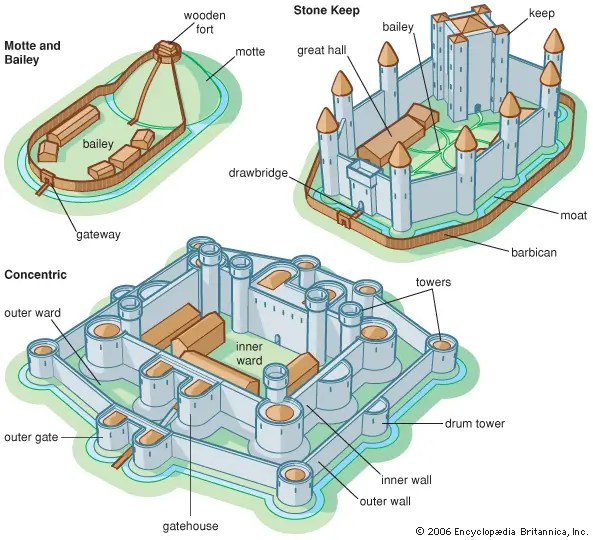
Keep – A keep was a fortified tower or building. It was in the most defensible part of the castle. It was as a home for the residing lord, his family, and household. [1] In most early castles, the keep consisted of only a few rooms. Sometimes only a screen would separate the Great Hall from the lord’s bedroom. [2] However, as castles became bigger and more complex, the keep became larger. Later castles had buildings ringed around a central courtyard or enceinte instead of a single keep. [3] In motte-and-bailey castles, the keep is set on top of a motte, an earthen mound.
Within the keep was located the Great Hall, a large room used for greeting guests, feasting, social gatherings and meetings, and legal trials.
Bailey or Ward – The bailey or ward is an open space enclosed by a curtain wall. All castles have at least one. Its primary function was to leave invaders exposed to attack from the keep and battlements. Baileys often contained buildings such as barracks, stables, kitchens, storerooms, chapels, and workshops. The well was also in the bailey. As castles became more complex, they used a series of baileys for protection. The central bailey was called the inner bailey, the further out, the outer bailey. A bailey off to one side was called a nether bailey.
Curtain Walls – Curtain walls surrounded the baileys. A typical curtain wall was 10 feet thick (3 m) and 39 feet tall (12 m). They had to be tall enough that it was difficult to scale them with ladders and thick enough to withstand bombardment from siege engines. Besides going over or through, curtain walls were vulnerable to tunneling, known as sapping. The sappers would either tunnel under the walls, coming up inside the bailey, or create a void under the wall, causing it to collapse.
Gatehouse – A gatehouse was a fortified entrance. Because of the vulnerability of the gate, they often had flanking towers that stuck out further than the gatehouse, allowing the defenders to fire upon attackers. [4] The gates opened outward, so that anyone trying to force them in would work against the hinges. Most gatehouses had at least two sets of gates. Heavily fortified gatehouses were known as barbicans.
Portcullises were heavily latticed gates that were opened by being raised vertically. Their chief advantage was that they could be closed quickly by a single person. They were often set inside the gatehouse, behind the outer set of gates. They could trap attackers inside the gatehouse.
Moat – Moats became a popular way to protect curtain walls. They could be dry or filled with water. Moats were crossed either by a flying bridge or a drawbridge. [5] Moats were not limited to the outside of a castle. Some castles have moats inside the curtain walls, protecting the keep, for example.
Postern – A postern gate or door was a small, hidden door in the curtain wall that allowed people to sneak in and out of a castle. During a siege, messengers or soldiers could leave and enter without the knowledge of the attackers.
Battlements
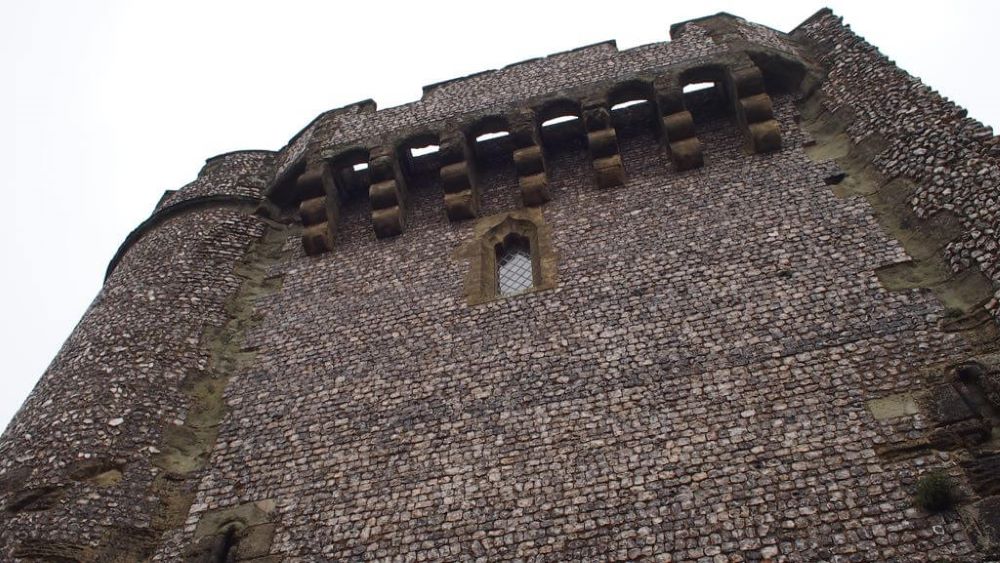
Battlements are defensive architecture built into curtain walls and towers. The most familiar type of battlements are crenelations, the tooth-like structures of alternating spaces. The upright part is called a merlon with the space called a crenel. Merlons were the height of a person and provided cover from incoming fire. Crenels allowed archers to fire back.
Machicolations were battlements that extended beyond the top of a curtain wall or tower, creating an opening through which stones, hot sand, and other nasty surprises could be dropped on people at the base of the walls. [6]


Arrow Slits
Arrow slits, also known as loopholes, were vertical openings in outer walls that archers and crossbowmen used to fire on attackers. The walls were angled on either side of the opening, providing a wide field of fire. [7] Plus, the narrow slit was a small target, protecting the archer inside.

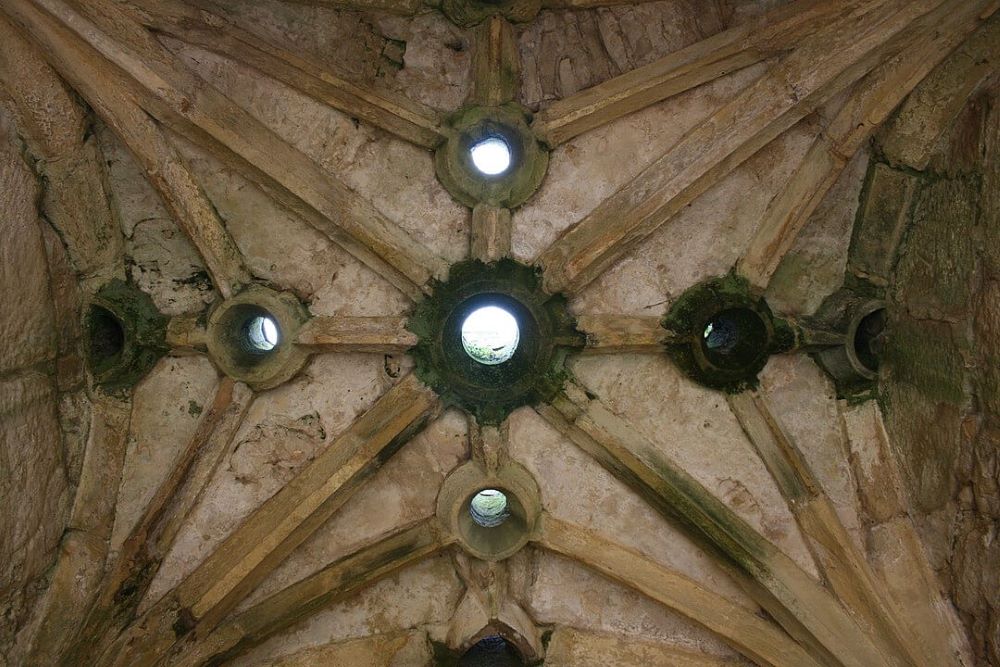
Murder Holes
Murder holes were similar in function to machicolations, except they were in the ceilings of gatehouses or buildings. Boiling water, hot sand, or stones could be dropped onto invaders.
I hope this was helpful. Let me know if you have any questions or suggestions by using the Contact Me form on my website or write a comment. I post every Friday and would be grateful if you would share my content.
If you want my blog delivered straight to your inbox, every month along with exclusive content and giveaways, please sign up for my email list here.
Let’s get writing!
Copyright © 2021 Rebecca Shedd. All rights reserved.
[1] Cathcart King, David James (1988). The Castle in England and Wales: An interpretative history. London, UK: Croom Helm. ISBN 0-918400-08-2.
[2] Barthélemy, Dominique (1988). “Civilizing the fortress: Eleventh to fourteenth century”. In Duby, Georges (ed.). A History of Private Life: Volume II · Revelations of the Medieval World. Cambridge, MA: Harvard University [via] Belknap Press. pp. 397–423. ISBN 978-0-674-40001-6.
[3] Friar, Stephen (2003). The Sutton Companion to Castles. Stroud, UK: Sutton Publishing. ISBN 978-0-7509-3994-2.
[4] Friar, Stephen (2003). The Sutton Companion to Castles. Stroud, UK: Sutton Publishing. ISBN 978-0-7509-3994-2.
[5] Cathcart King, David James (1988). The Castle in England and Wales: An interpretative history. London, UK: Croom Helm. ISBN 0-918400-08-2.
[6] Jaccarini, C. J. (2002). “Il-Muxrabija: Wirt l-Izlam fil-Gzejjer Maltin” (PDF). L-Imnara (in Maltese). Ghaqda Maltija tal-Folklor. 7 (1): 17–22.
[7] Friar, Stephen (2003). The Sutton Companion to Castles. Stroud, UK: Sutton Publishing. ISBN 978-0-7509-3994-2.
The Writer’s Guide to Castles
Posted on November 5, 2021 6 Comments
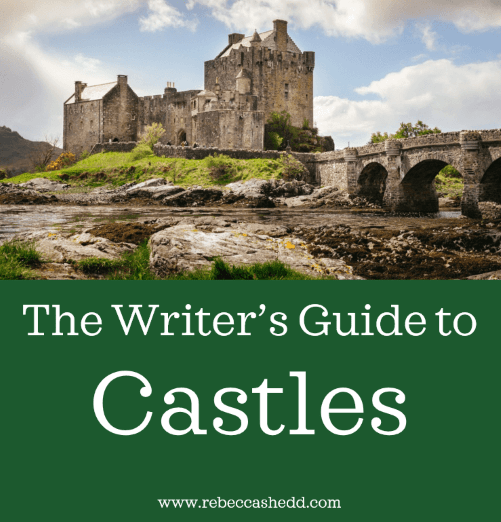
From the Red Keep to Cair Paravel to Skyhold, castles have loomed large in fantasy and are a familiar part of the landscape of movies, TV shows, video games, and books. They are a favorite among writers and often grab the imagination of readers and viewers. However, unless you live in Europe, most writers don’t have the opportunity to visit a real castle. These fortresses were built with an intentional purpose, clever engineering, and impressive technology. The fact that so many of them are still standing today is a testament to the quality of their construction.
Today I will be diving into the basics of castles.
As always, magic is the exception to the rules. Because magic.
Definition
The term “castle” gets tossed around quite a bit but what is a castle? What makes it different from a palace or fortress? Historians usually define a castle as a private fortified residence. [1] They were commonly held individually by members of the nobility or the royal family since land ownership and a lot of money for construction and upkeep were required. [2] The main way to acquire land in medieval Europe was to be gifted it by the monarch, usually as a reward for loyal service. There was also the expectation of continued military service from the lord and his vassals. [3] Ownership was hereditary, usually passing to the oldest son. This type of inheritance is known as patrilineal.

Purpose
The castle served multiple purposes. First, it was a residence, housing the owner, their family, and household. Second, it was an administrative center from which to oversee the owner’s lands. Third, it was a military base from which soldiers could attack and retreat to. [4]
Evolution
Walled fortifications are incredibly old and were built in the Indus Valley, Egypt, and China. There is some debate regarding when the first castles were built. The ancestors of castles were likely the fortified homes of lords. The most common defenses were walls and earthworks. The first castles were often made of wood.

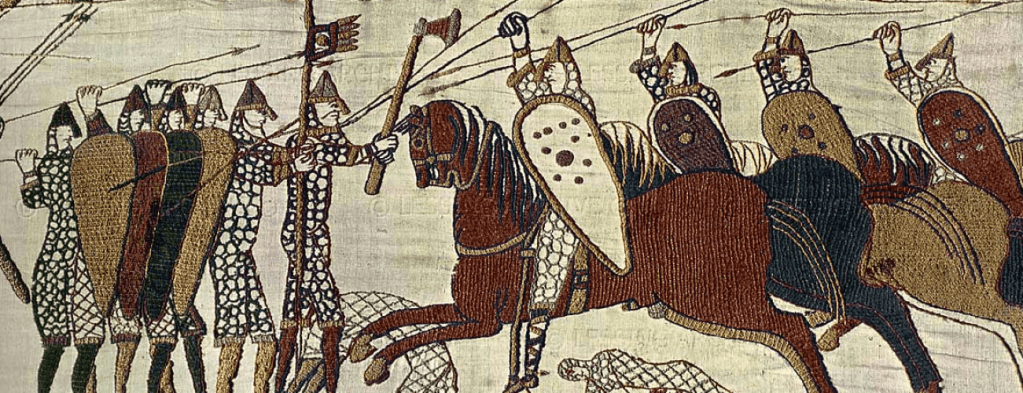
Notice it is made of wood and the attackers are trying to set it on fire. Photo source.
The first type of castle is a motte-and-bailey castle. A motte is an earthen mound, usually flattened at the top. It could be natural or manmade. [5] They ranged in height from 10 to 100 feet (3-30 m) and in diameter from 100 to 300 feet (30-90 m) [6] On top of the motte, was built a keep, which housed the lord, his family, and household. The early keeps were constructed of wood, which made them susceptible to fire. Over time, stone became the more common building material. The motte and keep were surrounded by a wall or palisade that enclosed the bailey. It was an open space that keep attackers at a distance and housed various buildings such as the stables, forge, workshops, storehouses, barracks, and kitchen. [7] Motte-and-bailey castles were first built in northern Europe in the 10th century, spreading to southern Europe throughout the following century. The Normans introduced them to England when they invaded, and they were adopted through Britain and Ireland during the 12th and 13th centuries. The design was surpassed by others by the end of the 13th century.
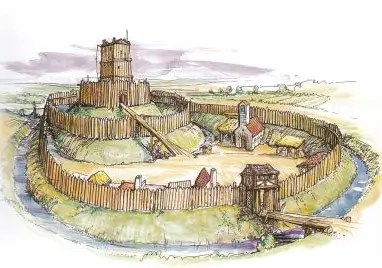
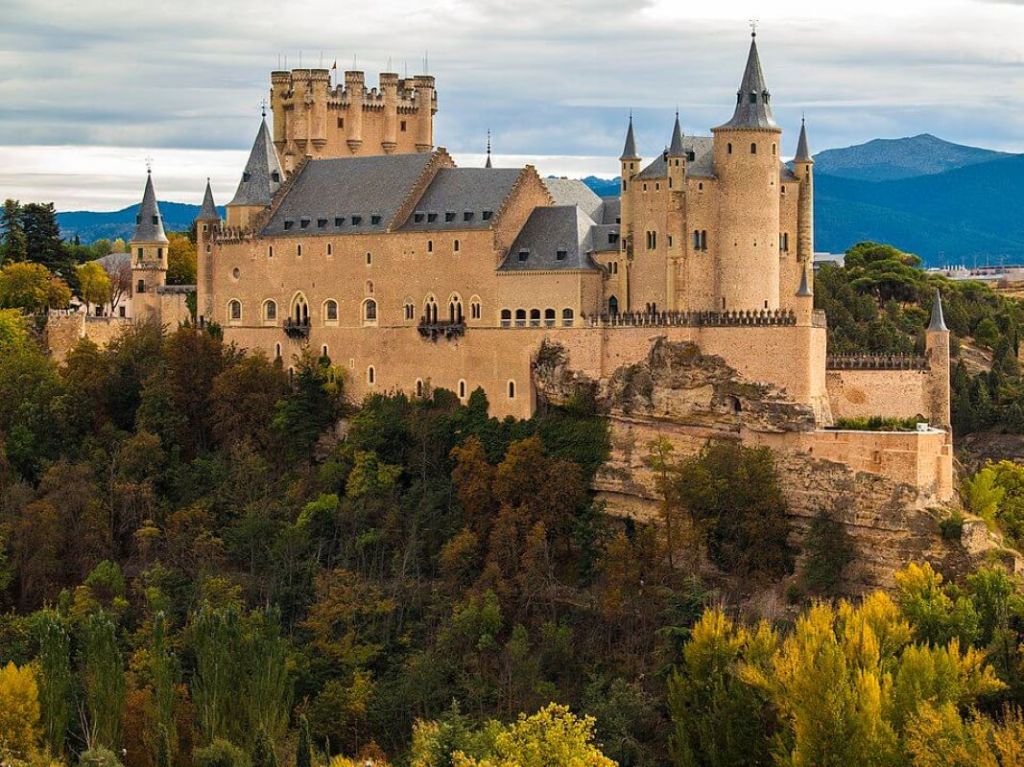
Castles continued to evolve from the motte-and-bailey. The biggest advance was replacing wood with stone. This happened slowly and unevenly across Europe since stone was harder to move and lift. There was often a mixing of the two. For example, a keep could be stone, but the wall would be made of wood.
Over time, castle design became more sophisticated. Walls were added, creating more baileys. Gatehouses and barbicans protected the passages through these walls. The entrance to the keep was moved to the second floor for security. Crenellations were added to the walls to protect the defenders. I will be covering the defensive features and parts of castles in my next article.
I hope this was helpful. Let me know if you have any questions or suggestions by using the Contact Me form on my website or writing a comment. I post every Friday and would be grateful if you would share my content.
If you want my blog delivered straight to your inbox every month along with exclusive content and giveaways please sign up for my email list here.
Let’s get writing!
Copyright © 2021 Rebecca Shedd. All rights reserved.
[1] Coulson, Charles (2003). Castles in Medieval Society: Fortresses in England, France, and Ireland in the Central Middle Ages. Oxford, UK: Oxford University Press. ISBN 0-19-927363-4.
[2] Liddiard, Robert (2005). Castles in Context: Power, symbolism and landscape, 1066 to 1500. Macclesfield, UK: Windgather Press Ltd. ISBN 0-9545575-2-2.
[3] Herlihy, David (1970). The History of Feudalism. London, UK: Humanities Press. ISBN 0-391-00901-X.
[4] Friar, Stephen (2003). The Sutton Companion to Castles. Stroud, UK: Sutton Publishing. ISBN 978-0-7509-3994-2.
[5] Toy, p.52; Brown (1962), p.24.
[6] Toy, p.52.
[7] Meulemeester, p.105; Cooper, p.18; Butler, p.13.

The Writer’s Guide to Shields
Posted on October 29, 2021 114 Comments

Today I will be covering some of the most common misconceptions of shields that I see in movies, TV shows, and books. Again, my focus is on medieval Europe since that is where most of my expertise is.
If you want a guide to types of medieval shields, please visit my previous post here.
As always, magic is the exception to the rules. Because magic.
Use in Battle
There were two main uses of the shield: personal protection and group formations.
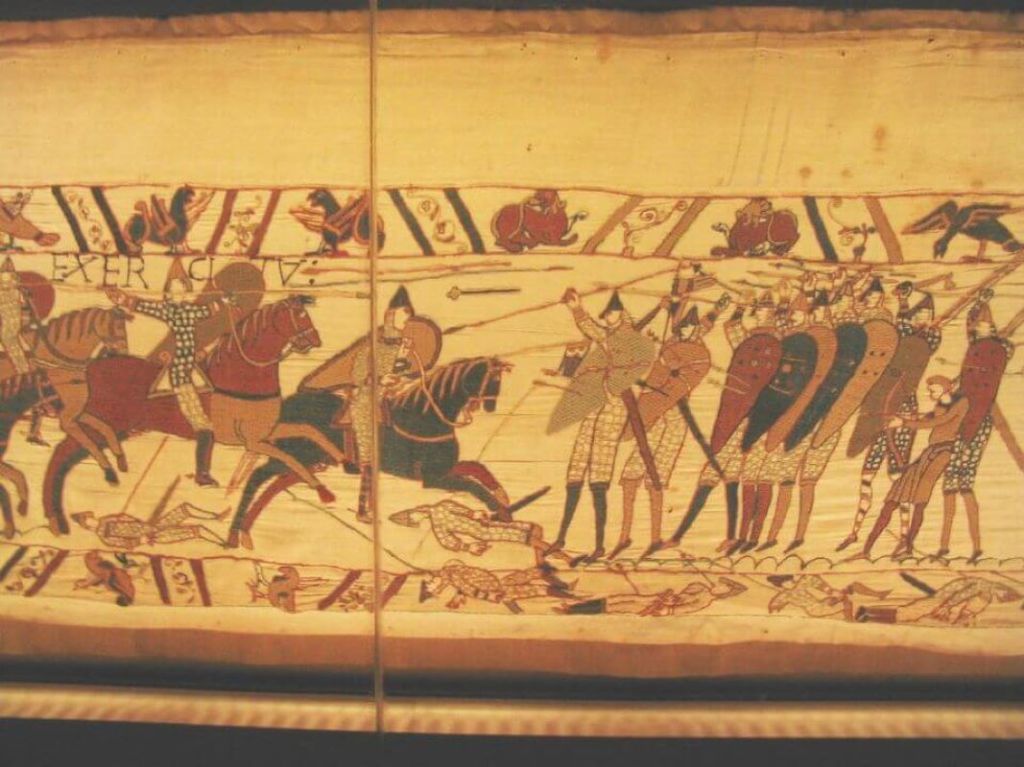
Personal protection is exactly what it sounds like: an individual using a shield to protect himself. Group formations, such as the shield wall or the Roman testudo, were used on the battlefield. They were especially effective against cavalry charges or volleys of arrows.
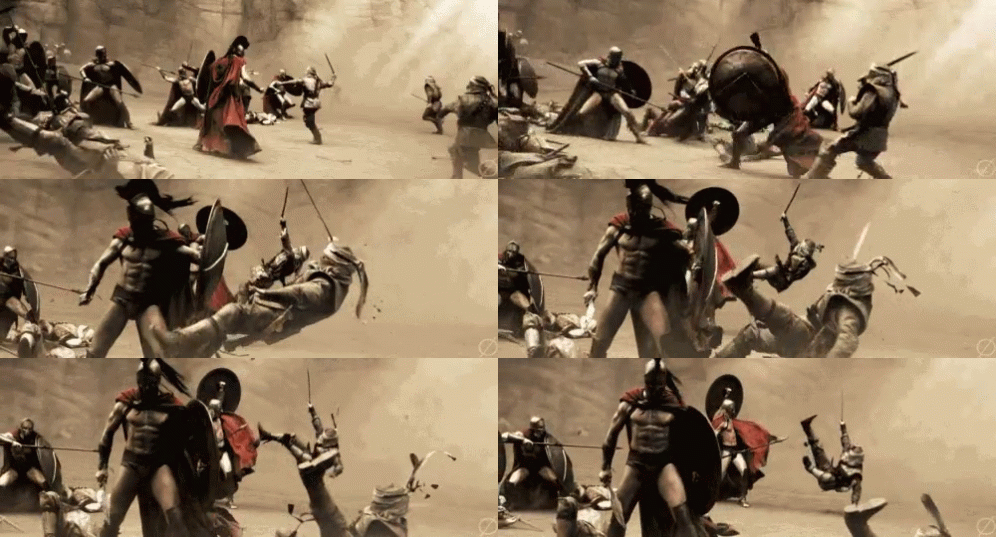
However, the shield wasn’t only used for defense. It could also be used as a weapon. The shield bash has become a staple in video games, movies, TV shows, and books. However, we have limited information regarding how often it was actually used during the medieval period.
Tactics
For individual use, there are multiple tactics. A combatant can use their shield as moving protection, meaning that they can rotate it, opening it like a door, to provide opportunities to strike. Since it is usually held out in front, it provides almost complete coverage. The pointed bottom of the Norman kite shield can be angled toward an opponent, keeping them at even further distance than other types of shields.
Multiple types of weapons can be used in the main hand including swords, axes, spears, knives, and batons.
Writer’s Tip: Swords and axes have commonly been paired with shields. I would love to see other weapons, especially the spear, which is incredibly effective when paired with a shield because of the longer reach.
The most familiar group tactic is the shield wall. It was also the most used in history, likely because it was effective and didn’t require a lot of training. Often strapped shields were used because this method put the shield off center and allowed it to overlap with the one on the bearer’s right. This interlinking made the shield wall stronger. The shield wall could also be formed into V and slanted half V shapes. A V pointed at the enemy is an enfilade while one pointed away is a defilade. [1] There is also the tortoise or testudo formation that was developed by the Romans. Another tactic was the hedgehog, a circular formation that could also incorporate archers and polearms.
Effectiveness
Just like armor, a shield was not perfect protection against an incoming strike. The effectiveness was heavily dependent on the type of attack and the construction of the shield. Shields were at their most effective when they were used to deflect incoming attacks, dissipating the energy rather than completely absorbing it. [2]
I recommend this video about the effectiveness of shields against arrows.

Construction
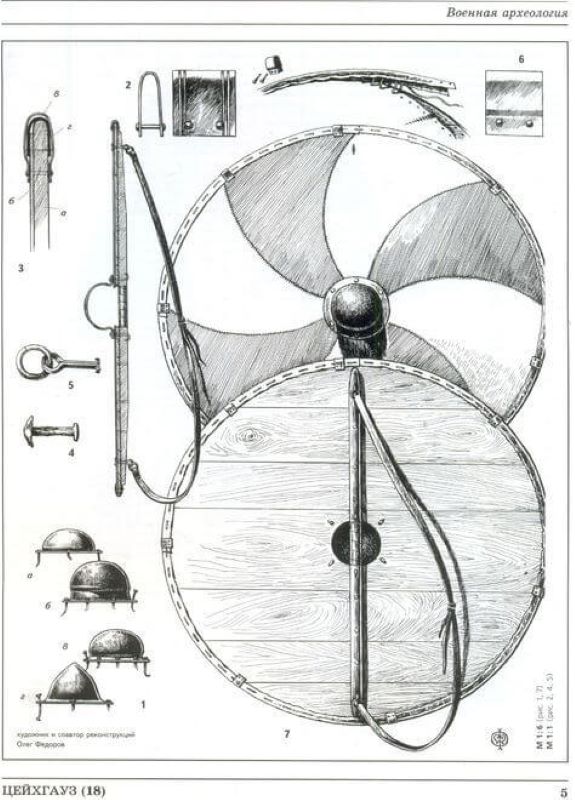
The construction of shields varied greatly depending on period and location. Early shields were usually just planks of wood held together by slats on the back. Later, they were covered with leather or canvas and could have a leather or metal rim. Further into the Middle Ages, shields were made completely of metal. Shields from other parts of the world were made of hide or wicker.
I hope this was helpful. Let me know if you have any questions or suggestions by using the Contact Me form on my website or writing a comment. I post every Friday and would be grateful if you would share my content.
If you want my blog delivered straight to your inbox every month along with exclusive content and giveaways please sign up for my email list here.
Let’s get writing!
Copyright © 2021 Rebecca Shedd. All rights reserved.
[1] Marine Rifle Squad. United States Marine Corps. 2007-03-01. p. 2.10. ISBN 978-1-60206-063-0.
[2] https://www.youtube.com/watch?v=I1LScbpp9vM&t=179s
The Writer’s Guide to Types of Shields
Posted on October 22, 2021 127 Comments

The shield is almost as iconic as the sword when it comes to fiction and legend. Just like the sword, since it is not a commonly encountered item, most modern writers are lacking in accurate information. There is unfortunately a lot of misinformation presented as fact.
Today we will be looking at types of shields. My focus will mainly be on medieval Europe since that is when and where most of my knowledge is and because most depictions of shields in movies, TV shows, and books are from this period.
As always, magic is the exception to the rules. Because magic.
Types of Grip
There are two main ways to hold a shield: center grip or straps.
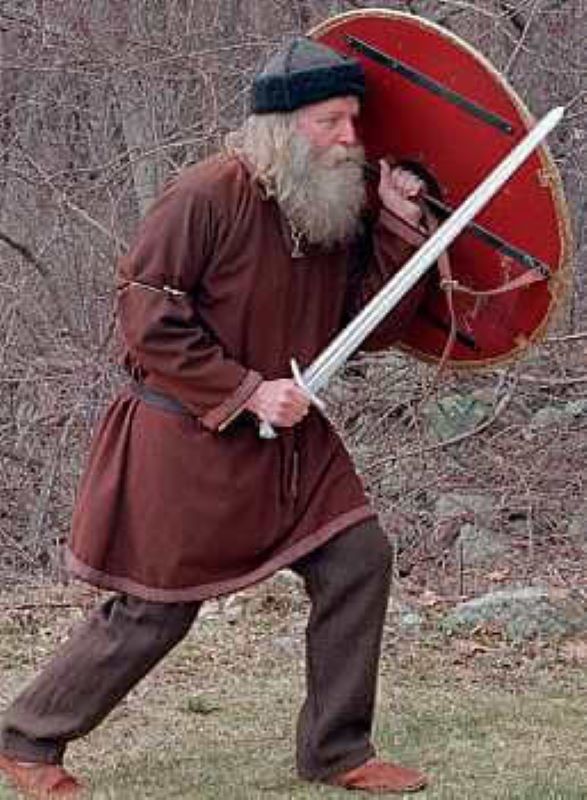
Center Grip – The center grip, just as it sounds, has a center handle that the user holds with one hand. Some shields are domed or have an extending center boss that allows room for the hand. Others just have an extending handle.
The benefit of the center grip is the ability to move it anywhere it is needed, making it quick and nimble. The downside is that any impact to the shield is concentrated on the user’s wrist. This limits the amount of force the shield and its wielder can absorb or dish out.
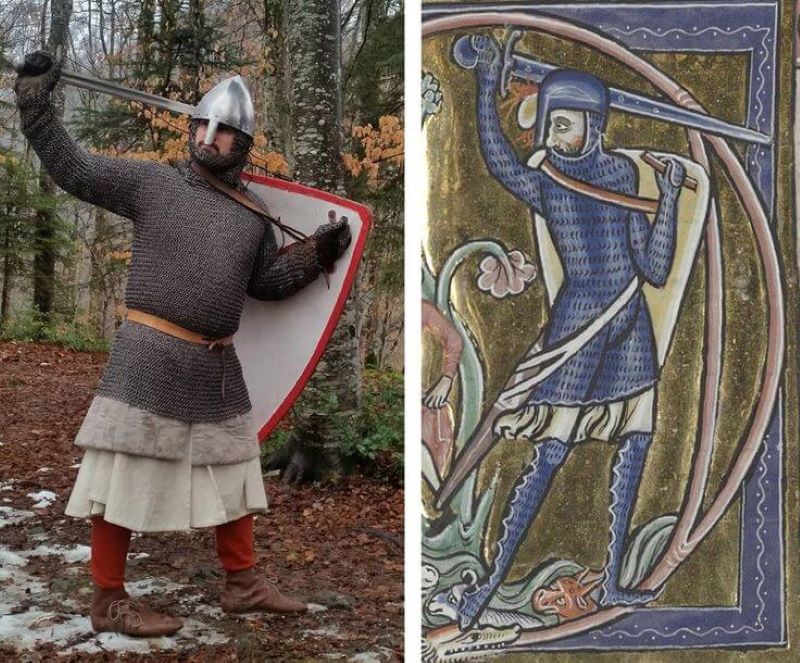
Straps – For shields that were strapped to the arm, there was a leather strap that the user slipped their arm through and a handle that they gripped with their hand. The handle could be made from either leather, wood, or metal. There was a variation of this set up that used a belt known as a guige. The guige looped around the neck or shoulders, helping to support the weight. It also allowed the shield to be carried on the back or dropped and retrieved later. [1]
This configuration was more secure than the center grip and put the hand closer to the edge of the shield. This allowed the user to hold something in their left hand, such as reins or a dagger. Since the shield was more firmly secured to the body, the user could absorb and exert much more impact. The off-center configuration was also beneficial in shield formations and walls since the edge overlapped the shield to its right. The downside was the loss of agility in moving the shield to different locations since it was attached to the body.

Types of Shields
There are many types of shields from around the world and throughout history. Below I will be focusing on the most common medieval European shields.
One thing I will point out before I begin are the terms I’m using. Most of them are not from the period but assigned later by historians to differentiate between types of shields. Most shields used during the Middle Ages were just called “shield.”
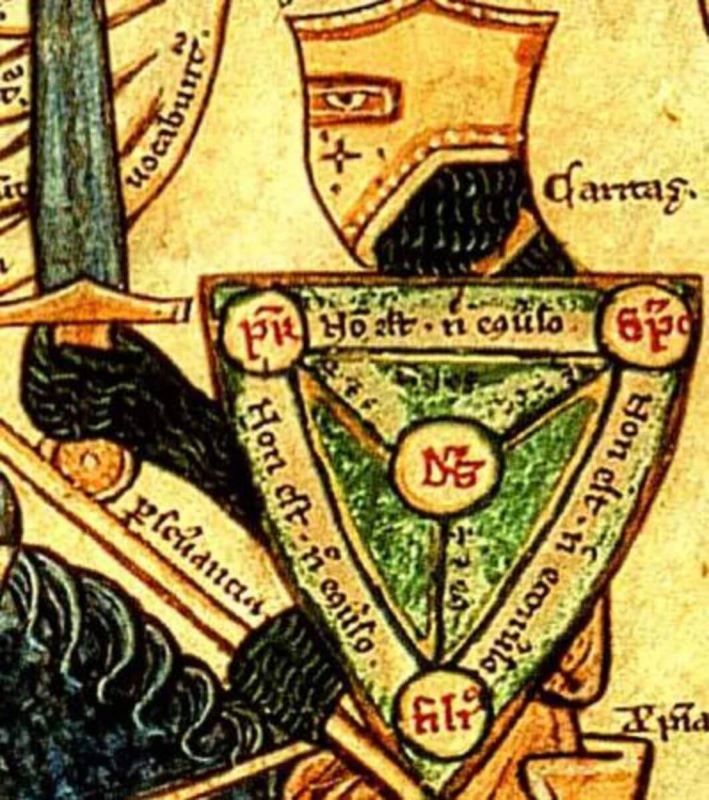
Heater Shield – This shield is probably the most iconic and the one most people think of when picturing a medieval shield with the flat top and pointed bottom. It was developed during the 12th century from the kite shield (more on that later). It commonly used straps. It was carried by every class of society and became the standard for displaying heraldry. It was on the smaller side and left the legs unprotected. It was named a heater shield by 19th century historians who thought it resembled the shape of an iron.
Kite Shield – Also known as a teardrop shield, the kite shield was large with a rounded top and a pointed bottom. It was developed to protect the entire body of a mounted rider. However, it was also used by foot soldiers because of the amount of protection it provided. It was used heavily by the Normans starting in the 11th century. [2] Straps and occasionally a guige were the most common ways of holding it.
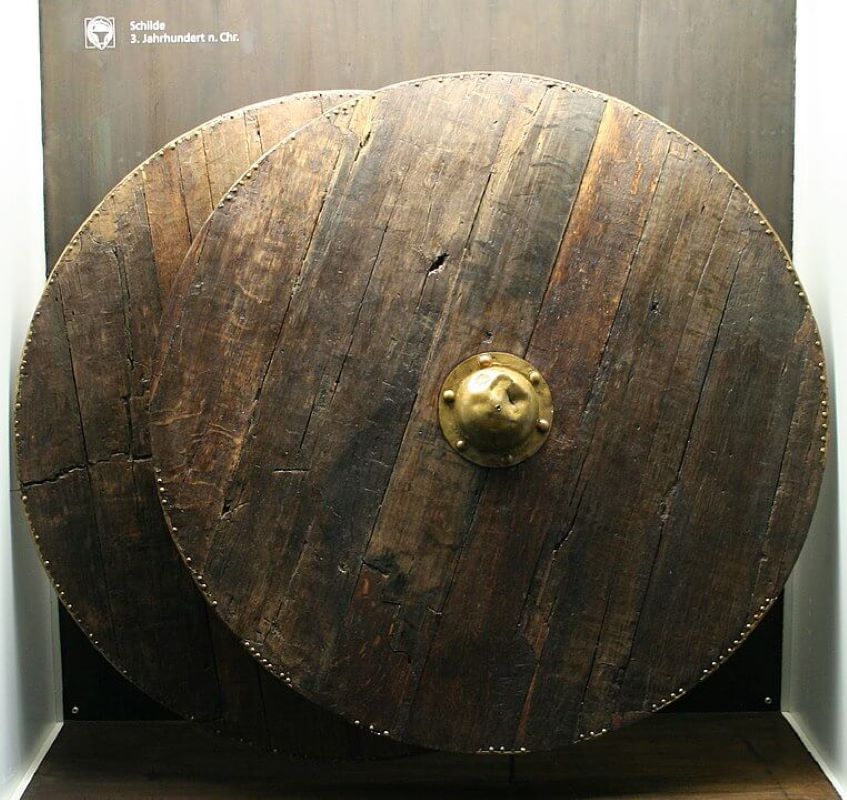
Round Shield – This type is one of the oldest and simplest forms of the shield. It is closely associated with the Vikings, who commonly used this type of shield. It could have a center boss or not, and could either use a center grip or straps.
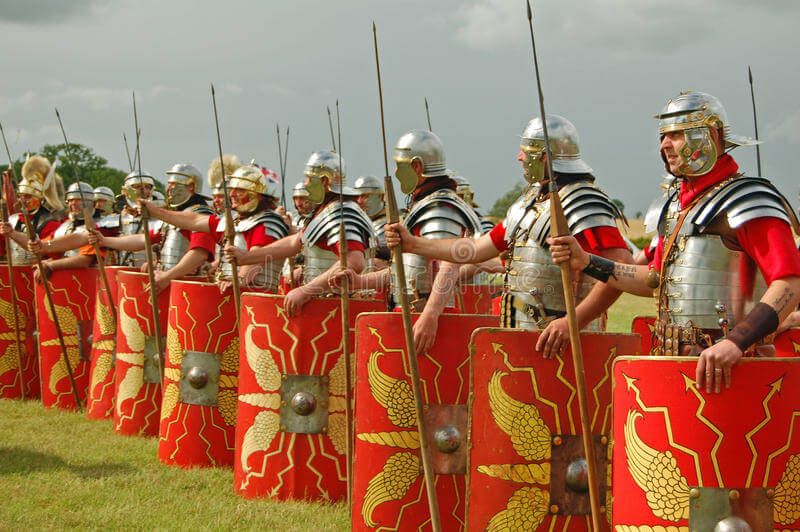
Tower Shield – The tower shield was not a commonly seen type of medieval shield but people during that period were aware of them. The most famous version of the tower shield was the Roman scuta, a center grip used by Rome legionnaires including in the testudo or tortoise formation.
I hope this was helpful. Let me know if you have any questions or suggestions by using the Contact Me form on my website or writing a comment. I post every Friday and would be grateful if you would share my content.
If you want my blog delivered straight to your inbox every month along with exclusive content and giveaways please sign up for my email list here.
Let’s get writing!
Copyright © 2021 Rebecca Shedd. All rights reserved.
[1] Clements, John (1998). Medieval Swordsmanship: Illustrated Methods and Techniques. Boulder, Colorado: Paladin Press. ISBN 1-58160-004-6.
[2] Oakeshott, Ewart (1997) [1960]. The Archaeology of Weapons: Arms and Armour from Prehistory to the Age of Chivalry. Mineola: Dover Publications. pp. 176–177. ISBN 978-0812216202.
The Writer’s Guide to Victorian Clothing Myths
Posted on October 15, 2021 96 Comments
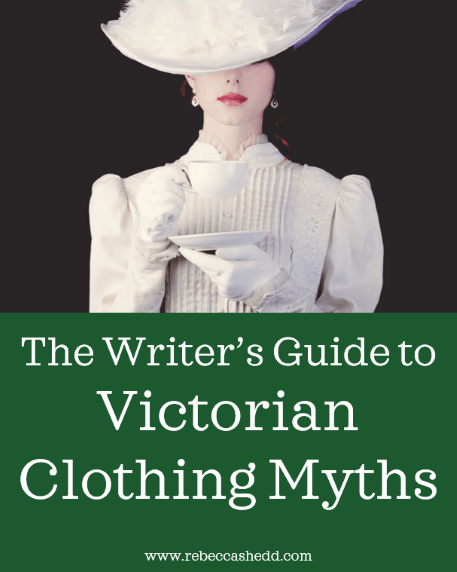
The corset tends to take the spotlight when it comes to misinformation about Victorian dress. But there are myths surrounding other articles of clothing that have been repeated in books, TV shows, and movies.
If you are interested in corset myths, I suggest reading my two articles here and here.
Hoop Skirts Were Solid
Hoop skirts, also known as crinolines or cage crinolines, were developed to replace the multiple layers of petticoats that were being used to achieve the fashionable wide skirt of the 1850s and 60s. They were made of a widening series of flexible wire hoops connected by vertical tapes suspended from the waistband. The hoops could be left bare or covered with fabric. This arrangement meant that hoops skirts could be squished into different shapes for passing through narrow spaces or sitting. When removed, they collapsed flat.
Unfortunately, several movies and TV shows depict them as been solid rigid structures with no give. For an idea of how flexible hoop skirts are I suggest watching this video by Prior Attire.

Clothing was Hot and Uncomfortable
One of the questions I get as a historical reenactor all the time is: Aren’t you hot? Of course, if the outside temperature is in the 90s or 100s °F (32-37° C) everyone is hot no matter what they are wearing. However, most of the time I’m comfortable because my entire outfit is made of natural breathable fabrics. Even if I’m wearing a corset, because it’s made of natural fibers, it’s usually not too bad. If I’m wearing a hoop skirt, I’m even more comfortable because I get the air flow under the skirt. Honestly, I’m probably cooler than the people wearing skin-hugging polyester.

It Took a Long Time to Get Dressed
There is a belief that historical clothing, especially that from the Victorian era, took a long time to get into. This is probably due to how complicated it looks. However, I can say from personal experience that getting dressed in full Victorian attire usually takes about 15-20 minutes. Honestly, it sometimes takes me longer to do my hair than it does to get dressed.
Also, contrary to popular belief, I can completely dress myself. It helps to have another person lace the corset, but I can do it on my own, if needed.
I recommend this video to see how long it takes to get into various women’s styles from the Victorian era.
Going to the Bathroom
Another question I get is: How do you go to the bathroom in that? I do it the way they did back then. I wear split bloomers, which are open at the crotch. Then I lift the skirt in the front and straddle. That way I don’t have to mess with lifting everything in the back, which would be especially difficult with the bustle styles. If a woman was using a chamber pot, she would just lift her skirt in the front and place it between her legs

People Were Much Smaller Back Then
People were slightly smaller during the Victorian era. However, they were not the midgets that people think of. The main reason we picture Victorians as tiny is because most of the clothing from the period that survives was worn by teenagers and women in their early 20s. This clothing made it for a couple of reasons. One, since only small young women could fit into it, it wasn’t worn until it fell apart. Two, many of these dresses were sentimental and expensive, such as wedding and court presentation gowns. Think about how many women today save their wedding dresses even though they can’t fit into them years later.
Most of the larger clothing was worn until it disintegrated, leaving us with mostly smaller examples.

I hope this was helpful. Let me know if you have any questions or suggestions by using the Contact Me form on my website or writing a comment. I post every Friday and would be grateful if you would share my content.
If you want my blog delivered straight to your inbox every month along with exclusive content and giveaways please sign up for my email list here.
Let’s get writing!
Copyright © 2021 Rebecca Shedd. All rights reserved.
The Writer’s Guide to Corset Myths
Posted on October 8, 2021 19 Comments
Part 2
Today we are busting more corset myths.
If you want to read Part 1, please go here.
Passing Out
The image of the swooning lady is one of the most lasting of the Victorian era. Were some women passing out because they had laced down too severely? I’m sure there were. I personally have seen a woman pass out from being too tightly laced. However, there were a lot of other things going on to lead to swooning.
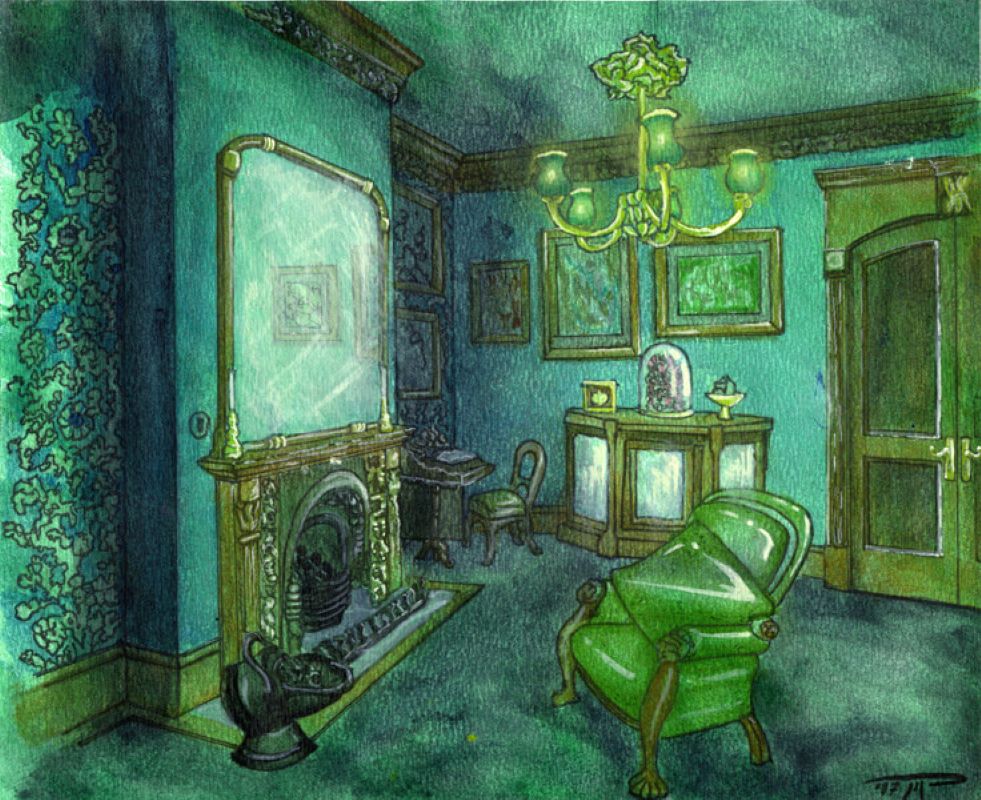
Gaslighting (using a gas flame as lighting, not the method of psychological manipulation) was first developed in the 1790s. [1] It became widespread in cities by the 1820s. Victorian homes often had small rooms and they rarely opened their windows. Being in a closed room with open gas flames would understandably lead to a shortness of breath.
Arsenic was commonly used during the 19th century to produce a popular green color for wallpaper and clothing. White arsenic was also used in makeup and skin whitening treatments. [2] One of the symptoms of arsenic poisoning is an abnormal heart rhythm and lung cancer can occur with long term exposure. [3]
Lastly, swooning was a common device used in literature of the period. Real life women began copying their literary counterparts and swooning to get attention or escape a distressing situation.
Moving Internal Organs
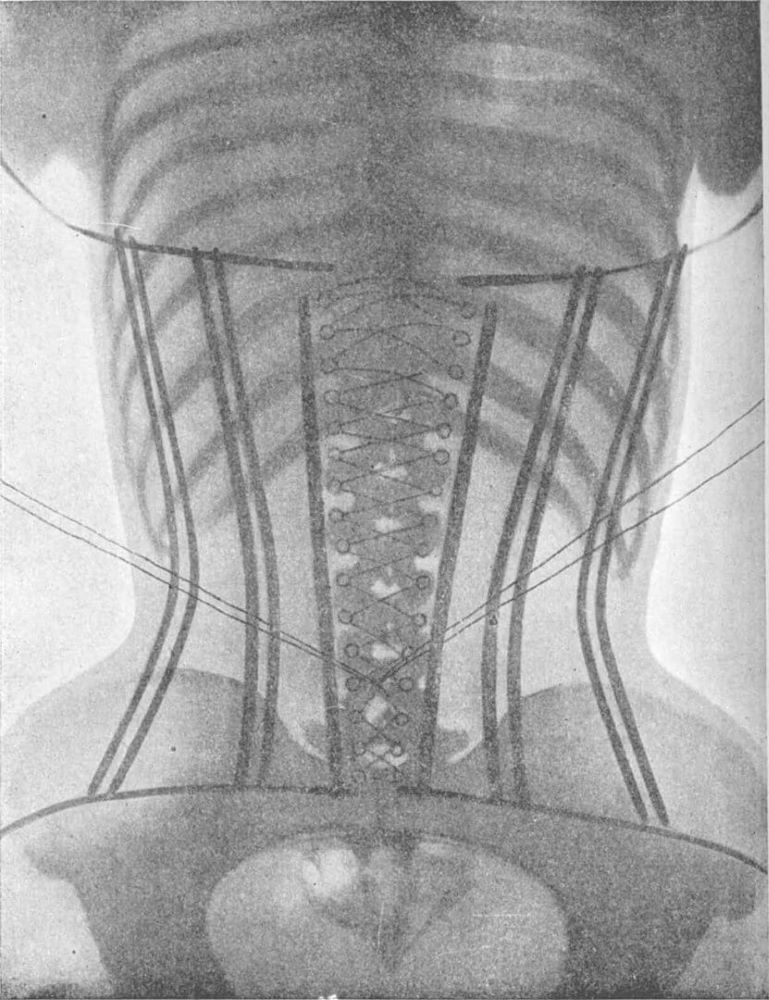
A corset can cause some shifting of internal organs and fat. However, when it is removed, the organs just go back to their normal positions, sort of like squishing a water balloon. Mainly, corsets lift the bust and squish the fat either down or up. It should also be kept in mind that internal organs are displaced during pregnancy, only to return to their original positions after birth.
When wearing a corset (or stays) there is some compression of the bottom of the ribs, making it harder to take a deep breath. However, you simply learn to breath more shallowly and in the top of your lungs. Honestly, after a few minutes of wearing a corset, I hardly notice I’m breathing differently.
Removing Ribs
There is no documented case that I know of a woman having ribs removed during the Victorian era. Considering the primitive state of medicine and anesthesia at the time it is unlikely a woman would voluntarily go under the knife to remove ribs.
Inability to Move
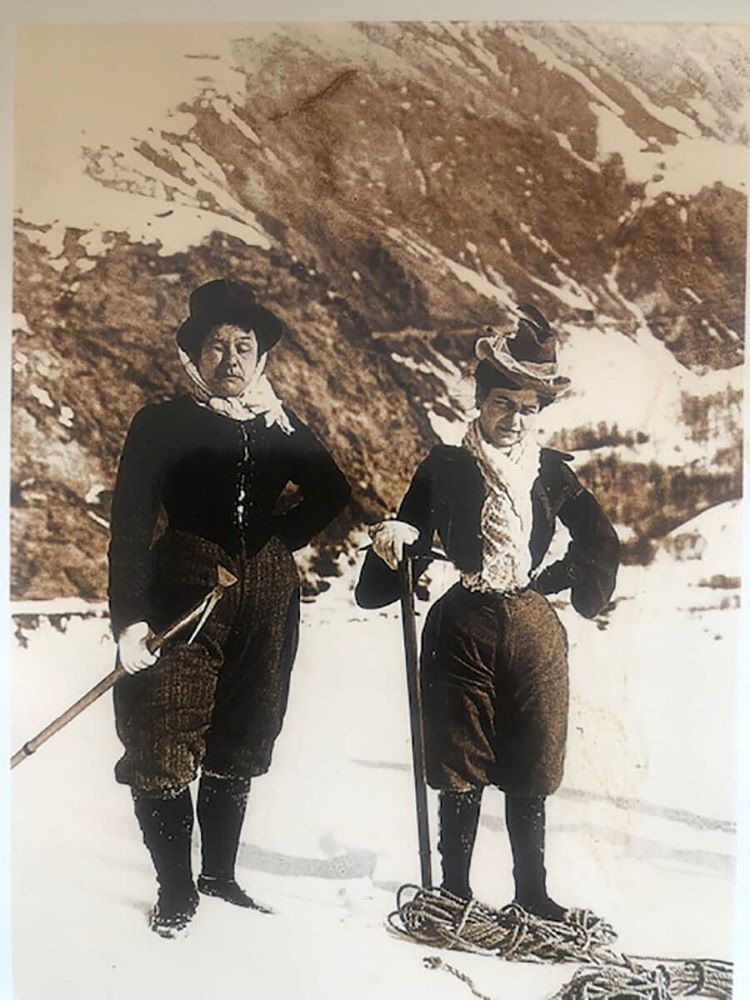
I can confirm from practical experience, that a corset (or any other boned garment) doesn’t drastically affect movement. I have shot archery, ridden a horse, and fenced in a corset. There are many examples of women being active while wearing corsets, including this article of female mountain climbers.
Yes, there is some limiting of movement but not enough to prevent most activities. The biggest limitation is being unable to bend at the waist. But it’s easy enough just to bend at the hips instead.
Male Corsetry
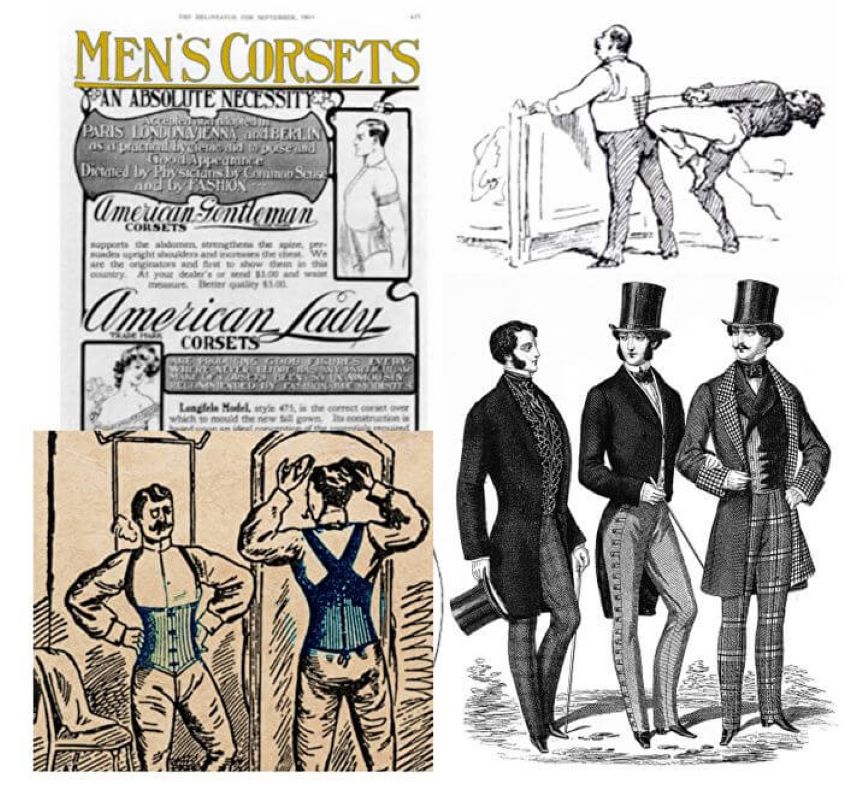
Men were not excluded from corsetry. Military officers during the Napoleonic War began discretely wearing boned waistcoats or other garments to achieve the flat-bellied look. During the 1820s and 1830s, the silhouette for men had a severely nipped in waist that pretty much demanded a corset to achieve.
I hope this was helpful. Let me know if you have any questions or suggestions by using the Contact Me form on my website or writing a comment. I post every Friday and would be grateful if you would share my content.
If you want my blog delivered straight to your inbox every month along with exclusive content and giveaways please sign up for my email list here.
Let’s get writing!
Copyright © 2021 Rebecca Shedd. All rights reserved.
[1] Janet Thomson; The Scot Who Lit The World, The Story Of William Murdoch Inventor Of Gas Lighting; 2003; ISBN 0-9530013-2-6
[2] "Display Ad 48 – no Title". The Washington Post (1877–1922). 13 February 1898.
[3] https://www.healthline.com/health/arsenic-poisoning#complications
 Rebecca Shedd - Author