
The Writer’s Guide to 1840s Women’s Fashion
Posted on July 2, 2021 10 Comments

The 1840s continued the somber formal trend that had begun in 1836. The depictions of and expectations for women changed. With the fading of Romanticism, carefree exuberance was replaced by a cultivated austerity and a focus on domesticity. Queen Victoria was a big reason for this shift. She married Prince Albert on February 10th, 1840, and gave birth to their first child on November 21, 1840. They went on to have nine children in seventeen years.
For an overview of fashion for the entire 19th century, please read my Writer’s Guide to 19th Century Fashion.

Underwear
The standard first layer was still a linen or cotton chemise or shift. During this decade they often had a drawstring neck that allowed for adjustment between different necklines.
The corset was an important structural undergarment and was stiffened by heavy cording and whalebone. They laced in the back and most also had a pocket in the front for a busk. [1] The corset flattened and spread out the bust. [2]
Petticoats were essential for creating the fashionable wide and dome-shape skirt silhouette. A woman would wear at least two and up to seven. [3] One was usually stiffened with pintucks, horsehair, or wool weft to provide width and support. [4] The bum pad or bustle from the 1830s continued to be used at the beginning of the decade before disappearing. [5]

Dresses
The fashionable silhouette of the 1840s consisted of a long, pointed waistline, narrow sleeves, sloping shoulders, and a wide, floor-length skirt in a dome shape. Trim and embellishment were uncommon with the fabric being the real star of the show. Silk was becoming more widely used and became acceptable for daytime. It was particularly suited to the crisp front points and wide pleated skirts of the era. Shot silk was especially popular. With the warp and weft different colors, the fabric subtly shifted hue. [6] Wool, cotton, and linen were also used but for morning and informal dresses. Patterns, such as plaid, florals, and stripes, were popular. Most women’s clothing was either made at home or by a seamstress, with only corsets, cloaks, and mantles available readymade. [7]
Bodices were tailored to fit snugly and smoothly and often came to a sharp point, although it softened to a rounded curve by the end of the decade. [8] Gathering, shearing, and pleating was a popular form of embellishment. [9] By the late 1840s, darts had become more common. [10] Various necklines were seen including a V or a wide and shallow curve for dressier daytime gowns [11] Evening dresses had a wide long neckline that was almost off the shoulder and usually embellished with a bertha, a pleated or hanging panel of fabric that covered the short sleeves. [12]
The voluminous sleeves of the 1830s continued until about 1842 when they were replaced by a narrow, fitted sleeve. They were usually cut on the bias, resulting in patterned fabric appearing to spiral up the arm. [13] Sleeve caps were common and were sometimes embellished with fringe or ribbon. [14] The sleeves began to loosen going further into the decade, opening into a narrow bell shape, and predicting the pagoda sleeves of the 1850s.
A new technique for pleating skirts was introduced in 1841: gauging, also known as organ or cartridge pleating. This method allowed the fabric to “spring” out from the waistline and create the distinctive dome-shape of the decade. It also allowed for more fabric to be used, increasing the width of skirts. Since the hemlines had lengthened, a band was added inside at the hem to protect them from wear. [15]
Pelerines were commonly worn outside the home. They were a light, cape-like garment that covered the top of the dress and extended to the elbows. They often had long lappets in the front. [16]


Outerwear
Mantles, mantlets, coats, and jackets were popular and were generically referred to as pardessus. [17] There were also ankle-length cloaks with slits for the arms covered by cape-collars. The shawl had returned to popularity. While those from India were the most highly prized, mills throughout Europe churned out imitations. [18]
Hairstyles & Headwear
“Spaniel curls” were still popular from the previous decades but the bun or chignon moved down from the top of the head to the nape. [19] Hair was usually parted in the center. Another popular style was smoothing the sides over the ears and tucking it into the bun.
Linen or cotton caps were worn by married and conservative women indoors. They could be plain or adorned with lace, ribbons, and frills. [20]
The bonnet was practically mandatory for outdoors. The brim became narrower around the face and extended past it, limiting the peripheral vision. [21] This style was named the “coal-scuttle” bonnet after the buckets used to carry coal. [22] Married women wore their caps under their bonnets. They were less decorated that previous decades, mainly with flowers on the inside of the brim or a veil.


Footwear
Stockings made of silk, cotton or wool came above the knee and were secured with ribbon garters.
Shoes for daytime were usually boots with low thick heels. They typically extended from the ankle up to the mid-calf and could be buttoned or laced.
Accessories
Several accessories were popular including fans, parasols, and muffs. Gloves were worn for evening, usually opera-length, and some daytime occasions. Reticules were necessary for carrying belongings since integral pockets were uncommon.
I hope this was helpful. Let me know if you have any questions or suggestions by using the Contact Me form on my website or writing a comment. I post every Friday and would be grateful if you would share my content.
If you want my blog delivered straight to your inbox every month along with exclusive content and giveaways please sign up for my email list here.
Let’s get writing!
Copyright © 2021 Rebecca Shedd. All rights reserved.
[1] Cunnington, Phillis. The History of Underclothes. London: Michael Joseph, 1951 p. 148-149.
[2] Severa, Joan L. Dressed for the Photographer: Ordinary Americans and Fashion 1840-1900. Kent, OH: Kent State UP, 1995 p. 8.
[3] Bruna, Denis, ed. Fashioning the Body: An Intimate History of the Silhouette. New Haven: Yale University Press, 2015 p. 178.
Severa, Joan L. Dressed for the Photographer: Ordinary Americans and Fashion 1840-1900. Kent, OH: Kent State UP, 1995 p. 17.
[4] Cunnington, Phillis. The History of Underclothes. London: Michael Joseph, 1951 p. 145.
[5] Thieme, Otto C., Elizabeth A. Coleman, Michelle Oberly, and Patricia Cunningham. With Grace and Favor: Victorian & Edwardian Fashion in America. Cincinatti: Cincinatti Art Museum, 1993 p. 35.
Byrde, Penelope. Nineteenth Century Fashion. London: Batsford, 1992 p. 50.
[6] Shrimpton, Jayne. Victorian Fashion. Oxford: Shire Publications, 2016 p. 9.
Thieme, Otto C., Elizabeth A. Coleman, Michelle Oberly, and Patricia Cunningham. With Grace and Favor: Victorian & Edwardian Fashion in America. Cincinatti: Cincinatti Art Museum, 1993 p. 35.
[7] Tortora, Phyllis G. and Keith Eubank. Survey of Historic Costume, 5th ed. New York: Fairchild Books, 2010 p. 330.
[8] Severa, Joan L. Dressed for the Photographer: Ordinary Americans and Fashion 1840-1900. Kent, OH: Kent State UP, 1995 p. 75.
[9] Fukai, Akiko, ed. The Collection of the Kyoto Costume Institute: Fashion, A History from the 18th Century to the 20th Century. Kyoto: Taschen, 2013 p. 180-181.
Tortora, Phyllis G. and Keith Eubank. Survey of Historic Costume, 5th ed. New York: Fairchild Books, 2010 p. 335-336.
[10] Severa, Joan L. Dressed for the Photographer: Ordinary Americans and Fashion 1840-1900. Kent, OH: Kent State UP, 1995 p. 9, 43.
[11] Cunnington, C. Willett. English Women’s Clothing in the Nineteenth Century: A Comprehensive Guide with 1,117 Illustrations. Mineola, NY: Dover Publications, 1990 p. 135.
[12] Tortora, Phyllis G. and Keith Eubank. Survey of Historic Costume, 5th ed. New York: Fairchild Books, 2010 p. 336.
[13] Thieme, Otto C., Elizabeth A. Coleman, Michelle Oberly, and Patricia Cunningham. With Grace and Favor: Victorian & Edwardian Fashion in America. Cincinatti: Cincinatti Art Museum, 1993 p 27.
[14] Severa, Joan L. Dressed for the Photographer: Ordinary Americans and Fashion 1840-1900. Kent, OH: Kent State UP, 1995 p. 7-9.
[15] Severa, Joan L. Dressed for the Photographer: Ordinary Americans and Fashion 1840-1900. Kent, OH: Kent State UP, 1995 p. 8.
[16] Thieme, Otto C., Elizabeth A. Coleman, Michelle Oberly, and Patricia Cunningham. With Grace and Favor: Victorian & Edwardian Fashion in America. Cincinatti: Cincinatti Art Museum, 1993 p 31-35.
Cumming 153
[17] Shrimpton, Jayne. Victorian Fashion. Oxford: Shire Publications, 2016 p 10.
Tortora, Phyllis G. and Keith Eubank. Survey of Historic Costume, 5th ed. New York: Fairchild Books, 2010 p. 338.
[18] Laver, James. Costume and Fashion: A Concise History, 5th ed. London: Thames & Hudson, Ltd, 2012 p. 175.
[19] Foster, Vanda. A Visual History of Costume: The Nineteenth Century. London: BT Batsford, 1984 p. 13.
Severa, Joan L. Dressed for the Photographer: Ordinary Americans and Fashion 1840-1900. Kent, OH: Kent State UP, 1995 p. 43.
[20] Tortora, Phyllis G. and Keith Eubank. Survey of Historic Costume, 5th ed. New York: Fairchild Books, 2010 p. 338.
[21] Foster, Vanda. A Visual History of Costume: The Nineteenth Century. London: BT Batsford, 1984 p. 13.
Severa, Joan L. Dressed for the Photographer: Ordinary Americans and Fashion 1840-1900. Kent, OH: Kent State UP, 1995 p. 10-11.
[22] Buck, Anne (1997). Victorian costume and costume accessories. Costume & Fashion Press. ISBN 0896762203.
The Writer’s Guide to 1830s Men’s Fashion
Posted on June 25, 2021 7 Comments

Men’s fashions during the 1830s reflected the trends in women’s fashion but in a subtler way. Early in the decade, the stylish silhouette was one with wide shoulders, a nipped-in waist, and flaring coattails. Gradually, the shoulders slimmed, and the waistline lengthened.
For an overview of fashion for the entire 19th century, please read my Writer’s Guide to 19th Century Fashion.
The Prince of Dandies
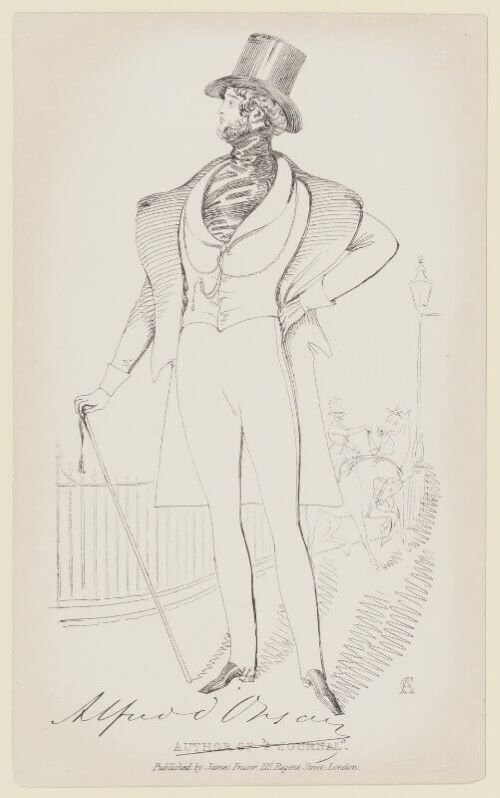
Alfred Guillaume Gabriel, Count d’Orsay, also known as the “Prince of Dandies”, brought a French flair to the ascetic of the dandy. An aristocrat from France, he moved to London in 1830 with his wife and her mother, Lady Blessington, who was also his patron. He created quite a splash in London society with his extravagant and excessive style. He famously wore five pairs of gloves throughout a day, each one a different color and scented with perfume. He displayed his sumptuous waistcoats, accessorized with multiple gold chains, by throwing back the lapels of his coats. He ran in select social circles and his house was a sought-after gathering place for the elites of the artistic, literary, social, and political spheres. [1]
Underwear
White, high-collared shirts of cotton or linen were still the standard. Those worn during the day had tucks while evening shirts had frills down the front. [2]
The male corset was also discretely used to achieve the dramatic slim waist that was fashionable during this period. Padding was subtly added to coats and waistcoats to expand the chest and shoulders. [3] This padding disappeared after 1837 in favor of a slimmer silhouette. [4]
The Suit
The suit did not change much from the previous decade.
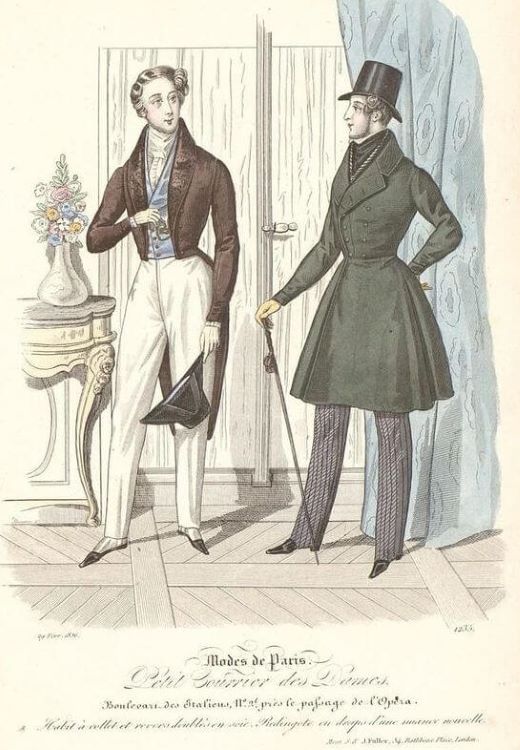
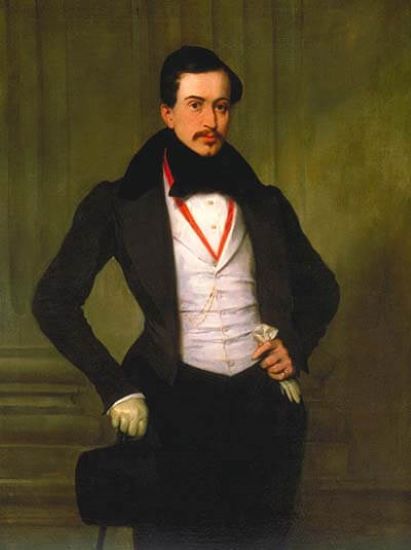
The dress coat, also known as the tailcoat, was standard for formal daytime and evening events while the frock coat was popular for casual daytime affairs. [5] The morning coat, a variation of the dress coat, was worn for early daytime occasions and for riding. [6] All coats were usually made of wool in dark colors such as black, navy, brown, and green.
Waistcoats switched from the standing collar to a shawl collar. Later, they would change again to a notched collar. Just like the previous decades, they were the most elaborate part of a man’s dress and more than one could be worn. [7]
Light-colored trousers were the standard for daytime and could be paired with any of the coats. [8] They were narrow with an in-step strap to keep the line straight. The fly-front began to replace the fall-front. Cossacks were a baggier style inspired by Russian dress that had wide legs that tapered to the ankle and a pleated front. The standard for evening was blank pantaloons, an older, more fitted style. [9] However, light-colored pantaloons could be paired with tall Hessian boots for riding. [10] Breeches were still required for court dress and would remain so throughout the century.

Outerwear
Greatcoats were worn during the day. They were long with wide sleeves. [11] Cloaks were the outwear of choice for evening.

Photo source.
Hairstyles & Headwear
Curly hair with sideburns was still a popular style. Straight hair parted to the side was also trendy.
The top hat was still the standard for daytime and evening headwear. By the end of the decade, silk was overtaking beaver felt as the standard material. [12] The crown was straighter than the previous decades. The “gibus hat,” a collapsible top hat invented by Antione Gibus, was patented in 1835. [13]
Footwear
The low, slipper-like shoes and the boot styles of the previous decade were still the dominate footwear.
Accessories
Neckwear was an essential element with the choice being either a stock or a cravat. The “scarf cravat,” also known as the “waterfall” was a large cravat that filled in the entire neckline and was secured with a decorative pin. [14]
Gloves were an essential accessory.
Canes and walking sticks were also popular and commonly seen in fashion plates and paintings of the day.
The watch fobs were steadily being replaced by watch chains. One style was known as the Albert chain, after Prince Albert, the consort to Queen Victoria. It came in single and double variations.
I hope this was helpful. Let me know if you have any questions or suggestions by using the Contact Me form on my website or writing a comment. I post every Friday and would be grateful if you would share my content.
If you want my blog delivered straight to your inbox every month along with exclusive content and giveaways please sign up for my email list here. https://rebeccashedd.com/contact-me/
Let’s get writing!
Copyright © 2021 Rebecca Shedd. All rights reserved.
[1] Foulkes, Nick. Last of the Dandies: The Scandalous Life and Escapades of Count d’Orsay. New York: St. Martin’s Press, 2014 ch. 14.
[2] Tortora, Phyllis G. and Keith Eubank. Survey of Historic Costume, 5th ed. New York: Fairchild Books, 2010 p. 341.
[3] Laver, James. Costume and Fashion: A Concise History, 5th ed. London: Thames & Hudson, Ltd, 2012 p. 164.
Waugh, Norah. The Cut of Men’s Clothes: 1600-1900. New York and London: Routledge, Taylor and Francis Group, 2015 p. 113.
[4] Tortora, Phyllis G. and Keith Eubank. Survey of Historic Costume, 5th ed. New York: Fairchild Books, 2010 p. 287–89.
[5] Byrde, Penelope. Nineteenth Century Fashion. London: Batsford, 1992 p. 9595-96.
[6] Tortora, Phyllis G. and Keith Eubank. Survey of Historic Costume, 5th ed. New York: Fairchild Books, 2010 p. 341.
Waugh, Norah. The Cut of Men’s Clothes: 1600-1900. New York and London: Routledge, Taylor and Francis Group, 2015 p.113.
[7] Waugh, Norah. The Cut of Men’s Clothes: 1600-1900. New York and London: Routledge, Taylor and Francis Group, 2015 p. 115.
Byrde, Penelope. Nineteenth Century Fashion. London: Batsford, 1992 p 97.
[8] Byrde, Penelope. Nineteenth Century Fashion. London: Batsford, 1992 p 95.
[9] Waugh, Norah. The Cut of Men’s Clothes: 1600-1900. New York and London: Routledge, Taylor and Francis Group, 2015 p. 116.
[10] Byrde, Penelope. Nineteenth Century Fashion. London: Batsford, 1992 p 97-98.
[11] Tortora, Phyllis G. and Keith Eubank. Survey of Historic Costume, 5th ed. New York: Fairchild Books, 2010 p. 287–89
[12] Ginsburg, Madeliene. The Hat: Trends and Traditions. London: Studio Editions, 1990 p. 86.
[13] Byrde, Penelope. Nineteenth Century Fashion. London: Batsford, 1992 p 98.
[14] Byrde, Penelope. Nineteenth Century Fashion. London: Batsford, 1992 p 97.
Foster, Vanda. A Visual History of Costume: The Nineteenth Century. London: BT Batsford, 1984 p. 52.
The Writer’s Guide to 1830s Women’s Fashion
Posted on June 18, 2021 8 Comments

The 1830s continued the trend of brash, exuberant styles from the previous decade. However, by the middle of the decade, bold trends were suddenly reined in for a more understated and modest look as Romanticism gave way to the Gothic Revival.
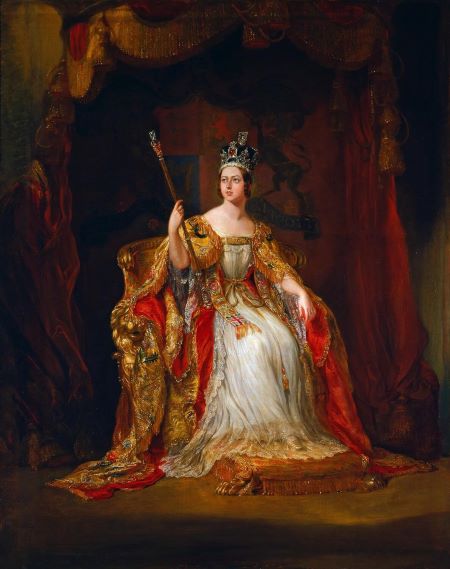
The coronation of Queen Victoria in 1837 had a large impact on women’s fashions and officially kicked off the Victorian era.
For an overview of fashion for the entire 19th century, please read my Writer’s Guide to 19th Century Fashion.
Long Live the Queen (of Fashion)
Just as with most monarchs before and after her, Queen Victoria had an outsized impact on fashion. Whatever the queen wore, almost every woman in the empire wanted to wear as well. Victoria preferred restrained and modest styles and was leery of new trends. Her ascension to the throne was likely a big contributing factor to the sudden shift in the aesthetic at the middle of the decade. [1]
Undergarments
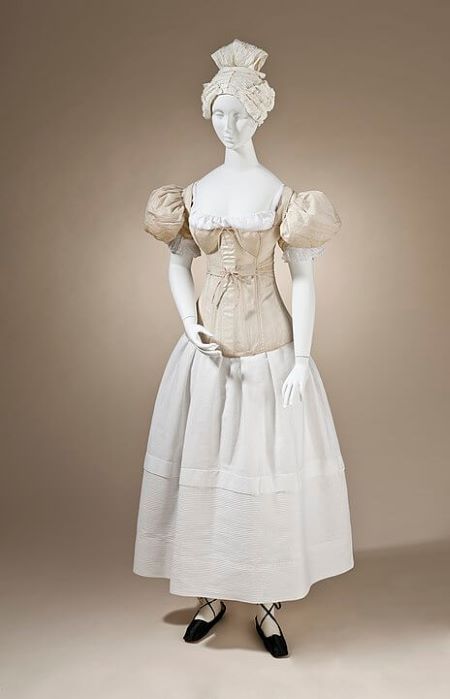
The base layer was still the linen or cotton chemise. During this decade, it came to the knees and had narrow elbow length sleeves.
The corset was worn over it and extended to the hips. It could be lightly structured with cording or more heavily stiffened with baleen boning. Thanks to the introduction of the metal eyelet, corsets could now be tight-laced. They also had gored cups for the breasts.
Since the fashionable silhouette demanded ever-widening skirts, multiple layers of petticoats were required. [2] Some were starched or corded for extra support and width.
A bum pad known as a bustle was worn tied around the waist. It supported the skirts in the back. [3]
Since sleeves became so outrageously wide during this period, it became necessary for women to wear padded sleeve supports also known as sleeve plumpers tied around their upper arm. Although usually stuffed with feathers they could also be reinforced with wire or buckram. {4]
Dresses: 1830-1836
As I mentioned in the introduction, the styles at the beginning of this decade were brash, bold, and wide. The most striking feature was the sleeves known as gigot or leg-of-mutton. They often were wider than the waist and required undergarment supports for them to keep their shape. The volume could extend down the length of the arm or be confined to the upper arm with a fitted forearm or be banded at intervals to create a series of puffs. [5] Sleeves were long for daytime but short and puffed for evening. Sometimes a long sleeve of gauze overlaid the short evening sleeve. [6] A sloping line from the shoulder into the sleeve was fashionable.
Necklines were usually wide. For evening, they were almost off the shoulder although summer dresses sometimes had similar necklines but with long sleeves. Morning dresses usually had high necklines.
The waistline was just above the natural waist and was nipped in and fitted. A lot of emphasis was placed on the waist with all bodice styles incorporating a V shape.
Skirts were wide and ended just above the ankle. [7]
Riding habits were a popular style and were made with the fashionable wide sleeves and skirts.
Dresses: 1836-1840
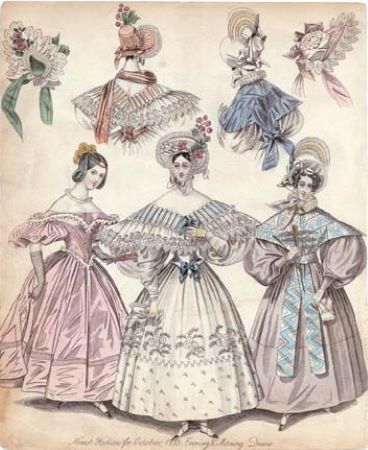
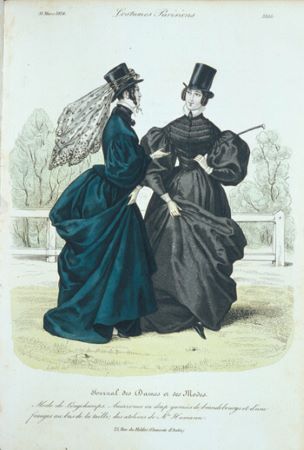
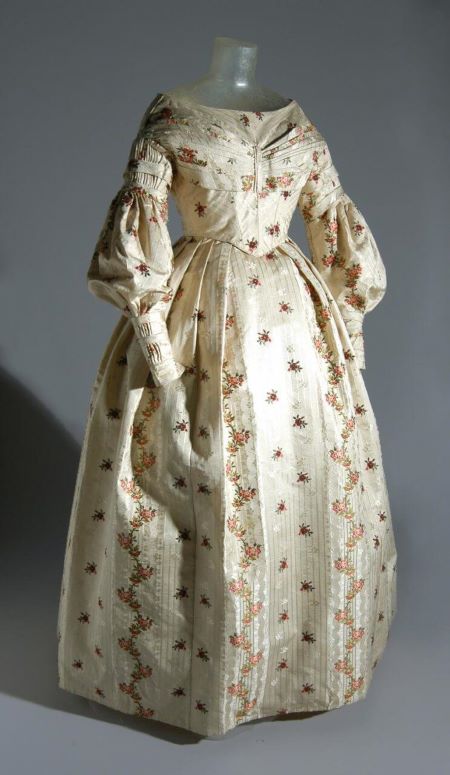
Beginning in 1836, the necklines began to rise and the skirts to lengthen. The fullness of the sleeves moved down on the arm and the volume at the top was often pleated to control it. Going into the 1840’s, the sleeves began to narrow.
Outerwear
Due to the wide necklines, shawls became popular again.
Ankle-length mantles were fashionable until about 1836 when they were shortened and became known as mantlets or shawl-mantlets. They had points which hung down in the front. There was also a three-quarter length mantle known as a burnous, named after the garment from Arabia. A paletot was a knee-length mantle with slits for the arms instead of sleeves. The pardessus was a half or three-quarter length coat with sleeves. [8]
Hairstyles & Headwear
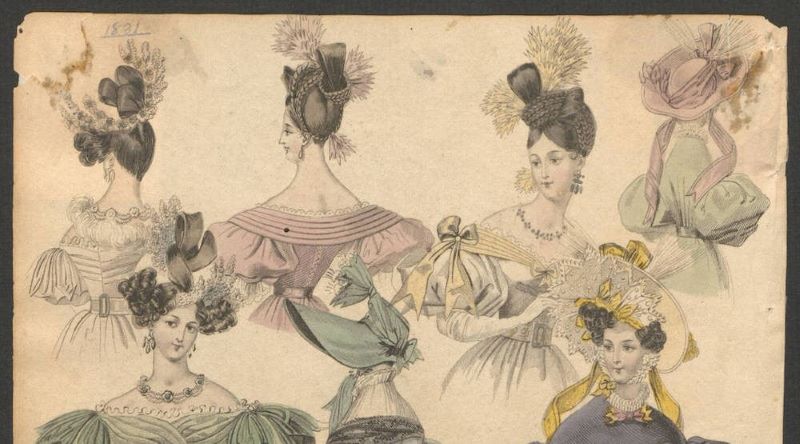
At the beginning of the decade, hairstyles were flamboyant to match the clothing fashions. “Spaniel curls” over the ears were still popular from the previous decade while the rest of the hair was looped, braided, or curled into a high bun. The Apollo knot and the hairstyle à la Chinoise were two of the styles. [9] Hairstyles for evening were elaborate and heavily decorated. [10]
Throughout the decade, it was customary for married women to wear white day caps indoors and under their headwear. [11] They would continue wearing headwear for evening. Turbans were a popular choice. [12]
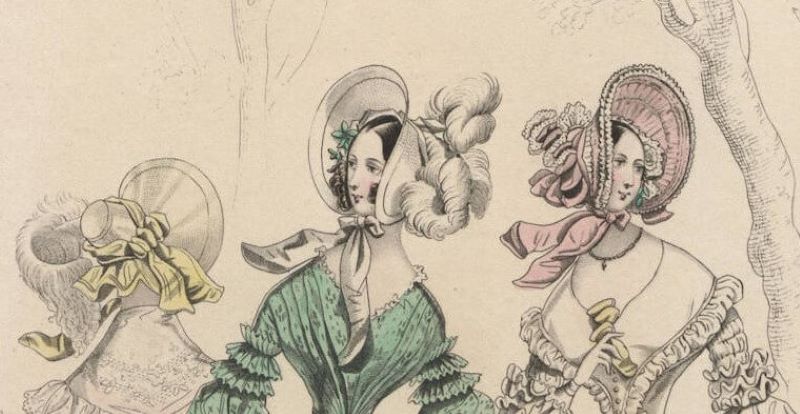
The hats and bonnets of the early 1830’s were also large and heavily bedecked with feathers, trim, and flowers. They usually had a high crown and a wide brim.
With the shift in the middle of the decade, hairstyles and headwear changed as well. The “spaniel curls” disappeared and hair was often parted in the center and brushed back into a low bun. The brim of hats and bonnets became narrower, the latter often concealing the face. [13]
Footwear
Flat slippers with square toes made of fabric or leather were the standard footwear. During this decade, low boots with an elastic inset were introduced. [14]
Accessories
During the beginning of the decade, wide white pelerines were worn over the shoulders and added to the wide silhouette. Belts were a popular accessory. Long gloves were worn for evening.
Jewelry was abundant with brooches, drop earrings, bracelets (sometimes worn in pairs), and long decorative chains being popular. [15]
I hope this was helpful. Let me know if you have any questions or suggestions by using the Contact Me form on my website or writing a comment. I post every Friday and would be grateful if you would share my content.
If you want my blog delivered straight to your inbox every month along with exclusive content and giveaways please sign up for my email list here. https://rebeccashedd.com/contact-me/
Let’s get writing!
Copyright © 2021 Rebecca Shedd. All rights reserved.
[1] Bassett, Lynne Z. Gothic to Goth: Romantic Era Fashion and Its Legacy. Hartford: Connecticut Wadsworth Antheneum Museum of Art, 2016 p. 30
Byrde, Penelope. Nineteenth Century Fashion. London: Batsford, 1992 p. 46.
[2] Byrde, Penelope. Nineteenth Century Fashion. London: Batsford, 1992 p. 41-42.
[3] Tortora, Phyllis G. and Keith Eubank. Survey of Historic Costume, 5th ed. New York: Fairchild Books, 2010 p. 332.
[4] Lynn, Eleri. Underwear: Fashion in Detail. London: V&A Publishing, 2010 p. 168.
[5] Byrde, Penelope. Nineteenth Century Fashion. London: Batsford, 1992 p. 39.
Johnston 76; Tortora 333; Foster 56
[6] Byrde, Penelope. Nineteenth Century Fashion. London: Batsford, 1992 p. 40.
[7] Byrde, Penelope. Nineteenth Century Fashion. London: Batsford, 1992 p. 41.
[8] Tortora, Phyllis G. and Keith Eubank. Survey of Historic Costume, 5th ed. New York: Fairchild Books, 2010 p. 286.
[9] Foster, Vanda. A Visual History of Costume: The Nineteenth Century. London: BT Batsford, 1984 p. 13, 54.
Tortora, Phyllis G. and Keith Eubank. Survey of Historic Costume, 5th ed. New York: Fairchild Books, 2010 p. 334.
[10] Tortora, Phyllis G. and Keith Eubank. Survey of Historic Costume, 5th ed. New York: Fairchild Books, 2010 p. 334.
[11] Ginsburg, Madeliene. The Hat: Trends and Traditions. London: Studio Editions, 1990 p. 77.
Tortora, Phyllis G. and Keith Eubank. Survey of Historic Costume, 5th ed. New York: Fairchild Books, 2010 p. 334.
[12] Byrde, Penelope. Nineteenth Century Fashion. London: Batsford, 1992 p. 45.
[13] Cunnington, C. Willett. English Women’s Clothing in the Nineteenth Century: A Comprehensive Guide with 1,117 Illustrations. Mineola, NY: Dover Publications, 1990 p. 122.
[14] Payne 1969, p. 507
[15] Byrde, Penelope. Nineteenth Century Fashion. London: Batsford, 1992 p. 44-45.
Tortora, Phyllis G. and Keith Eubank. Survey of Historic Costume, 5th ed. New York: Fairchild Books, 2010 p. 340.
The Writer’s Guide to 1820s Men’s Fashion
Posted on June 11, 2021 7 Comments

The Romantic Movement impacted men’s fashion just as it did for women. Describing this decade, fashion historian Jane Ashelford wrote: “The Romantic movement stressed the creative power of the ‘shaping spirit of Imagination’ and was motivated by a desire to escape from the chilly neo-classicalism of the turn of the century and the harsh realities of the Industrial Revolution. It manifested itself in dress by an enthusiasm for extrovert personal display and theatrical fashions which, in the 1820s and early 1830s, led to men wearing their clothes with a swaggering bravado and panache.”
For an overview of fashion for the entire 19th century, please read my Writer’s Guide to 19th Century Fashion.
Silhouette
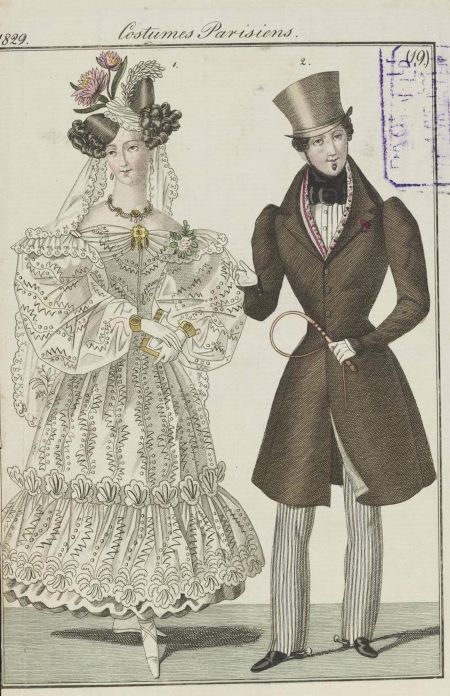
The fashionable male silhouette mirrored that of the ladies with wide sleeves and chest, a cinched in waist, volume at the tops of the trousers, and flaring coattails. [1] Collars on coats, waistcoats, and shirts were tall to frame the face. Padding was used to achieve the fashionable silhouette, most commonly in coats and stockings to create a shapely calf. [2] The styles of the decade were roundly mocked in the press and the satirical cartoons of the day. [3]

Underwear
The base layer was a cotton or linen shirt with a standing collar. Daytime shirts had pleats or tucks on the front while those worn for evening had frills. [4]
Male corsets became increasingly common during this decade and were pretty much required to achieve the severely nipped in waist that was in vogue. [5] However, they were usually referred to as “girdles,” “belts,” or “vests” to distinguish them from female corsets and stays. They were made in several styles ranging from a fully boned corset to waistcoats with baleen boning that laced in the back. Male corsets had been in use since the late 18th century and become common among military officers.
The Suit
The style of suit was determined by the formality of the occasion and the time of day.
There were three main types of coats: the dress coat, the morning coat, and the frock coat. The dress coat was worn for formal occasions, both daytime and evening. It was cut straight across at the waist with tails in the back. The morning coat was a variation of the dress coat with front panels that gently curved to the back. The frock coat from the previous decade was a fashionable informal choice. All coats were usually made in dark colors, often wool, and were commonly single breasted. [6]
Waistcoats were usually a solid color, with white or black being worn for evening. Most had either a standing collar or a rolled shawl collar. [7] It was trendy to wear more than one in keeping with the fashionable large-chested silhouette. [8]
Trousers were becoming the standard daytime fashion, with pantaloons being commonly worn for evening events, paired with a black dress coat. [9] Breeches were only worn for evening, at court, or out hunting and paired with tall boots. [10] Trousers were still narrow but had widened a bit from the previous decade. They reached to the top of the shoe and were often secured with an in-step strap. [11] They closed with a fall front although the fly front appeared during this decade but it did not become widespread until the 1840’s. Voluminous cossacks remained in fashion from the previous decade. Lighter colors were worn for day and darker for evening.


Hairstyles & Headwear
Short curly hair with sideburns was fashionable.
The silk top hat was king and came in several colors. [12] During this decade, the style was for the crown to curve outward from the brim.

Footwear
Besides the boots which remained fashionable from the previous decade, men wore low narrow shoes. The introduction of rubber to Europe and America paved the way for the invention of galoshes.

Accessories
By far, the most important accessory for the well-dressed gentleman was his immaculately tied cravat. It was a large square of silk or muslin knotted in a variety of bows and knots. [13] The stock, which was borrowed from military uniforms, was also worn. It was a stiff band covered in velvet or satin that fastened at the back of the neck. Black and white were the standard colors, especially for formal affairs, but patterns were worn for casual events. [14]
Watches on fobs tucked in a specially made watch pocket were still the standard. [15] Gloves were worn for daytime and evening.
I hope this was helpful. Let me know if you have any questions or suggestions by using the Contact Me form on my website or writing a comment. I post every Friday and would be grateful if you would share my content.
If you want my blog delivered straight to your inbox every month along with exclusive content and giveaways please sign up for my email list here. https://rebeccashedd.com/contact-me/
Let’s get writing!
Copyright © 2021 Rebecca Shedd. All rights reserved.
[1] Foster, Vanda. A Visual History of Costume: The Nineteenth Century. London: BT Batsford, 1984 p. 16.
Laver, James. Costume and Fashion: A Concise History, 5th ed. London: Thames & Hudson, Ltd, 2012 p. 162.
[2] Byrde, Penelope. Nineteenth Century Fashion. London: Batsford, 1992 p. 96.
Bruna, Denis, ed. Fashioning the Body: An Intimate History of the Silhouette. New Haven: Yale University Press, 2015 p. 202-203.
[3] Laver, James. Costume and Fashion: A Concise History, 5th ed. London: Thames & Hudson, Ltd, 2012 p. 162.
Ashelford, Jane. The Art of Dress: Clothes and Society, 1500-1914. London: National Trust, 1996 p. 191.
[4] Byrde, Penelope. Nineteenth Century Fashion. London: Batsford, 1992 p. 94.
[5] Bruna, Denis, ed. Fashioning the Body: An Intimate History of the Silhouette. New Haven: Yale University Press, 2015 p. 199-204.
Tortora, Phyllis G. and Keith Eubank. Survey of Historic Costume, 5th ed. New York: Fairchild Books, 2010 p. 340.
[6] Waugh, Norah. The Cut of Men’s Clothes: 1600-1900. New York and London: Routledge, Taylor and Francis Group, 2015 p. 117.
[7] Tortora, Phyllis G. and Keith Eubank. Survey of Historic Costume, 5th ed. New York: Fairchild Books, 2010 p. 342.
[8] Waugh, Norah. The Cut of Men’s Clothes: 1600-1900. New York and London: Routledge, Taylor and Francis Group, 2015 p. 115.
[9] Byrde, Penelope. Nineteenth Century Fashion. London: Batsford, 1992 p. 91-97.
[10] Waugh, Norah. The Cut of Men’s Clothes: 1600-1900. New York and London: Routledge, Taylor and Francis Group, 2015 p. 116.
Tortora, Phyllis G. and Keith Eubank. Survey of Historic Costume, 5th ed. New York: Fairchild Books, 2010 p. 341-342.
[11] B. Payne, "Men's Wear in the Nineteenth Century", History of Costume: From the Ancient Egyptians to the Twentieth Century (1965).
[12] Ginsburg, Madeliene. The Hat: Trends and Traditions. London: Studio Editions, 1990 p. 76, 85.
[13] Waugh, Norah. The Cut of Men’s Clothes: 1600-1900. New York and London: Routledge, Taylor and Francis Group, 2015 p.119.
Tortora, Phyllis G. and Keith Eubank. Survey of Historic Costume, 5th ed. New York: Fairchild Books, 2010 p. 341.
[14] Byrde, Penelope. Nineteenth Century Fashion. London: Batsford, 1992 p. 94.
[15] Ashelford, Jane. The Art of Dress: Clothes and Society, 1500-1914. London: National Trust, 1996 p. 186.
Cumming, Valerie ed., The Dictionary of Fashion History. New York: Berg, 2010 p. 83.
The Writer’s Guide to 1820s Women’s Fashion
Posted on June 4, 2021 116 Comments
With the death of King George III of England in 1820 and the coronation of George IV, the Regency era was over. Bright saturated colors and patterns came into vogue. Rows of trim and tucks, fluttering ribbons and shimmering gauzes and bobbin lace were used with abandon. After years under the rule of an old and mentally unstable king, fashion embraced the youthful exuberance of a new monarch.
For an overview of fashion for the entire 19th century, please read my Writer’s Guide to 19th Century Fashion.
So Romantic
This decade was a transitory period between the classical Regency styles and the more structured Victorian styles which started in 1837 with the coronation of Queen Victoria. It was part of the Georgian era, which lasted from 1714 to 1837 and covered the reign of Britain’s King Georges I-IV.
This decade saw the abandonment of the classically inspired fashions of the first two decades of the 19th century. Instead, the Romantic Movement was all the rage. The influence of this movement impacted not only fashion but literature, art, and music. It placed importance on personal emotions and expression. Clothing of this decade draws a large amount of influence from an idealized version of the past, especially the Middle Ages. [1]

Undergarments
A chemise or shift was still the first layer worn by all classes of women. Increasingly, it was made of cotton even though linen breathed better and didn’t stick to the body. But linen has a long and time-consuming manufacturing process. The processing of cotton had been dramatically shortened by the invention of the cotton gin in 1793 and various spinning machines in 1760s and 1770s.
Stays began to fade out of use and the corset began more prominent. The corset originally had only soft cording for structure while stays had more rigid boning. As the waistline began to drop, stays and corsets lengthened from the previous decade. While the main job of the garment during the Regency era was to hoist and separate the girls, the focus during this decade was to slim the waist and emphasis the curves. [2] The metal eyelet, first used on corsets in 1828, allowed them to take the strain of tight lacing. Before this invention, the fabric around thread-enforced eyelets would tear if laced too severely. [3]
A small bustle pad was worn on the rump to fill out the back of the skirt. Over this were several layers of petticoats. [4]

Dresses
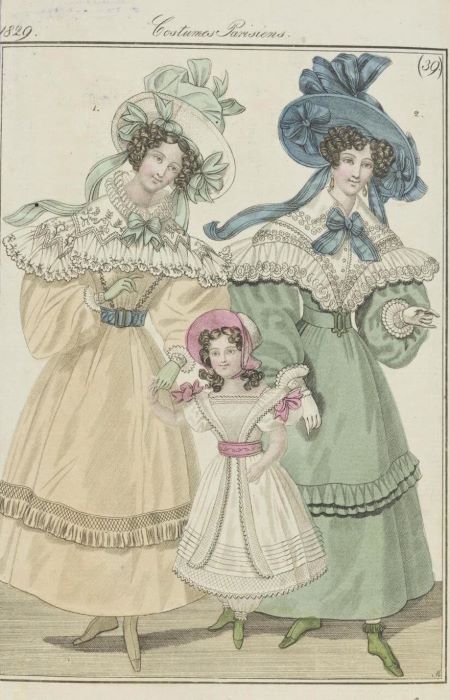
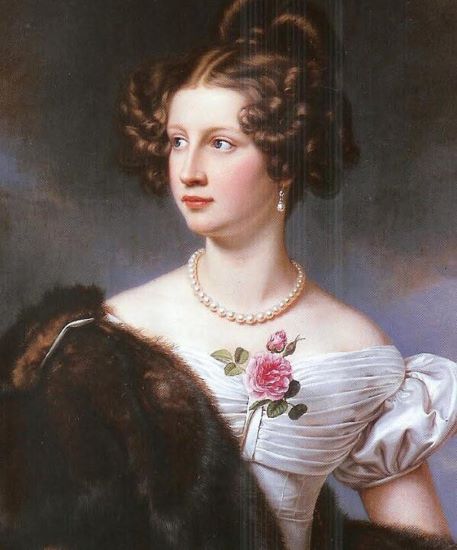
While waistlines started high at the beginning of the decade, they began to drop. By 1825, it was almost at the natural waist. [5] The skirts began to widen with the use of gores. By the end of the decade, they had become so voluminous that the excess fabric had to be pleated in at the waistband. The applied trim and decoration of the previous decade continued with lace, ruffles, flounces, puffs, and rouleaux, stuffed tubes of fabric. The weight of these decorations caused the hemlines to be raised above the floor. [6]
However, it was with sleeves that they really went crazy. Sleeves began to widen until “the upper arm appeared to be quite double the size of the waist” [7] These styles were known as gigot or leg-o-mutton since they resembled a leg of lamb. One of the few narrow styles was the “Marie” sleeve, which had a series of puffs going down the arm and evokes a romanticized medieval style. Slashing, puffs, and other elements that conjured the 16th and 17th century were also popular. Sleeves were usually long for daytime but short for evening although long sleeves of sheer netting were stylish. [8]
Necklines could be high for daytime or filled in with a chemisette. Wide collars known as pelerines became popular and covered the chest and shoulders. They often had decorative edges such as “vandyck points,” a reference to the 17th century artist, Anthony van Dyck. [9] For evening, necklines were frequently low and open. Ruffs at the neck were another design element that recalled historical styles.
The pelisse-robe, a type of coat-dress, was often worn for walking in the morning. [10]
Color overtook white in popularity, especially deep saturated tones such as chrome yellow and Turkish red. [11] Patterns such as checks and plaids also became all the rage. The popularity of plaid mirrored the appeal of the romantic writings of Sir Walter Scott. [12]

Outwear
The shawl was still the reigning outer garment although cloaks and coats were worn in cold and/or wet weather.
Hairstyles and Headwear
Hairstyles at the beginning of the decade continued the “spaniel curls” and center parts of the 1810s. By the middle of the decade, the Apollo knot, several large loops of hair at the top of the head, had become the fad. It was usually paired with sausage curls at the temples. Another style was à la Chinoise, which came into fashion at the end of the decade. It was an arrangement of braids and knots with curls at the temples decorated with long pins. [13]
Caps were worn by older and conservative women both indoors and under bonnets. They tied under the chin and were usually heavily adorned with pleats, lace, ribbons, feathers, flowers, and jewels.
The bonnets of the previous decade widened along with everything else with the brims and crowns increasing in width and height. Decoration also exploded, with ribbons, feathers, greenery, and flowers being attached to the outside and the underside of the brim. [14]
Turbans were also worn and were as heavily adorned as other headwear styles. They were considered exotic. [15]

Footwear
The slipper was still the fashionable shoe. In the late 1820’s, the first high shoe was introduced and was popular with both men and women. It had a three-inch (7.62 cms) cloth upper that laced on the inside and a square toe. [16]
Accessories
Reticules continued to be popular accessories since most of the fashions of the decade did not feature integrated pockets. Fans and parasols were also common.
I hope this was helpful. Let me know if you have any questions or suggestions by using the Contact Me form on my website or writing a comment. I post every Friday and would be grateful if you would share my content.
If you want my blog delivered straight to your inbox every month along with exclusive content and giveaways please sign up for my email list here.
Let’s get writing!
Copyright © 2021 Rebecca Shedd. All rights reserved.
[1] Tortora, Phyllis G. and Keith Eubank. Survey of Historic Costume, 5th ed. New York: Fairchild Books, 2010 p. 328.
Laver, James. Costume and Fashion: A Concise History, 5th ed. London: Thames & Hudson, Ltd, 2012 p. 163.
[3] Lynn, Eleri. Underwear: Fashion in Detail. London: V&A Publishing, 2010 p. 84.
Bruna, Denis, ed. Fashioning the Body: An Intimate History of the Silhouette. New Haven: Yale University Press, 2015 p. 160-161.
[2] http://www.frockflicks.com/metal-grommets/#:~:text=When%20metal%20grommets%20were%20first,popular%20in%20the%20Victorian%20era.
[4] Byrde, Penelope. Nineteenth Century Fashion. London: Batsford, 1992 p. 36.
[5] Byrde, Penelope. Nineteenth Century Fashion. London: Batsford, 1992 p. 35.
[6] Byrde, Penelope. Nineteenth Century Fashion. London: Batsford, 1992 p 36.
Cunnington, C. Willett. English Women’s Clothing in the Nineteenth Century: A Comprehensive Guide with 1,117 Illustrations. Mineola, NY: Dover Publications, 1990 p. 34.
Johnston, Lucy, Marion Kite, Helen Persson, Richard Davis, and Leonie Davis. Nineteenth Century Fashion in Detail. London: V&A Publications, 2005 p. 223.
[7] Cunnington, C. Willett. English Women’s Clothing in the Nineteenth Century: A Comprehensive Guide with 1,117 Illustrations. Mineola, NY: Dover Publications, 1990 p. 74.
[8] Byrde, Penelope. Nineteenth Century Fashion. London: Batsford, 1992 p. 35-36.
[9] Bassett, Lynne Z. Gothic to Goth: Romantic Era Fashion and Its Legacy. Hartford: Connecticut Wadsworth Antheneum Museum of Art, 2016 p. 20.
[10] Tarrant, Naomi E. A. The Rise and Fall of the Sleeve: 1825-1840. Edinburgh: Royal Scottish Museum, 1983 p. 13.
Cunnington, C. Willett. English Women’s Clothing in the Nineteenth Century: A Comprehensive Guide with 1,117 Illustrations. Mineola, NY: Dover Publications, 1990 p. 75.
[11] Tarrant, Naomi E. A. The Rise and Fall of the Sleeve: 1825-1840. Edinburgh: Royal Scottish Museum, 1983 p. 13.
Cunnington, C. Willett. English Women’s Clothing in the Nineteenth Century: A Comprehensive Guide with 1,117 Illustrations. Mineola, NY: Dover Publications, 1990 p. 75.
[12] Mackrell, Alice. Art and Fashion: The Impact of Art on Fashion and Fashion on Art. London: B T Batsford, 2005 p. 71.
[13] Cunnington, C. Willett. English Women’s Clothing in the Nineteenth Century: A Comprehensive Guide with 1,117 Illustrations. Mineola, NY: Dover Publications, 1990 p. 95.
Tortora, Phyllis G. and Keith Eubank. Survey of Historic Costume, 5th ed. New York: Fairchild Books, 2010 p. 334.
[14] Cunnington, C. Willett. English Women’s Clothing in the Nineteenth Century: A Comprehensive Guide with 1,117 Illustrations. Mineola, NY: Dover Publications, 1990 p. 95-96.
[16] Warren, Geoffrey (1987). Fashion Accessories Since 1500. London: Unwin Hyman. p. 93.
[15] Wilcox, Turner R. (1958). The Mode in Costume. New York, NY: Charles Scribner's Sons. p. 248.
The Writer’s Guide to 1810s Men’s Fashion
Posted on May 28, 2021 7 Comments

While women’s Victorian fashions changed wildly between the decades, men’s styles had a more measured and lengthy progression. Each decade saw some changes from the previous one. It is easy to look at men’s fashions from this decade and see the influence they had on the modern suit.
A splendid example of this clothing in action is Zack Pinsent. I recommend looking him up on YouTube.
For an overview of fashion for the entire 19th century, please read my Writer’s Guide to 19th Century Fashion. Over the next couple of weeks I will look into each decade with greater depth.
Influences
Beau Brummel still had an outsized influence on men’s fashions during this period, but his social standing had taken a big hit with his falling out with the Prince Regent in 1811. Despite the loss of his patron and the attending royal favor, he remained in society and stayed relevant, an unusual achievement. [1] He ended up racking up enormous debts trying to keep up with his aristocratic friends. In 1816, he fled to France, leaving behind a debt of thousands of pounds. He was committed to a debtor’s prison in 1835 and died broke and insane from syphilis in 1840 in Caen.
Underwear
A white shirt with a ruffled or pleated front and a standing collar was still the norm. [2] Some men discretely wore male corsets to achieve the svelte fashionable figure.
The Suit
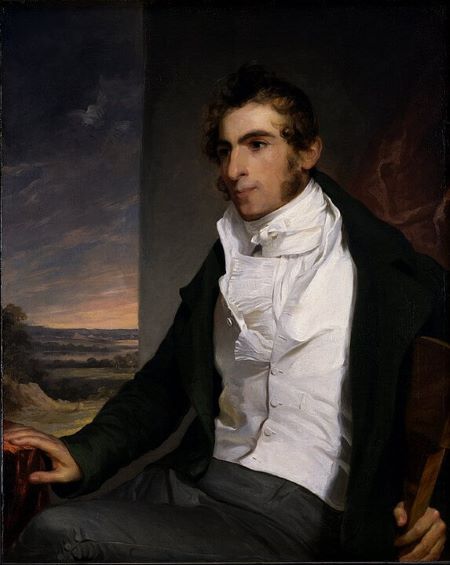
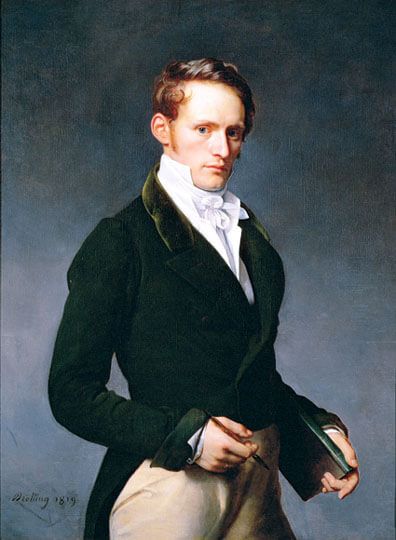
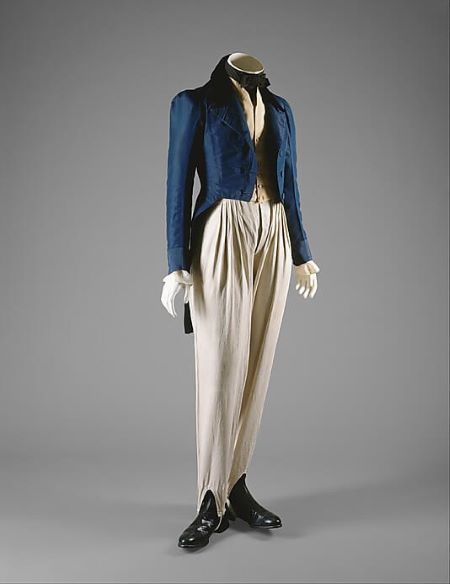
The suit continued to be the staple of menswear. The silhouette changing slightly after 1811 with the waist dropping and padding added to the shoulders. [3] Impeccable fit was still of utmost importance. Color and embellishment continued to retreat. The primary form of adornment was that inspired by the military fashions of the day. [4] The ditto suit or a three-piece suit with all elements made of the same fabric was unusual. [5]
The dress coat and the riding coat continued to be the two dominate styles. Toward the end of the decade, darts were added to the riding coat to achieve a smoother fit and eliminate the unsightly crease at the waist. [6] Around 1815, the frock coat was introduced and was worn for informal daytime affairs. It had knee-length tails and a fitted waist, which eventually incorporated a waist seam. The frock coat likely evolved from the greatcoat or military uniforms and became the staple of the respectable Victorian gentleman’s wardrobe. [7]
Waistcoats continued to be cut straight across at the waist and were single or double breasted.
The 1810s was an overlap period, during which both breeches and pantaloons were worn. Breeches were almost unchanged from the 18th century. They were snug with a fall-front and closed below the knee with buttons and buckles, and were worn for evening events. Pantaloons were longer, usually extending to the calf or ankle. [8] They were cut on the fabric’s bias, providing some stretch that helped to achieve a figure-hugging fit. Trousers also existed and were growing in popularity. They differed from pantaloons in their fit since they were looser around the calf. Starting shorter, by 1817, trousers reached the shoe. The instep strap, used to keep a tight line, is attributed to Beau Brummell. [9] During the middle of the decade, a style of trousers known as “Cossacks” saw a brief popularity. They were inspired by the visit to London of the Russian Czar and his troops in 1814. “Cossacks” were voluminous and pleated into the waistband. [10]
Hairstyles and Headwear
The hairstyles of the previous decade continued to be popular as well as the top hat, which was usually made of beaver felt. [10] The two-sided chapeau-bras was a stylish choice for evening. [11]
Accessories
The cravat continued to be a gentleman’s most important accessory. [12] This obsession was satirized in the publications of the day.
Watches on a fob continued to be stylish.

Shoes
Several styles of boots were immensely popular and show the influence that military uniforms had on civilian fashion. Hessian boots with tassels and heart-shaped tops were a favorite style, with the pantaloons tucked into them. They also showed off a man’s shapely calves. [13]
However, low shoes were a requirement for evening.

I hope this was helpful. Let me know if you have questions or suggestions by using the Contact Me form on my website or writing a comment. I post every Friday and would be grateful if you would share my content.
If you want my blog delivered straight to your inbox, every month along with exclusive content and giveaways please sign up for my email list here.
Let’s get writing!
Copyright © 2021 Rebecca Shedd. All rights reserved.
[1] Campbell, Kathleen (1948). Beau Brummell. London: Hammond.
[2] Tortora, Phyllis G. and Keith Eubank. Survey of Historic Costume, 5th ed. New York: Fairchild Books, 2010 page 319.
le Bourhis, Katell, ed. The Age of Napoleon: Costume from Revolution to Empire 1789-1815. New York: The Metropolitan Museum of Art, 1989 page 112.
[3] le Bourhis, Katell, ed. The Age of Napoleon: Costume from Revolution to Empire 1789-1815. New York: The Metropolitan Museum of Art, 1989 page 112.
[4] le Bourhis, Katell, ed. The Age of Napoleon: Costume from Revolution to Empire 1789-1815. New York: The Metropolitan Museum of Art, 1989 page 112, 117.
[5] Tortora, Phyllis G. and Keith Eubank. Survey of Historic Costume, 5th ed. New York: Fairchild Books, 2010 page 319.
[6] Waugh, Norah. The Cut of Men’s Clothes: 1600-1900. New York and London: Routledge, Taylor and Francis Group, 2015 page 113.
[14] Waugh, Norah. The Cut of Men’s Clothes: 1600-1900. New York and London: Routledge, Taylor and Francis Group, 2015 page 114-115.
Byrde, Penelope. Nineteenth Century Fashion. London: Batsford, 1992 page 92-93.
Davidson, Hilary. Dress in the Age of Jane Austen: Regency Fashion. New Haven: Yale University Press, 2019 page 28.
[7] Byrde, Penelope. Nineteenth Century Fashion. London: Batsford, 1992 page 93.
Johnston, Lucy, Marion Kite, Helen Persson, Richard Davis, and Leonie Davis. Nineteenth Century Fashion in Detail. London: V&A Publications, 2005 page 14.
[8] Ashelford, Jane. The Art of Dress: Clothes and Society, 1500-1914. London: National Trust, 1996 page 186.
Byrde, Penelope. Nineteenth Century Fashion. London: Batsford, 1992 page 93-94.
[9] Davidson, Hilary. Dress in the Age of Jane Austen: Regency Fashion. New Haven: Yale University Press, 2019 page 232.
Waugh, Norah. The Cut of Men’s Clothes: 1600-1900. New York and London: Routledge, Taylor and Francis Group, 2015 page 116.
[10] Ginsburg, Madeliene. The Hat: Trends and Traditions. London: Studio Editions, 1990 page 85.
le Bourhis, Katell, ed. The Age of Napoleon: Costume from Revolution to Empire 1789-1815. New York: The Metropolitan Museum of Art, 1989 page 112-113.
[11] Davidson, Hilary. Dress in the Age of Jane Austen: Regency Fashion. New Haven: Yale University Press, 2019 page 200, 226.
[12] Waugh, Norah. The Cut of Men’s Clothes: 1600-1900. New York and London: Routledge, Taylor and Francis Group, 2015 page 119.
[13] Ashelford, Jane. The Art of Dress: Clothes and Society, 1500-1914. London: National Trust, 1996 page 186.
Johnston, Lucy, Marion Kite, Helen Persson, Richard Davis, and Leonie Davis. Nineteenth Century Fashion in Detail. London: V&A Publications, 2005 page 14.
The Writer’s Guide to 1810’s Women’s Fashion
Posted on May 21, 2021 4 Comments

The 1810’s spanned the Empire era, which ended with the fall of Napoleon’s First French Empire in 1815, and the beginning of the Regency era, which started in 1811 with the regency of Britain’s Prince George. While the high-waisted classically inspired styles of the previous decade continued, a shift in focus to the Romantic Movement occurred and it became popular in incorporate influences from the Middle Ages and Renaissance. This decade also saw elements from India, Egypt, China, and other parts of the world impacting European fashion and Western styles spreading around the globe.
This period is popular among writers and producers of TV shows and movies. The new hit Netflix series, “Bridgerton,” is set in 1813. There have also been many, many adaptions of Jane Austen’s novels that were published in this period such as Sense and Sensibility (1811), Pride and Prejudice (1813), Mansfield Park (1814), and Emma (1815). Of course, each of these productions have varying levels of accuracy in their costuming.
Influences
The woman at the leading edge of fashion was Marie-Josèphe Rose Tascher de La Pagerie, better known as Empress Joséphine Bonaparte. She married Napoleon Bonaparte in 1796 and was crowned empress of France in 1804. She adored fine muslins and Kashmiri shawls, two staples of the decade’s look. Josephine supported the rebuilding of the French fashion industry after it was devasted by the Revolution. [1] Although her husband limited the importation of British muslin and Indian cashmere, she still found ways to acquire them. [2] She also had a voracious hunger for clothes. An 1809 inventory of her wardrobe included 49 court dresses, 666 winter dresses, 230 summer dresses, 60 cashmere shawls, and 1,132 pairs of gloves. [3]
This is what biographer Andrea Stuart had to say of her: “She was the wife of the world’s most powerful man, and the most visible female figure of her era. Her every action and nuance of appearance were followed eagerly by newspapers and journals in France and abroad. She was the high priestess of style, and fashion-conscious women the world over idolized her. They pored over fashion journals like le Journal des Dames et de la Mode…in order to see what Josephine was wearing, and attempted to copy her style. Joséphine reinforced Paris’s position as fashion capital of the world, which in turn boosted French industry.”

Undergarments
A linen or cotton shift or chemise continued to be worn.
Over that, was a pair of stays or a corset to support the bust. The term stays referred to the heavily boned support garment that originated in the 18th century while a corset had lighter or minimal boning. Over time, the terms became interchangeable, stays faded from use, and corsets became more heavily structured and boned. [4] Both short and long stays existed during this period. The short ones were used to support and shape the breasts, while the long did that as well as slimming the figure. [5]
Petticoats were worn under the skirts for support, modesty, and warmth.
Women would also wear a bustle pad, a crescent-shaped roll tied around the torso. Since the waistlines were so high, it rested just below the shoulder blades, creating a round-backed look known as a “Grecian bend.” [6]
Dresses
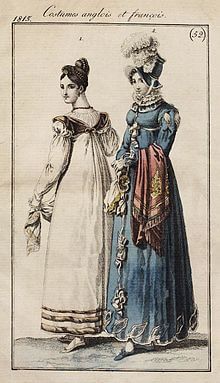
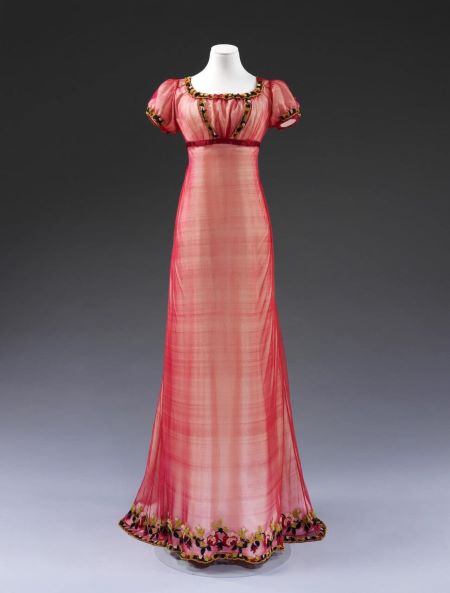
Gowns continued the high-waisted columnar look that began in the previous decade. However, the skirts became more angular with the use of gores, with the fullness gathered at the back. [7] The fall-front bodice disappeared in favor of back closures. A smoother fit was achieved by cutting the fabric on the bias and using darts. [8] The sleeves could be either short or long and were set further forward. Sleeves became fuller and were sometimes fashioned into puffs. Necklines could be square or V-shaped. [9] Cleavage was hidden during the day by a chemisette but was on full display for evening. [10] Some evening bodices were as short as two and a half inches (6.35 cm)!
White was still a stylish color, but brighter shades and patterns were increasingly popular. [11] Stiffer silks and cottons began replacing the gauzy muslins. Light transparent netting became incredibly trendy and more affordable after the invention of the bobbin-net machine by John Heathcoat in 1808. [12] It was used heavily in evening dresses where it was embroidered or otherwise decorated and worn over a silk slip. Pintucks and flounces on skirts also became incredibly popular as well as puffs and rouleaux, or stuffed rolls of fabric.
Overall, the neo-classical look was supplanted by Romanticism, which drew influence from the idealized past, especially the Middle Ages. Fashions from the decade have an ethereal quality about them or evoked elements from the past such as panes and puffs that recall the slashing of the Renaissance. [13]

Outerwear
The most common outer garments included the long redingote and the short spencer jacket. [14] The pelisse-robe, a type of coat dress, was developed by 1817. [15] These garments were heavily influenced by the military uniform styles of the day and made great use of braid, tassels, frogs, cords, and Brandenburg buttons. [16]
Shawls were an essential part of the look with the most sought after being Kashmiri shawls from India. Since they were so expensive, many imitations sprang up. One of the most noteworthy was from Paisley, Scotland, which gave its name to the pattern. [17]
Hairstyles and Headwear
“Spaniel curls,” which hung over both ears remained popular with the rest of the hair done up in curls in the back. [18] The cropped hairstyles of the previous decade were still seen at the beginning of the 1810’s. [19]
A wide variety of hats, bonnets, caps, and other headwear were worn. Foreign styles such as the turban reflected the influence of Napoleon’s overseas campaigns. [20] Poke bonnets shielded the face from the sun. Tall hats inspired by the shakos worn by Hussars were also popular. [21] Older women would often wear day caps indoors. [22]


Footwear
The low slipper and white stockings of the previous decade were still the standard for footwear.
Accessories
Accessories included fur muffs and reticules. Fans also were a popular item.
I hope this was helpful. Let me know if you have any questions or suggestions by using the Contact Me form on my website or writing a comment. I post every Friday and would be grateful if you would share my content.
If you want my blog delivered straight to your inbox every month along with exclusive content and giveaways please sign up for my email list here.
Let’s get writing!
Copyright © 2021 Rebecca Shedd. All rights reserved.
[1] Fukai, Akiko, ed. The Collection of the Kyoto Costume Institute: Fashion, A History from the 18th Century to the 20th Century. Kyoto: Taschen, 2013 page 125.
[2] Jensen, Heather Belnap. “Parures, Pashminas, and Portraiture, or, How Joséphine Bonaparte Fashioned the Napoleonic Empire.” in Fashion in European Art: Dress and Identity, Politics and the Body, 1775– 1925. Edited by Justine De Young, 36-59. London/New York: I.B.Tauris, 2017. Bloomsbury Fashion Central via The New York Public Library.
Davidson, Hilary. Dress in the Age of Jane Austen: Regency Fashion. New Haven: Yale University Press, 2019 page 272.
[3] Jensen, Heather Belnap. “Parures, Pashminas, and Portraiture, or, How Joséphine Bonaparte Fashioned the Napoleonic Empire.” in Fashion in European Art: Dress and Identity, Politics and the Body, 1775– 1925.
Tortora, Phyllis G. and Keith Eubank. Survey of Historic Costume, 5th ed. New York: Fairchild Books, 2010 page 311.
[4] Davidson, Hilary. Dress in the Age of Jane Austen: Regency Fashion. New Haven: Yale University Press, 2019 page 64.
[5] Foster, Vanda. A Visual History of Costume: The Nineteenth Century. London: BT Batsford, 1984 page 31.
[6] Cunnington, C. Willett. English Women’s Clothing in the Nineteenth Century: A Comprehensive Guide with 1,117 Illustrations. Mineola, NY: Dover Publications, 1990 page 32-33.
Davidson, Hilary. Dress in the Age of Jane Austen: Regency Fashion. New Haven: Yale University Press, 2019 page 26, 66. Tortora, Phyllis G. and Keith Eubank. Survey of Historic Costume, 5th ed. New York: Fairchild Books, 2010 page 315.
[7] Cunnington, C. Willett. English Women’s Clothing in the Nineteenth Century: A Comprehensive Guide with 1,117 Illustrations. Mineola, NY: Dover Publications, 1990 page 26.
Johnston, Lucy, Marion Kite, Helen Persson, Richard Davis, and Leonie Davis. Nineteenth Century Fashion in Detail. London: V&A Publications, 2005 page 74, 46.
Byrde, Penelope. Nineteenth Century Fashion. London: Batsford, 1992 page 30, 35.
[8] Davidson, Hilary. Dress in the Age of Jane Austen: Regency Fashion. New Haven: Yale University Press, 2019 page 26.
[9] le Bourhis, Katell, ed. The Age of Napoleon: Costume from Revolution to Empire 1789-1815. New York: The Metropolitan Museum of Art, 1989 page 94, 233.
[10] Ashelford, Jane. The Art of Dress: Clothes and Society, 1500-1914. London: National Trust, 1996 page 180.
[11] Byrde, Penelope. Nineteenth Century Fashion. London: Batsford, 1992 page 36.
Foster, Vanda. A Visual History of Costume: The Nineteenth Century. London: BT Batsford, 1984 page 36.
[12] Johnston, Lucy, Marion Kite, Helen Persson, Richard Davis, and Leonie Davis. Nineteenth Century Fashion in Detail. London: V&A Publications, 2005 page 146. le Bourhis, Katell, ed. The Age of Napoleon: Costume from Revolution to Empire 1789-1815. New York: The Metropolitan Museum of Art, 1989 page 100.
[13] Johnston, Lucy, Marion Kite, Helen Persson, Richard Davis, and Leonie Davis. Nineteenth Century Fashion in Detail. London: V&A Publications, 2005 page 46.
Davidson, Hilary. Dress in the Age of Jane Austen: Regency Fashion. New Haven: Yale University Press, 2019 page 37-38.
Cunnington, C. Willett. English Women’s Clothing in the Nineteenth Century: A Comprehensive Guide with 1,117 Illustrations. Mineola, NY: Dover Publications, 1990 page 29.
le Bourhis, Katell, ed. The Age of Napoleon: Costume from Revolution to Empire 1789-1815. New York: The Metropolitan Museum of Art, 1989 page 100.
[14] Cunnington, C. Willett. English Women’s Clothing in the Nineteenth Century: A Comprehensive Guide with 1,117 Illustrations. Mineola, NY: Dover Publications, 1990 page 35-38. le Bourhis, Katell, ed. The Age of Napoleon: Costume from Revolution to Empire 1789-1815. New York: The Metropolitan Museum of Art, 1989 page 98.
[15] Byrde, Penelope. Nineteenth Century Fashion. London: Batsford, 1992 page 27.
[16] Fukai, Akiko, ed. The Collection of the Kyoto Costume Institute: Fashion, A History from the 18th Century to the 20th Century. Kyoto: Taschen, 2013 page 148-151.
Byrde, Penelope. Nineteenth Century Fashion. London: Batsford, 1992 page 30.
Davidson, Hilary. Dress in the Age of Jane Austen: Regency Fashion. New Haven: Yale University Press, 2019 page 233.
[17] Laver, James. Costume and Fashion: A Concise History, 5th ed. London: Thames & Hudson, Ltd, 2012 page 155.
Davidson, Hilary. Dress in the Age of Jane Austen: Regency Fashion. New Haven: Yale University Press, 2019 page 273.
Ashelford, Jane. The Art of Dress: Clothes and Society, 1500-1914. London: National Trust, 1996 page 179.
[18] Foster, Vanda. A Visual History of Costume: The Nineteenth Century. London: BT Batsford, 1984 page 32.
[19] le Bourhis, Katell, ed. The Age of Napoleon: Costume from Revolution to Empire 1789-1815. New York: The Metropolitan Museum of Art, 1989 page 103.
Tortora, Phyllis G. and Keith Eubank. Survey of Historic Costume, 5th ed. New York: Fairchild Books, 2010 page 317.
[20] le Bourhis, Katell, ed. The Age of Napoleon: Costume from Revolution to Empire 1789-1815. New York: The Metropolitan Museum of Art, 1989 page 108.
Laver, James. Costume and Fashion: A Concise History, 5th ed. London: Thames & Hudson, Ltd, 2012 page 156.
[21] Ginsburg, Madeliene. The Hat: Trends and Traditions. London: Studio Editions, 1990 page 72-73.
[22] Cunnington, C. Willett. English Women’s Clothing in the Nineteenth Century: A Comprehensive Guide with 1,117 Illustrations. Mineola, NY: Dover Publications, 1990 page 53.
The Writer’s Guide to 1800-1810 Men’s Fashion
Posted on May 14, 2021 5 Comments

Men’s fashions of the first decade of the 19th century were buffeted by the same winds of change that influenced women’s styles. The French Revolution had an outsized impact although the revolutions in Britain’s American colonies and Haiti influenced fashion as well. The Napoleonic War also had a large effect with various elements of military uniform seeping into civilian wear.
For an overview of fashion for the entire 19th century, please read my Writer’s Guide to 19th Century Fashion.
Influences
A distancing from the elaborate styles of the 18th century was due in large part to the shock of the French Revolution. Nobody wanted to look like an aristocrat after that. However, a move towards a more sober style was already underway, starting as early as the 1790’s.
The rise of the dandy in this period set the tone for men’s fashions throughout the century and still holds sway over men’s styles to this day. George Bryan “Beau” Brummel is considered the father of dandyism. The son of a minor noble, he rose to prominence with his exquisitely tailored coats, crisp perfectly tied cravats, and immaculate linen shirts. [1] The impression he made was so lasting that fifty years after his death, the English essayist Max Beerbohm wrote: “In certain congruities of dark cloth, in the rigid perfection of his linen, in the symmetry of his glove with his hand, lay the secret of Mr. Brummell’s miracles.” [2]
The restrained clothing of the English country gentleman had been gaining popularity in Britain and on the Continent. It was a rebellion against the ostentatious styles of the older generation as well as becoming the new standard for the professional man. [3]

Underwear
The shirt was the standard first layer and was made of either linen or cotton with a standing collar that skimmed the jawline. Ruffles decorated the front, giving way to pleats as the decade progressed. [4] Some men had begun to discretely wear a male version of the corset to achieve the flat-bellied fashionable silhouette.
The Suit
The suit continued to be the mainstay of men’s fashion although it underwent several changes from the elaborate and heavily embellished suits of the 18th century. Under the influence of the dandy, the decorations disappeared and sober colors such as black, navy, brown, red, and green became the standard. [5]
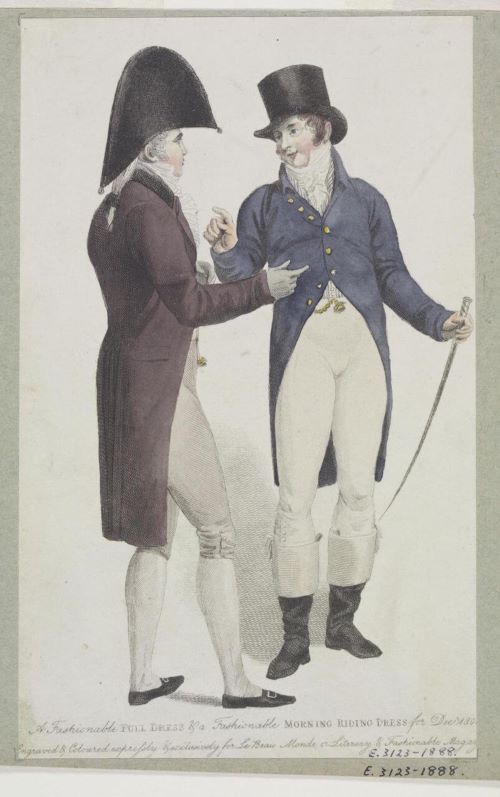
The coat could either be a formal dress coat or an informal riding coat. The dress coat either cut straight across at the waist or in the shape of an inverted U before flowing into the tails at the back. The high collar featured an M shape at the back which is unique to this period. [6] The riding coat sloped gently from the waist into the tails. Unlike the coats of the previous century, both styles were meant to be worn buttoned.
Waistcoats were either single or double breasted. They were also the only piece of a man’s wardrobe where he could indulge in color and pattern. [7] They were cut straight across with only a bit of them peeking out from under the bottom of the coat. They had tall collars and wide lapels.
Pantaloons extended to the calf or ankle where they fastened with ties or buttons and were cut on the bias to hug the body. They still had the fall front of the previous century. White or cream breeches were worn for formal affairs while dark colors were favored for daytime. [8] Beau Brummel is credited with inventing the instep strap to keep his pantaloons taut and straight. [9] During this period, trousers became acceptable as an informal option.
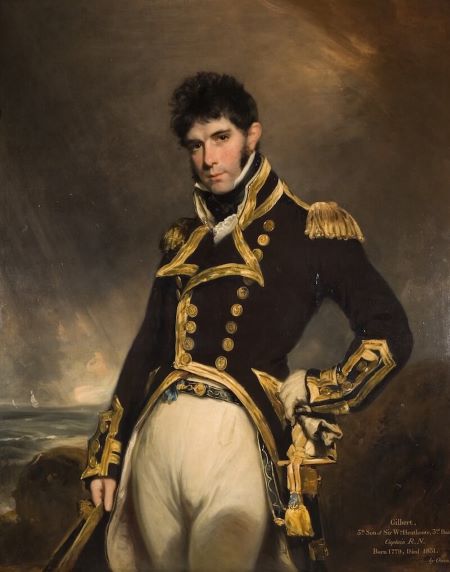
Captain Gilbert Heathcote painted by William Owen. Photo source.
Outerwear
For outdoors, greatcoats were popular, often sporting contrasting collars of velvet or fur. A style of coachman’s coat called a garrick with three to five short capes attached at the collar was also worn. [10]
Accessories
The cravat was an essential accessory and was usually made of fine muslin or silk. Dandies were overly concerned by the proper wrapping and tying of their cravats and there were several instruction manuals that advised on the correct methods. [11]
Watch fobs or a decorated strip of ribbon or metal were still popular from the previous century. [12]
Hairstyles and Headwear
The wig fell out of fashion except among older men and specific professions such as lawyers, judges, and physicians. In fact, you will still see judges in the UK wearing white wigs to this day. The Duty on Hair Powder Act of 1795 introduced a tax that radically decreased the demand for hair powder. The abandonment of the wig was also championed by Beau Brummel. Hair was instead cut short and naturally tousled, a look known as à la Titus or Brutus in keeping with the classical influences of the decade. [13]
The top hat had replaced the tricorn as the dominate hat, coming in a variety of heights and shapes. It was originally made of felt, but silk began to be used around 1803. [14] The 18th century bicorn was still worn, especially as part of military uniforms. It was fashionable at formal evening events where it was carried under the arm. [15]

Footwear
Boots were the most popular footwear and took after the military fashions of the day. Hessian boots, named after the German soldiers, had heart-shaped tops with tassels. The jockey boot, which had previously only been used for riding, also came into style. They were dark colored with a turned-down cuff of lighter colored leather. [16] Low shoes were worn at court.
Court Dress
Just like with the women’s styles, the court dress for men stayed old-fashioned and was the last holdout of the embellished and elaborate suits of the 18th century. This was true for the English as well as Napoleon’s court that returned to the styles of the ancien régime that had been wiped out by the French Revolution.

I hope this was helpful. Let me know if you have any questions or suggestions by using the Contact Me form on my website or writing a comment. I post every Friday and would be grateful if you would share my content.
If you want my blog delivered straight to your inbox every month along with exclusive content and giveaways, please sign up for my email list here.
Let’s get writing!
Copyright © 2021 Rebecca Shedd. All rights reserved.
[1] Payne 1865, pp. 452–455
[2] https://en.wikipedia.org/wiki/1795%E2%80%931820_in_Western_fashion#Men's_fashion
[3] https://fashionhistory.fitnyc.edu/1800-1809/
[4] Tortora, Phyllis G. and Keith Eubank. Survey of Historic Costume, 5th ed. New York: Fairchild Books, 2010. http://www.worldcat.org/oclc/865480300 pg 319. Byrde, Penelope. Nineteenth Century Fashion. London: Batsford, 1992. http://www.worldcat.org/oclc/26300526 pg 94.
[5] Byrde, Penelope. Nineteenth Century Fashion. London: Batsford, 1992. http://www.worldcat.org/oclc/26300526 pg 91.
[6] Payne 1865, pp. 452–455
[7] Tortora, Phyllis G. and Keith Eubank. Survey of Historic Costume, 5th ed. New York: Fairchild Books, 2010. http://www.worldcat.org/oclc/865480300 pg 321. Davidson, Hilary. Dress in the Age of Jane Austen: Regency Fashion. New Haven: Yale University Press, 2019. http://www.worldcat.org/oclc/1115106379 pg 28-29.
[8] Byrde, Penelope. Nineteenth Century Fashion. London: Batsford, 1992. http://www.worldcat.org/oclc/26300526 pg 93. Johnston, Lucy, Marion Kite, Helen Persson, Richard Davis, and Leonie Davis. Nineteenth Century Fashion in Detail. London: V&A Publications, 2005. http://www.worldcat.org/oclc/61302743 pg 14
[9] Byrde, Penelope. Nineteenth Century Fashion. London: Batsford, 1992. http://www.worldcat.org/oclc/26300526 pg 94
[10] Payne 1865, pp. 452–455
[11] Byrde, Penelope. Nineteenth Century Fashion. London: Batsford, 1992. http://www.worldcat.org/oclc/26300526
[12] Ashelford, Jane. The Art of Dress: Clothes and Society, 1500-1914. London: National Trust, 1996. http://www.worldcat.org/oclc/243850605. Cumming, Valerie ed., The Dictionary of Fashion History. New York: Berg, 2010. http://www.worldcat.org/oclc/1003643284.
[13] Davidson, Hilary. Dress in the Age of Jane Austen: Regency Fashion. New Haven: Yale University Press, 2019. http://www.worldcat.org/oclc/1115106379 pg 57. Laver, James. Costume and Fashion: A Concise History, 5th ed. London: Thames & Hudson, Ltd, 2012. http://www.worldcat.org/oclc/966352776 pg 153.
[14] Ginsburg, Madeliene. The Hat: Trends and Traditions. London: Studio Editions, 1990 pg. 85-86. le Bourhis, Katell, ed. The Age of Napoleon: Costume from Revolution to Empire 1789-1815. New York: The Metropolitan Museum of Art, 1989 pg. 112-113.
[15] Tortora, Phyllis G. and Keith Eubank. Survey of Historic Costume, 5th ed. New York: Fairchild Books, 2010 pg. 322. Davidson, Hilary. Dress in the Age of Jane Austen: Regency Fashion. New Haven: Yale University Press, 2019 pg. 200, 226.
[16] Payne, p. 456.
The Writer’s Guide to 1800-1810 Women’s Fashion
Posted on May 7, 2021 35 Comments
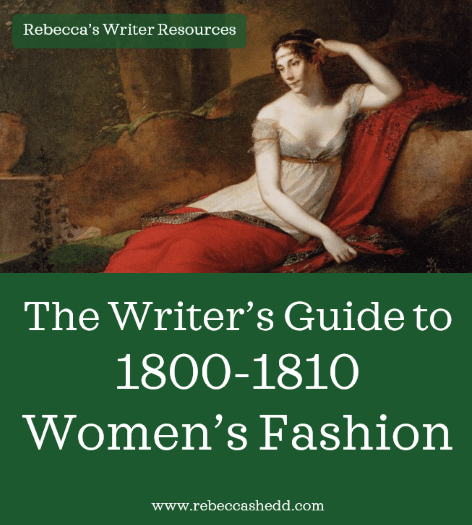
The first decade of the 19th century is known as the Empire period, named after Napoleon’s First French Empire. It is also sometimes referred to as the Napoleonic era. Women’s clothing of this period is often called Jane Austen dress, since many of the author’s books were written and set during this decade.
For an overview of fashion for the entire 19th century, please read my Writer’s Guide to 19th Century Fashion. Over the next couple of weeks I will be looking into each decade with greater depth.
Influences
As I mentioned in my blogs about the last decade of the 18th century, the French Revolution had a large impact on fashion and the stylish silhouette. The wide-hipped, tightly laced trends of the French court quickly disappeared in its aftermath in favor of a more natural figure. The new fashions reflected the desire for freedom and personal expression.
There was also increased interest in the classical Greek and Roman styles, leading to a revival not only in clothing but architecture, interior design, and the arts. This was due in large part to the discovery and excavation of Pompeii and Herculaneum. The styles of the ancient democracies fit in well with the values of the revolution and Napoleon’s empire. They were also championed by his wife, Josephine. [1] The performances of Emma Hamilton, which pulled heavily from classical imagery, also increased the popularity of the style. [2]
Underwear
Just as for centuries, the base layer for all classes of women was the chemise or shift. However, cotton was becoming increasingly more common, and linen was falling out of favor. The chemise had a low neckline and tight short sleeves to accommodate the styles of the day. It was always white, which helped to withstand rough laundering practices.
Stays were worn over the chemise, but they became shorter than those from the previous century, usually only extending a short distance below the bust. In fact, they look a lot like a laced-up modern sports bra. [3]
A petticoat was worn over the chemise. Since most of the dresses of this period were made of shear fabric, a petticoat was essential for modesty. They could be decorated with pintucks, lace, or ruffles.
Drawers were worn by few women but were gaining in popularity. They often had a split crotch for convenience visiting the bathroom.
Stockings were made of silk or cotton and secured by garters as they were in the previous century. They were often white or nude colored. [4]

Gowns
Dresses had a slim silhouette and drew heavily on classical Greek and Roman imagery. White was a common color since most ancient statues were white marble, having lost their coat of paint over the centuries. Other pastel colors were also popular and recommended for young ladies with jewel tones suggested for mature women. Gone were the wide skirt supports of the previous centuries. The change was so dramatic that it was heavily satirized in the publications of the day.
Lightweight fabrics that draped well such as muslin were used and were sometimes so flimsy to the point of being shear. It was essential to wear a petticoat for modesty. The fullness of the fabric was usually gathered at the back of the waistline, allowing the front to be smooth. The sleeves could be short, like a cap sleeves, or long, extending to the wrists.
Different classifications of dress appeared during this period, signaling a measured returned to formality after the expulsion of everything formal during the revolutions at the end of the previous century. Morning dress was casual at-home wear. Half dress for casual outings or meeting with guests. For both, it was recommended that the dress be long-sleeved and high-necked. Full dress was for formal occasions and evening dress for nighttime events, with plunging necklines and short sleeves being appropriate. [5] Other nuances appeared such as dinner dress, walking dress, etc., heralding the strict requirements of clothing based on occasion and time of day that the Victorian era is known for.
The styles of Spain began to deviate from the rest of Europe and North America. Black became a popular color again just as it was in the 16th century. Lace veils and large combs in the hair completed the look.


Outerwear
The shawl was an essential element as well as being needed for warmth. Patterns were fashionable with the Indian shawl being favored. [6] Variations of the shawl, including mantels and capes, were also popular.
Various styles of coats such as the redingote, and short jackets called spencers were in vogue. [7]
Gloves were worn when outside the house and only removed for dinning.
Accessories
Due to the slim shear styles of the day, the separate pockets worn during the previous century were abandoned. Instead, small purses or reticules were used to carry items. They usually hung from the wrist.
Fans were carried for cooling and over this period, an entire language made up of fan movements and placement was developed. [8]
Parasols were used outdoors to protect a lady’s pale skin.
Hairstyles and Headwear
Hairstyles were also influenced by ancient Greece and Rome, with a style known as a Psyche knot being popular. Daring women chopped their hair short and wore it “à la Titus”, a layered look with some pieces hanging down.
Bonnets were commonly worn outdoors although adventurous ladies began forgoing them in public. A variety of other headwear was popular including turbans and hats inspired by Asia and China. Conservative married women continued to wear linen caps.

Footwear
Flat slippers made of fabric or leather were the most common. High heels had gone out of fashion. When venturing out on the muddy streets, tall pattens were worn to raise a lady’s slippers up out of the muck.
Court Dress
Although the French court of Louis had fallen, the English court remained. Just as in the previous century, the styles of court were decidedly old-fashioned and harkened back to the 18th century. Skirt supports were still worn under court dresses. During this period, the English court tried to combine the wide-hipped styles of the late 18th century with the high-waisted trend. The result was rather absurd and probably not flattering on anyone.

I hope this was helpful. Let me know if you have any questions or suggestions by using the Contact Me form on my website or writing a comment. I post every Friday and would be grateful if you would share my content.
If you want my blog delivered straight to your inbox every month along with exclusive content and giveaways please sign up for my email list here.
Let’s get writing!
Copyright © 2021 Rebecca Shedd. All rights reserved.
[1] https://fashionhistory.fitnyc.edu/1800-1809/
[2] Hornsby, Clare (2000). "7". The Impact of Italy: The Grand Tour and Beyond. The British School at Rome. pp. 123–146.
[3] "Stays | V&A Search the Collections". V and A Collections. 2021-01-12. Retrieved 2021-01-12.
[4] "The Costume Book, Nesfield, Cookson. 1935:New York.
[5] "Mirror of Graces; or the English Lady's Costume". p. 95. Retrieved 4 July 2009.
[6] Payne 1965, p. 447–449
[7] Payne 1965, p. 447–449
[8] Cheltenham Art Gallery & Museum
The Writer’s Guide to 19th Century Fashion
Posted on April 30, 2021 39 Comments

The 19th century saw fundamental changes to society and technology as well as fashion. In previous centuries, the fashions of Europe only impacted that continent and perhaps their few colonies. But with the advent of better means of travel and communication, the styles of Europe spread around the world. In several ways, 19th century Western trends still impact us now.
Today I will be introducing the basics of 19th century fashion and will be diving deeper over the coming weeks.
Once the world returns to normal, I highly encourage you to attend a Victorian or American Civil War reenactment event near you. Most of the participants have extensive knowledge of the clothing of the period and are often happy to share it.
A Changing World
There were several major upheavals that impacted fashion in the 19th century.
Probably one of the biggest was the Industrial Revolution, a period of extreme technological growth and innovation. Modern production methods and new machinery were introduced, and the textile industry was one of the first to jump on the bandwagon. Spinning and weaving that had been done by hand before was now being done by machine, leading to increased productivity. [1] The first widely used sewing machine was invented in 1830. The earliest machines were operated using a foot-powered treadle or a hand crank. Although this limited their speed, they were still faster than sewing by hand. The first electric machines were introduced in 1889 by the Singer Sewing Co. [2] The introduction of the heavily regimented factory also increased output and lowered prices.
The beginning of globalization, spurred on by capitalism and colonialism, connected suppliers and consumers from around the world like never before. The British Empire is one example. Due to its reach, shoppers in London could purchase Indian cotton, Chinese silk, and other global fabrics and styles, often at affordable prices from the new department stores.
Queen Victoria of Britain, who ruled from 1838 to 1901, had an enormous impact on fashion. She put special effort in supporting the British textile industry and made style choices that were emulated around the globe.
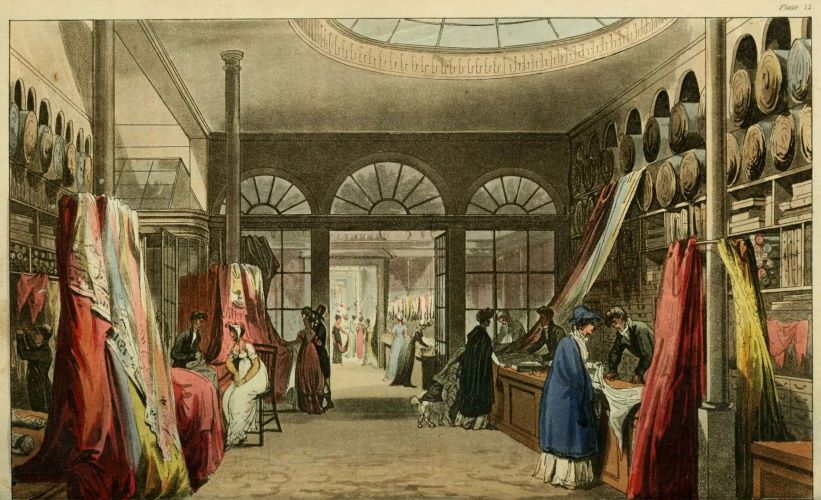
Women’s Fashion
Women’s fashions changed dramatically through the century. The pace of style increased and shifted from decade to decade. This section will just be brief overview and I will be looking at each decade in depth in future posts.
The Empire period (1799-1815), named after Napoleon’s First French Empire, was still influenced by the classical styles of the end of the 18th century. Dresses were slim and columnar with short sleeves and empire waistlines. Stays became shorter. These styles are also called Jane Austen dress after the English author, whose most well-known books such as Pride and Prejudice are set in this period.
The Regency period, named for George, the Prince Regent of Britain, stretched from 1811-1820. Waistlines began to drop, fabrics became more substantial, and skirts began to widen with the use of flounced or corded petticoats. Wigs were no longer worn, and hair was not powdered; bonnets were common. Hairstyles were kept low with ringlets (sometimes called “spaniel curls”) over the ears. [4]
In the 1820’s, waistlines continued to drop, and bright colors and patterns became popular, as opposed to the solid pastels of the last 18th century. [5] Sleeves and skirts continued to widen with an increase in embellishment at the hems. Hair was pulled up in loops at the back with curls in front and covered by a bonnet when outside. Shoes were flat slippers.
The 1830’s saw the widening of both skirts and sleeves with the waist cinched in with a corset. [7] Hair retained the front curls but became taller in the back. [8]
In the 1840’s, sleeves narrowed once more but the width of skirts increased with the use of many, many petticoats. Later into the decade, sleeves that flared below the elbow became popular. The fashionable hairstyle still included “spaniel curls” with the remainder of the hair pinned up in the back. Caps and bonnets were common.
The hoop skirt or crinoline was introduced in the 1850’s, allowing women’s skirts to expand to even greater widths. This decade also saw the rise of bell-shaped pagoda sleeves. Hair became simpler and indoor caps and outdoor bonnets were common.
Women’s skirts reached their widest in the 1860’s and the decade also saw the introduction of the first chemical dyes. [10] Wide pagoda sleeves were still the rage. Hair was styled simply, usually pulled back and caps and bonnets were common.
The 1870’s, known as the first bustle period, saw the volume of women’s skirts move to the back with the help of tapes and a bustle. Two skirts became popular. The bustle craze was short-lived and was replaced by a long-line bodice known as a cuirass.
The 1880’s saw the second bustle period with the volume of skirts rising from the bottom to just below the waist. Corseting was essential for achieving the dramatic and fashionable S-shaped silhouette.
The silhouette of the 1890’s slimmed from the previous decade with a hip pad being the only skirt support. The large “leg of mutton” sleeves of the 1830’s made a comeback. The corset became longer, producing a slight S-bend silhouette.
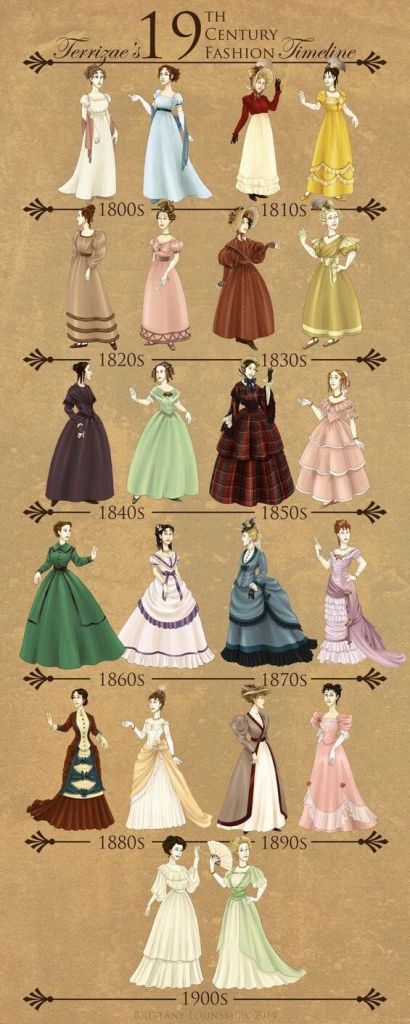
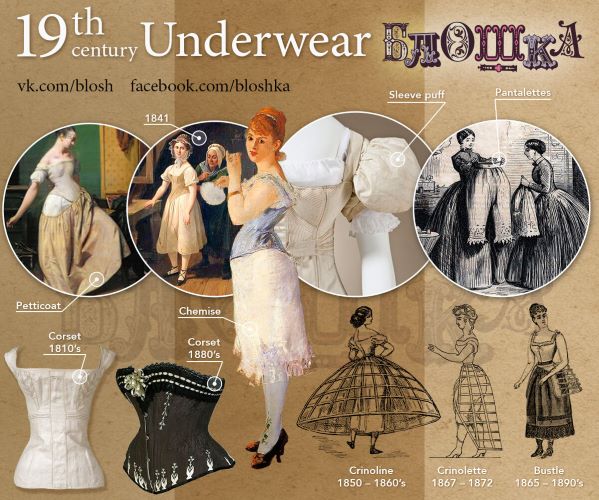
Men’s Fashion
Men’s styles were still dominated by the three-piece suit although it changed from its elaborately embellished 18th century origins. Under the influence of the dandy, colors became darker and more sober with an emphasis on impeccable tailoring and fit. [3]
During the Empire period, pantaloons, which reached to the calf, were worn along with breeches. They both began to fade in popularity and were almost completely replaced by trousers by the Regency period. Wigs had been abandoned altogether. Hair became shorter and facial hair made a reappearance with sideburns being popular.
In the 1820’s, the influence of the dandy led to an emphasis on tailoring and a slim figure. Men’s corsets became more widely used. The construction of coats changed, with the addition of a waist seam that improved the fit. Trousers became looser and the top hat reappeared. [6] Curly hair with sideburns was popular.
Men’s fashions of the 1830’s also put an emphasis on wide shoulders and a small waist, the same as the women. [9] Frock coats became more common, and waistcoats were single or double breasted. The modern fly-front closure for trousers was replacing the fall-front. Moustaches came into fashion.
The fashionable style for the men in the 1840’s was like the previous decade. Ascots and cravats were common. Different styles of coats were required for varying social occasions. Prince Albert, the husband of Queen Victoria, emerged as a trendsetter.
The 1850’s saw little change in men’s fashions although a new style of coat, the sack coat, became popular. It fitted loosely and came to mid-thigh and was popular for outdoor pursuits. Facial hair of all styles became incredibly trendy.
In the 1860’s the sack coat almost completely displaced the frock coat for informal occasions. Top hats became taller and straighter. The bowler hat became popular as casual headwear.
Patterned shirts became accepted in the 1870’s and neckties were replaced with ascots. Collars were pressed down instead of standing up. Blue jeans were introduced by Levi Strauss in 1873 in San Francisco. [11]
The 1880’s saw a return of the popularity of the “ditto suit,” coat, waistcoat, and trousers made of the same fabric, today known as a three piece. The middle of the decade also saw the introduction of the tuxedo, a more relaxed formal style.
Men’s silhouettes also became leaner and simpler in the 1890’s. The sack coat gradually replaced the frock coat for most social occasions. The informal blazer was also introduced. The necktie and bowtie were popular. Top hat and bowlers were still stylish but straw boaters became fashionable for outdoor activities.
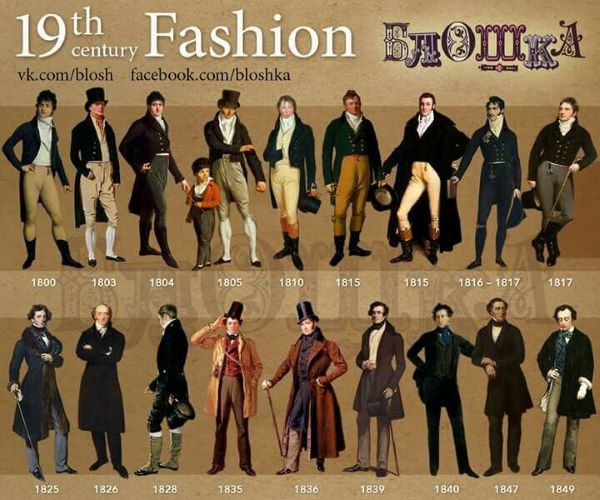
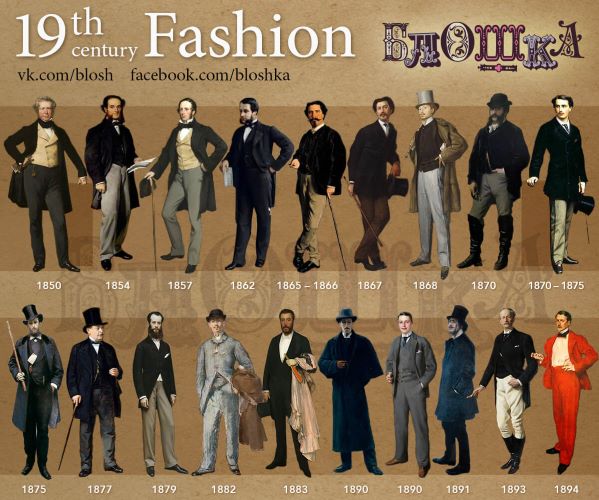
I hope this was helpful. Let me know if you have any questions or suggestions by using the Contact Me form on my website or writing a comment. I post every Friday and would be grateful if you would share my content.
If you want my blog delivered straight to your inbox every month along with exclusive content and giveaways please sign up for my email list here.
Let’s get writing!
Copyright © 2021 Rebecca Shedd. All rights reserved.
[1] Landes, D.S. (1969). The Unbound Prometheus: technological change and industrial development in Western Europe from 1750 to present. Cambridge, UK: Cambridge University Press.
[2] "Sewing Machine History – Invention of the Sewing Machine". Archived from the original on 2010-11-24. Retrieved 2010-09-12.
[3] Payne 1865, pp. 452–455
[4] Thomas, Pauline. "Regency & Romantic Hairstyles and Hats 1800–1840 Fashion History".
[5] Tozer and Levitt (1983), p. 29
[6] Kohler, Carl (1963). A History of Costume. New York, NY: Dover Publications. pp. 372–373.
[7] Tortora and Eubank 1994, p. 278
[8] Payne 1969, p. 505
[9] Payne 1969, p. 458
[10] Travis, Anthony S., "Perkin’s Mauve: Ancestor of the Organic Chemical Industry", Technology and Culture 31 (1), 1990 pp. 51–82
[11] http://www.uri.edu/personal/svon6141/history.htm Archived 2011-07-20 at the Wayback Machine The History of Jeans
 Rebecca Shedd - Author