
The Writer’s Guide to 15th Century Fashion
Posted on February 12, 2021 13 Comments
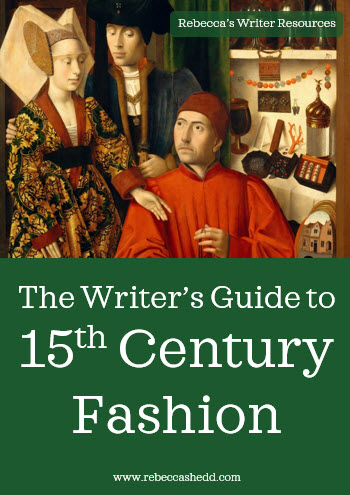
Just like the 12th century, the 15th century contains many fashion elements that will be familiar to readers and viewers of fantasy and fairy tale adaptations. Fashion was changing during this century and varied in significant ways from the styles of the centuries that proceeded it. It also saw the introduction of several iconic styles of headwear that are still used in fantasy today.
15th Century Fashion
The idea of “fashion” really started coalescing during this century and as fashion trends came and went for the first time wearing “out of date” clothing became a real problem. [1] Europe was also becoming more prosperous, leading to more and more complex clothing styles and expensive fabrics. This prosperity also meant that lower-class people had more money to spend on their clothing and could follow the fashion trends. The variations of clothing between nations became more pronounced, making it possible by the end of the century to look at a person’s style of dress and determine whether they were from England or Italy or Germany.
With England and France too busy with the Hundred Year’s War to focus on fashion, the Duchy of Burgundy became the style world’s beating heart. Its fashion-conscious ruler, Phillip the Good, had access to the finest and most fashionable fabrics from both East and West, from English wool to Italian silks to furs. Wool could be dyed in a rainbow of sumptuous colors and Mediterranean silk-weavers could produce richly detailed designs and opulent silk velvets.
One fashion trend that took hold was slashing. The outer garment was cut, often in a decorative pattern, to reveal the undergarment or lining. It allowed for incredibly colorful outfits. The Germany Landsknechts took the trend to often outrageous extremes.
The houppelande was a popular style that had variations for both men and women. It was a voluminous outer garment, usually floor-length, with large hanging sleeves. The edges were often dagged or cut in a decorative pattern. Appearing in the 1360’s, it stayed popular for over a century. [2]

Men’s Fashion
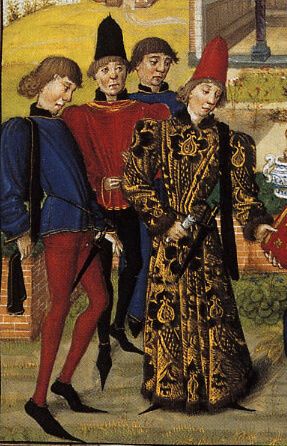
Men were still wearing the linen shirts and tailored hose from the previous centuries although the shirts had become shorter with changing fashions. The most popular outer garment worn during this time period was the cotehardie, a fitted coat-like garment that buttoned up the front. It usually had long sleeves and a “skirt” that extended to the knees. Over time, the cotehardie evolved into the doublet, with the skirt length shortening until it disappeared altogether. The doublet’s sleeves were often full. If another layer was worn, it was the houppelande.
Various hats were popular based on location and social status. The chaperon remained stylish from the 12th century and there were multiple styles ranging from tall to low crowned and wide brimmed to brimless. [3]
Women’s Fashion
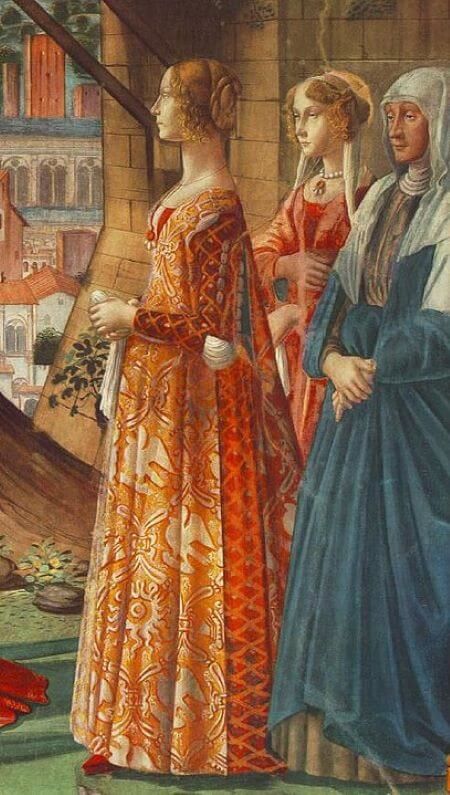
The most common woman’s garment was the kirtle, a snug-fitted ankle-length garment that was worn by all social classes over a long-sleeved linen chemise. The sleeves could be short or long and were sometimes detachable. This style was also sometimes called a cotehardie but the fashion began to fade in favor of the houppelande, which was popular to the middle of the century. [3] The Burgundian gown was also a popular style of dress with a V-shaped neckline that displayed the kirtle worn beneath, long sleeves, and a full skirt.
Italy developed its own styles such as the sleeveless overdress known as the cioppa, a lightweight underdress called a cotta and a sideless overdress known as a giornea. [4] The Spanish developed the verdugada, a gown with a bell-shaped hoop skirt stiffened by reed. This was the beginning of the Spanish farthingale, which would have a big impact on fashion going into the Renaissance.
Women’s hats during this time period were crazy. They include the fairy-tale famous hennin, a cone that extended from the back of the head often ending in or was covered by a veil. There were several versions of the hennin, some with two shorter horns. [5] This style is worn by Madame Vivienne in Dragon Age: Inquisition although she has disposed of the veil. Other styles used various padded or wired shapes covered by veils. In warmer countries, such as Italy, it was acceptable for even married women to wear their hair only covered by a sheer veil or cap. {6}

Footwear
Footwear consisted of laced ankle boots but later into the century, poulaines became popular. They sported long toes that could reach ridiculous lengths. To protect their shoes from dirt and mud, middle- and upper-class ladies would wear pattens, which are similar to wooden platform sandals.
I hope this was helpful. Let me know if you have any questions or suggestions by using the Contact Me form on my website or writing a comment. I post every Friday and would be grateful if you would share my content.
If you want my blog delivered straight to your inbox every month along with exclusive content and giveaways please sign up for my email list here.
Let’s get writing!
Copyright © 2021 Rebecca Shedd. All rights reserved.
 [1] Wilson, Elizabeth (1985). Adorned in Dreams. New York, NY: I.B. Tauris. https://en.wikipedia.org/wiki/1400%E2%80%931500_in_European_fashion#cite_ref-2
 [2] Laver, Concise History of Costume and Fashion. https://en.wikipedia.org/wiki/Houppelande#cite_ref-1
 [3] Laver, Concise History of Costume and Fashion. https://en.wikipedia.org/wiki/1400%E2%80%931500_in_European_fashion#cite_ref-Laver_33-1
 [4] Payne, Blanche: History of Costume from the Ancient Egyptians to the Twentieth Century, Harper & Row, 1965.
 [5] https://en.wikipedia.org/wiki/Hennin
 [6] Payne, Blanche: History of Costume from the Ancient Egyptians to the Twentieth Century, Harper & Row, 1965.
The Writer’s Guide to 12th Century Fashion
Posted on February 5, 2021 49 Comments
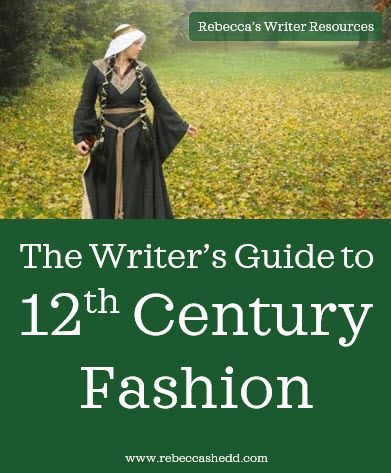
People seem fascinated by the European Middle Ages and it is a popular period for fantasy authors to draw upon. Part of that fascination rests on the clothing, the image of ladies in elegant flowing gowns with long sleeves, of knights in dashing doublets. However, the Middle Ages is a massive chunk of history, spanning from the 5th to the 15th century. That’s a thousand years of fashion! Plus, there was a lot of variations in style across regions. Today I’m going to be focusing on the 12th century and giving you the basics of men’s and women’s clothing during this century.
12th Century Fashion
When most people think of medieval European fashion what they often picture, usually without knowing it, is the 12th century. Long flowing garments with wide bell-shaped sleeves were in fashion for both men and women. Most of the fashions of the previous centuries had been loose-fitting and comprised mainly of square or rectangular shapes to prevent fabric wastage. However, with the growing use of lacing, clothing became more fitted through the waist, starting first with the upper classes.
The bliaut (pronounced bliːˌoʊ) was a French fashion with variations for men and women. It was characterized by sleeves that were fitted to the elbow then flared into a bell or trumpet shape, a skirt that flared at the hips, and was moderate to tightly fitted through the torso depending on the time period. It was common for the edges to have a decorative pattern called dagging. The bliaut was popular from the 11th to the 13th century. [1]
Men’s Fashion
Generally, men wore a knee or ankle-length tunic over a long-sleeved linen shirt and tailored leggings called chausses or hose. It was common for linen drawers or underwear known braies to be worn. Younger men usually wore knee-length tunics while older men opted for the more austere ankle-length. The legs of the hose were not attached in the middle and it was fashionable to have a different color for each leg. The hose was held up by being attached to the braies.
A shorter fitted garment that became known as the doublet was just coming into fashion during this century and was usually worn under the tunic. The style would change and remain popular into the mid-17th century. [2]
Hoods worn various ways were the most popular headwear (think of most depictions of Robin Hood). Some of them had long tails called a liripipe or short capes that covered the shoulders.
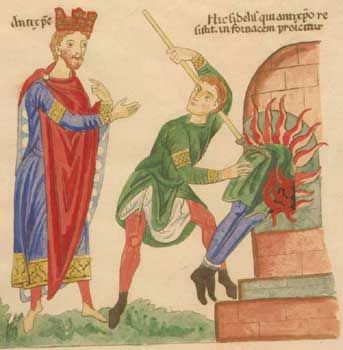
Women’s Fashion
Women generally wore tunics reaching the ankle or the floor over a linen chemise, chainse, or smock. A loose-fitting tunic was known in the French court as a cotte (pronounced coat). The tightly fitted bliaut was also popular and could have lacing in the front, sides, or back. The style was sometimes worn with a long belt or cinture that wrapped twice around the waist and knotted over the abdomen. Some examples end in decorative tassels or metal tags. A mid-century variation was the bliaut gironé, which had a pleated skirt attached at a waist seam. [3] Here is a fantastic “getting dressed” video by one of my favorite YouTubers, Prior Attire, showing the different layers worn by a 12th century woman.
Married women covered their hair with a veil although it was common for their long braids to hang out from underneath. The braids were frequently wrapped in ribbon and sometimes extended with purchased hair. Late in the century, the wimple was introduced and was fastened to the head under the veil and covered the neck. [4] The veil was pinned to two strips or bands of fabric that encircled the head. Contrary to popular belief, the veil was not held on by a circlet, although such jewelry was worn over them. With the veil securely pinned to the bands no other attachment method was needed.

A 12th century woman’s bliaut. Photo source. 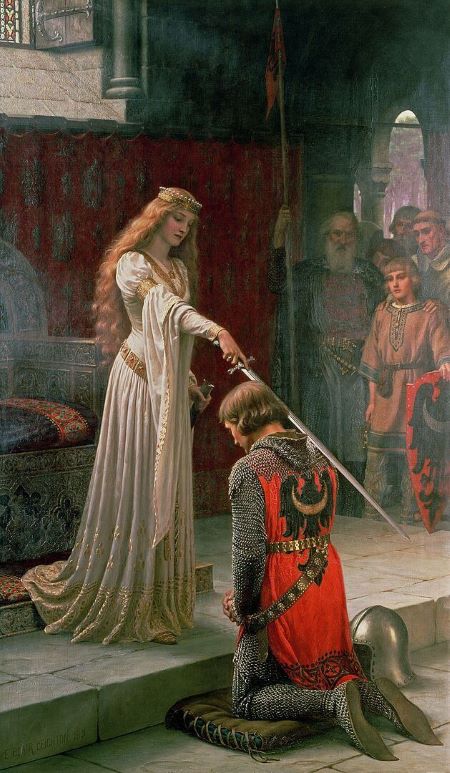
The Victorian idea of the bliaut.
The Accolade by Edmund Blair Leighton. Photo source.
I hope this was helpful. Let me know if you have any questions or suggestions by using the Contact Me form on my website or writing a comment. I post every Friday and would be grateful if you would share my content.
If you want my blog delivered straight to your inbox every month along with exclusive content and giveaways please sign up for my email list here.
Let’s get writing!
Copyright © 2021 Rebecca Shedd. All rights reserved.
 [1] https://en.wikipedia.org/wiki/Bliaut. https://en.wikipedia.org/wiki/1100%E2%80%931200_in_European_fashion
 [2] Boucher, François: 20,000 Years of Fashion, Harry Abrams, 1966, pp. 164–172.
 [3] Snyder, Janet, "From Content to Form: Court Clothing in Mid-Twelfth-Century Northern French Sculpture", in Désirée Koslin and Janet E. Snyder, eds.: Encountering Medieval Textiles and Dress: Objects, texts, and Images, Macmillan, 2002, ISBN 0-312-29377-1, pp. 85–101.
 [4] Payne, Blanche: History of Costume from the Ancient Egyptians to the Twentieth Century, pp. 159–168.
The Writer’s Guide to Historical Fabrics
Posted on January 29, 2021 6 Comments

As a writer, clothing holds so much possibility. What a character is wearing can tell your readers a lot about them from their social status to the care and attention they give to their personal appearance to where in your world they are from. Being accurate is important if you are writing historical fiction, especially if it involves dressing or undressing, such as in a romance novel. However, having a basic understanding of historical clothing can come in handy for the fantasy writer as well to use as inspiration for worldbuilding.
Today I will be covering some basics and over the next few weeks will be taking a close-up look at medieval, Renaissance and 18th and 19th century clothing.
As always, magic is the exception to the rules. Because magic.
Common Fabrics
If you are sticking with real-world fabrics instead of worldbuilding your own, here are some important things to keep in mind. Fabric varied in cost and availability depending on location and historical period. Also, there were varying levels of quality with each type, from fine to course. Some fabrics were expensive during certain time periods only to become cheap and common during others. Also, due to industrial manufacture crowding out hand production, there are types of fabrics that are no longer available.
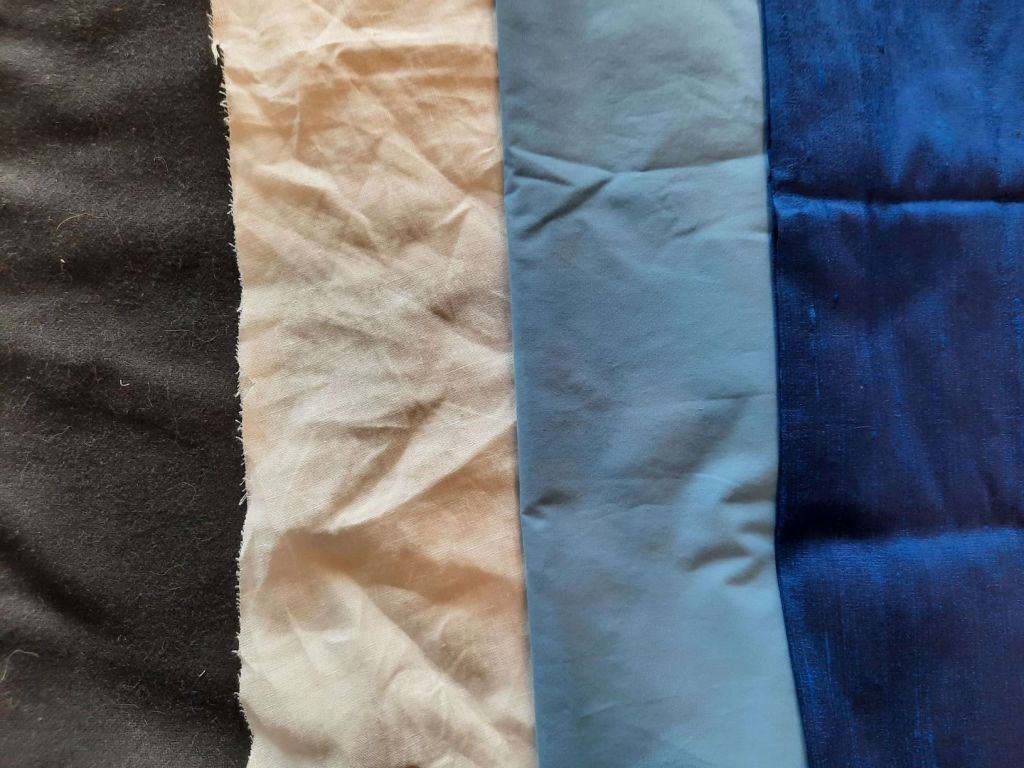
Wool – Made from the hair of sheep, wool has been a common and widely used fabric throughout history, prized for its warmth. The earliest woven woolen garments come from Iran and date back to 4,000-3,000 BC. [1] Historically, there have been several grades of wool from finely woven stuff from selectively bred sheep to course fabric produced by the peasant class from their own livestock. The wool trade stretched from Europe to Asia and was widespread and lucrative up until synthetic fibers were introduced in the mid-20th century.
Linen – Woven from the fibers of the flax plant, linen was an incredibility common fabric especially favored for any layer that touched the skin. The flax plant is native to Europe, North Africa, and the Middle East. Linen is exceptionally breathable, a big benefit in hot and humid climates. It can be woven incredibly fine, almost transparent. It also wicks moisture away from the skin and releases it, which means it doesn’t stick to you like cotton does. Linen was used heavily by all social classes in Europe and the Middle East for centuries and was also popular because it stood up to frequent and vigorous washing.
Cotton – A fabric made from the fluffy fiber around the seeds of the cotton plant. The plant is native to the Americas, Africa, Egypt, and India. [2] Fragments of cotton fabric have been found in the Indus Valley dating to the fifth millennium B.C. and in Peru dating to 6,000 B.C. Cotton fabric was common in the regions where it is native for most of history. The first Europeans to encounter the fiber were the Greeks led by Alexander the Great. Cotton was slowly introduced to Europe, beginning as a luxurious and expensive commodity. Over the centuries, it became cheaper and more common until becoming the unexpensive ordinary fabric we know today.
Silk – Made from the fibers of the silkworm’s cocoon, silk has always enjoyed a spot as a valued and expensive fabric. The Chinese developed the method of collecting the fibers and weaving them into fabric, a secret they closely guarded for centuries. The earliest example of silk fabric dates to 3,630 B.C. and was found in Qingtaicun near Xingyang, Henan. [3] India also has a long history of silk production and the country is the largest consumer of silk today. [4] The Roman Empire had a thriving silk trade and beginning in the 12th century, Italy became the primary supplier of silk to all of Europe. [5]
Linsey-Woolsey – A fabric made by combining linen and wool fibers. Although it has existed from ancient times, the fabric was most common in 18th century colonial America due to a scarcity of wool. [6]
Clothing and Social Class
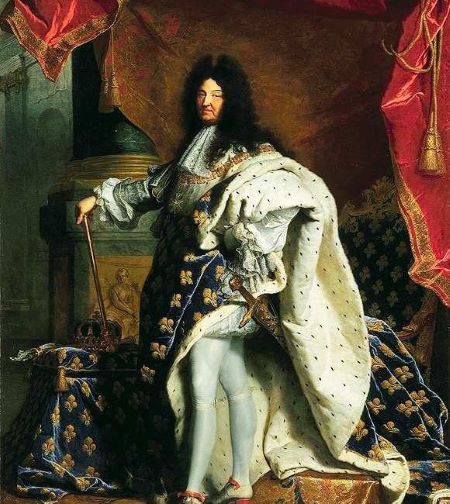
Throughout history, it has been common to be able to tell a person’s social standing and wealth by their clothing. The two biggest indicators are the cost of the fabric and whether the style follows the latest fashion trends. However, there have also been laws limiting people’s ability to wear certain styles, colors, or materials. For example, ermine became associated with royalty and several countries throughout the centuries passed laws forbidding anyone not of the royal family to wear it.
Sumptuary laws have been enacted throughout history in various parts of the world such as ancient Greece and Rome, Japan under the shoguns, China, and Europe during the Middle Ages and the Renaissance. They laid out rules on what a person could or could not wear based on their social status, including fabric, embroidery, and colors. Some of them could be incredibly picky, dictating the size of sleeves or whether you could wear lace. Most of these laws could be sidestepped by paying a fee although they were often widely ignored.
I hope this was helpful. Let me know if you have any questions or suggestions by using the Contact Me form on my website or writing a comment. I post every Friday and would be grateful if you would share my content.
If you want my blog delivered straight to your inbox every month along with exclusive content and giveaways please sign up for my email list here.
Let’s get writing!
Copyright © 2021 Rebecca Shedd. All rights reserved.
 [1] Smith, Barbara; Kennedy, Gerald; Aseltine, Mark (1997). Beginning Shepherd's Manual, Second Edition. Ames, IA: Iowa State University Press. ISBN 0-8138-2799-X. https://en.wikipedia.org/wiki/Wool#cite_ref-19
 [2] The Biology of Gossypium hirsutum L. and Gossypium barbadense L. (cotton). ogtr.gov.au. https://en.wikipedia.org/wiki/Cotton#cite_ref-1
 [3] Vainker, Shelagh (2004). Chinese Silk: A Cultural History. Rutgers University Press. pp. 20, 17. ISBN 978-0813534466. https://en.wikipedia.org/wiki/Silk#cite_ref-silkculture_12-1
 [4] https://en.wikipedia.org/wiki/Silk#India
 [5] "Italy – Calabria, Catanzaro". Office of Tourism. Archived from the original on 21 August 2015. https://en.wikipedia.org/wiki/Silk#cite_ref-35
 [6] Baumgarten, Linda: What Clothes Reveal: The Language of Clothing in Colonial and Federal America, Yale University Press, 2002. ISBN 0-300-09580-5, page 96. https://en.wikipedia.org/wiki/Linsey-woolsey#cite_ref-B96_2-1
The Writer’s Guide to Horse Myths: Part 3
Posted on January 22, 2021 45 Comments
This is my third and final installment on misinformation about horses. After this, I will be moving on to historical clothing.
As always, magic is the exception to the rules. Because magic.
Training for Battle
Horses are naturally flighty, easily startled animals. After all, in the wild, they are in almost constant danger from predators. A horse’s natural reaction to any scary situation is to spook and run away. When humans started using horses in battle, they had to train this flight reaction out of them. It’s similar to a human who trains themselves not to freeze in a dangerous situation through martial arts or other combat instruction. A critical part of normal training for a horse is to trust the rider and every horse must be desensitized to one extent or another. For some, it’s learning to not be afraid of the hose; for others, like police horses, it’s learning not to shy at gunshots, explosions or screaming people. Here is an interesting video about training police horses.

Horse Emotions
Horses experience a wide variety of emotions from joy to trauma to grief. They bond with horses, people, and other animals. They will put themselves in danger to save the ones they love.
A friend of mine told me a story of having to put a horse down. They led him from the corral to the barn and as my friend was walking back afterward, passed the horse in the next pen. The horse looked at him, look toward the barn and nickered. My friend said, “I’m sorry. He’s gone.” The horse let out a loud whinny and charged for the gate, calling for his friend. Then he turned and walked back slowly, his head held low.
Becoming a Good Rider
Becoming a competent rider takes time and training. Most people cannot mount a horse for the first time and be good riders. Yes, you can be told the basics of steering and getting the horse to move in a few minutes and probably do well enough at slow speeds but you are probably going to be in trouble trying to do anything more advanced like jumping or mounted combat. Another detail to keep in mind is that riding uses muscles that normally don’t get a lot of exercise so even if an amateur rider is fit, they are probably going to be in a world of hurt after a few hours.
Writer’s Tip: I would love to see a scene in a book showing the struggles of a first-time rider.

Breaking a Horse
Breaking a horse to saddle also takes time. If the horse has had little to no contact with humans it will take weeks to months before the trainer can even touch the horse. Once the horse is used to being touched and groomed, then they must become accustomed to the tack being put on them then weight put in the saddle. Generally, it’s not recommended to ride horses before the age of 2-4 because their skeletal and muscular structures are still maturing and too much weight could hurt them.
There are people who claim to be able to break a horse to saddle in a day or a week but usually most of their methods are abusive and involve terrorizing the horse into compliance. These methods are sometimes called rough breaking.
I hope this was helpful. Let me know if you have any questions or suggestions by using the Contact Me form on my website or writing a comment. I post every Friday and would be grateful if you would share my content.
If you want my blog delivered straight to your inbox every month along with exclusive content and giveaways please sign up for my email list here.
Let’s get writing!
Copyright © 2021 Rebecca Shedd. All rights reserved.
The Writer’s Guide to Horse Myths: Part 2
Posted on January 15, 2021 1 Comment
Today we are busting more horse myths. This is misinformation I see repeated by well-meaning authors who unfortunately don’t know they are spreading untruths.
As always, magic is the exception to the rules. Because magic.
Sleeping Standing Up
A horse can enter certain phases such as light sleep while standing but to go into deep sleep and REM (rapid eye movement) the horse must lie down. If the horse is standing when it enters these phases of sleep it would probably fall over due to the muscle relaxation. An adult horse needs a minimum of thirty minutes of deep and REM sleep to avoid sleep deprivation. [1] Foals spend a lot more time napping, up to half the day when they are less than three months old. [2] Usually horses will sleep only when they feel safe and often with one of their herd mates acting as a lookout.
Neglecting Grooming
Unfortunately, I have read several books where the protagonist rides all day, makes camp at night, and completely ignores her horse except to maybe take the saddle off. Grooming is important to a horse’s health because it removes dirt and sweat from its coat and gives the rider the opportunity to check for any injuries. One of the most important grooming tasks is cleaning the hooves. The sole of a horse’s foot has two grooves. Rocks and other debris can get caught in them and if not removed can cause the horse to go lame. Cleaning the hooves is also a good time to make sure the horseshoes are not coming loose.

Not Warming Up or Cooling Down
Just like it is important for you to warm up and cool down as part of a workout, it is critical for horses. When starting a ride, the horse should be walked or slowly trotted until its muscles warm up before attempting faster paces. The same should be done at the end of a ride to prevent the muscles from cramping up. Yet I see several books, shows and movies with riders mounting and galloping off or galloping up and immediately hitching their horse.
Not Tying Up
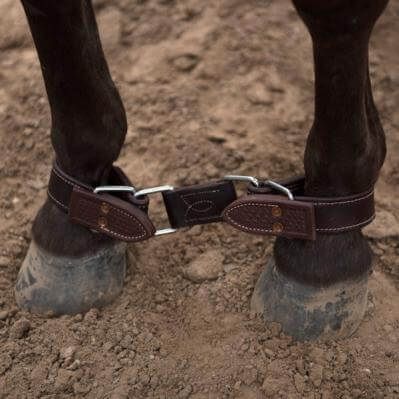
Speaking of hitching or tying up your horse, I’m amazed how many times I’ve seen the hero dismount and walk away, leaving his horse loose. It’s not like parking a car because your car won’t wander off. If you want your horse to be there when you get back it’s important to either hitch or hobble them. Hobbling involves connecting the horse’s front legs with a short piece of rope or leather. The horse can take small steps comfortably but can’t go very far.
Riding Without a Saddle
In a pinch, you can ride without a saddle but it does have some drawbacks. First, it’s not very comfortable. You are straddling the horse’s spine with the bony withers right in front of you. Second, without stirrups to help you stay in place you must use a lot more leg which becomes tiring after a while and starts to chafe.
I hope this was helpful. Let me know if you have any questions or suggestions by using the Contact Me form on my website or writing a comment. I post every Friday and would be grateful if you would share my content.
If you want my blog delivered straight to your inbox every month along with exclusive content and giveaways please sign up for my email list here.
Let’s get writing!
Copyright © 2021 Rebecca Shedd. All rights reserved.
 [1] https://ker.com/equinews/sleep-requirements-horses/
 [2] https://www.thesprucepets.com/learn-how-all-horses-sleep-1887328
The Writer’s Guide to Horse Myths: Part 1
Posted on January 8, 2021 4 Comments
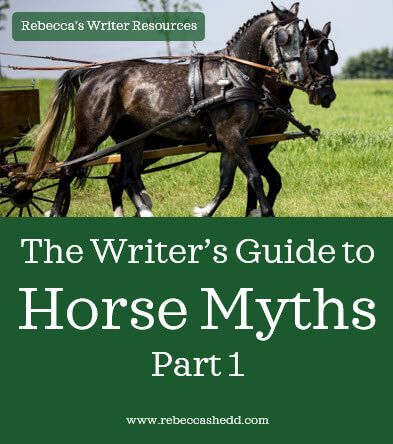
Today we are busting some of the most common horse myths that are repeated over and over in books, tv shows, and movies.
As always, magic is the exception to the rules. Because magic.
Noises
It seems that almost every movie or tv show I watch that has horses in it, the sound artist has a bizarre obsession with adding horse noises. Horses in these productions are constantly whinnying, whickering, screaming, and snorting. Most of the time they will add these sounds and the horse’s mouth won’t even be moving!
If you spend any time around horses you will quickly noticed that they are not noisy animals. In fact, they make few sounds at all and not with the level of frequency that movies and tv depict. The reason for this is because they are prey animals.
Here are some of the noises a horse will make:
Whinny – A loud noise that is usually used to communicate across distances. It is also common for horses to whinny when they know food is coming.
Nicker – A soft low-pitched sound that is usually a sign of affection.
Snort – Self-explanatory. Horses will snort when they see something that scares them.
Squeal – Usually a sound of frustration, like when another horse gets too close.
Blowing – When a horse blows out of its mouth or nose.
Screaming
Yes, I am covering horse screaming separately. There are so many books I have read that talk about horses screaming. While there are equestrians who will claim that horses don’t actually scream, I think that’s due to how rarely it happens. Horses will suffer horrific injuries and pain without a sound because noises of suffering draw in predators. However, we have soldier’s writings from World War I, the last major conflict to use horses, describing animals with horrific injuries screaming in pain such as this account by Lieutenant Dennis Wheatley. The British Army lost half a million horses in the war.
Cutting the Traces
I have read so many books in which a character has been riding in a carriage, needs to make a quick getaway, and cuts the traces of one of the carriage horses to ride off. It makes me cringe every time and makes it painfully obvious that the writer knows little about horse harness.
Let’s start with the basics. The traces, also known as tugs, are what connect the horse to the vehicle or load it is pulling. For light loads such as a cart the traces extend from a breastband. For heavier loads, a collar is used and the traces are attached to two metal pieces known as hams that are buckled over the collar. Most traces are between 3-5 inches wide (7.6-12.7 cms) and between ¼ to ½ inch (0.64-1.27 cms) thick.
There are two main ways the traces are connected to the vehicle. One way is to have slit or hole in the end of the traces that is slipped over a hook. The second is to have a length of chain at the end of the traces that is attached with a snap. There are also additional straps that connect the breech strap, which runs around the horse’s rump, to the vehicle, preventing it from bumping into the horse if it stops suddenly.
It would be hard and time-consuming to cut through the traces with something like a knife. It’s possible to use a sword as long as the shafts of a cart aren’t in the way. However, it makes no sense to cut through two traces when you can simply unhook them and unbuckle the breech straps.

Girths
Just like cutting traces, cutting girths doesn’t make a lot of sense either. Most girths are roughly 4 inches (10 cms) wide and up to 1 inch thick (2.5 cms) due to the padding. Obviously, this would take a while to cut through. It would be a lot easier and faster to simply unbuckle it. Western cinches are usually wider but not as thick but the same issues still apply. Again, it would be easier to undo the cinch strap.
Another misconception I see is that a girth can be sabotaged by partially cutting it. The first problem is that most girths are heavily reinforced and it would take significant damage for it to fail under stress. Another problem is that most riders or grooms saddling a horse are checking every piece for damage or weakened leather.
In Brandon Sanderson’s “The Way of Kings,” a character bunches up a girth and tucks it in his pocket. Due to the size, it is very unlikely this could be possible. It would however be plausible if it was a cinch strap, the strap that connects the cinch to the saddle, since it is a thinner strap than the cinch itself.

I hope this was helpful. Let me know if you have any questions or suggestions by using the Contact Me form on my website or writing a comment. I post every Friday and would be grateful if you would share my content.
If you want my blog delivered straight to your inbox every month along with exclusive content and giveaways please sign up for my email list.
Let’s get writing!
Copyright © 2021 Rebecca Shedd. All rights reserved.
The Writer’s Guide to Tack
Posted on January 1, 2021 5 Comments
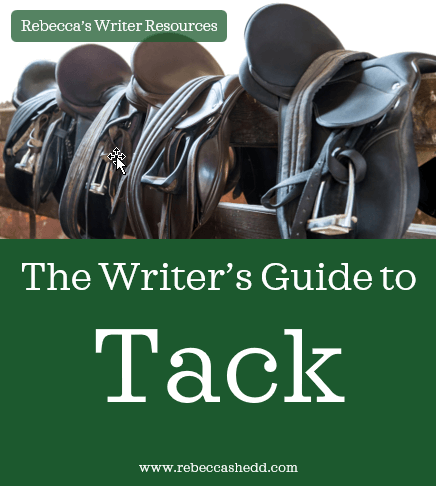
Of course, a critical part of riding a horse is the saddle, bridle, and other equipment, collectively known as tack. As with several the other topics we have covered, things have changed a bit since the Middle Ages. While modern tack is a descendant of medieval tack there are some distinct differences.
As always, magic is the exception to the rules. Because magic.
Parts of the Saddle
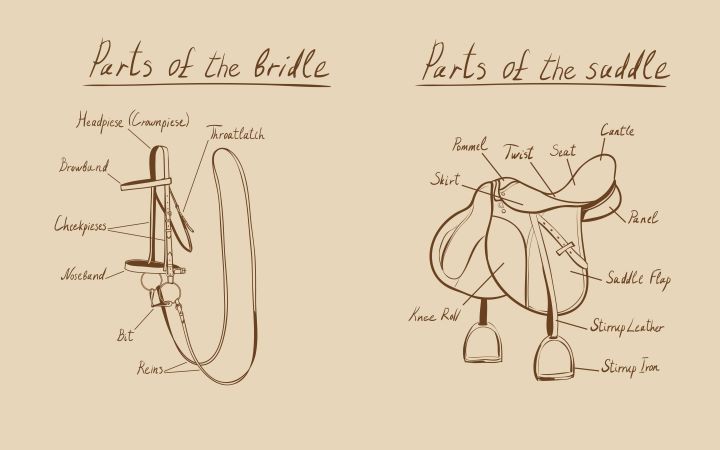
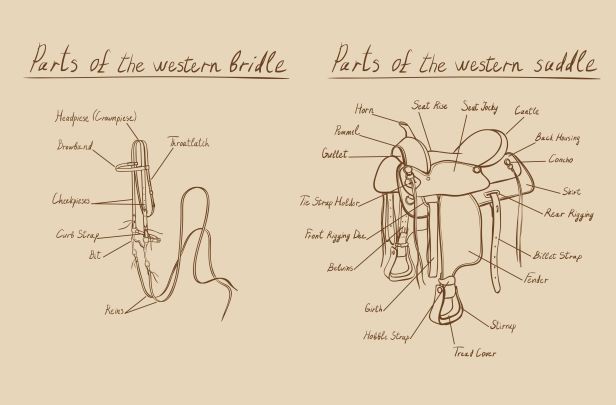
Just as with the names of the parts of the horse, there is unique lingo for describing the parts of a saddle and bridle. Please refer to the diagrams below.
Types of Saddles
Today most saddles fall into one of two categories: English and Western. There are differences in weight, shape, and purpose. The English saddle was primarily designed for jumping while the Western saddle was developed for ranch work. One important difference that I unfortunately see messed up frequently is the name of the strap that goes around the belly and holds the saddle on the horse. On an English saddle it is called a girth and attaches with two buckles on either side. On a Western saddle it is called a cinch that is attached either by a buckle or a cinch strap that wraps repeated through the ring of the cinch and a ring on the saddle.
There are some variations within these two categories such as dressage saddles that are usually put in the English saddle group but are shaped differently to encourage the rider to adopt the desired straight-legged upright posture. Outside of these categories there are several other styles including Australian stock saddles, Spanish saddles, racing saddles, and side saddles.
Medieval Saddles
However, medieval saddles looked quite different from our modern ones. The primary reason for this is because they were designed for warfare and keeping the rider as firmly in the saddle as possible. The front of a medieval saddle has a tall pommel, which offered protection to the rider. It also caused the rider’s legs to be quite straight, much more so than a modern English rider. The back or cantle was also tall and wrapped around the rider’s hips, helping to hold him in place.
However, just like today, there were other types of saddles for different uses. There were light saddles that were used when speed was needed, such as carrying messages and racing. [1]
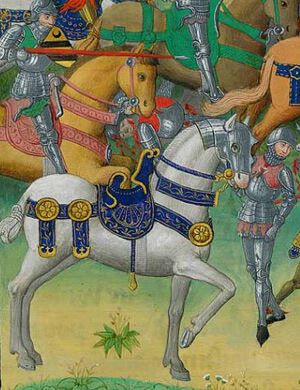
From the History of Alexander at the Bibliothèque Nationale de France. Photo source.
Side Saddles
For noble ladies in the Middle Ages, riding astride came to be seen as vulgar as well as impractical in long skirts. The earliest version of the side saddle was developed in the 14th century and is commonly credited to Anne of Bohemia. [2] The woman would sit sideways on the horse in a chair-like contraption with a footrest. However, since she was not very secure and the design made it difficult for her to control the horse herself, her horse would often led by a person on the ground or mounted astride another horse. This is why smooth-gaited and calm palfreys were popular for ladies.
In the 16th century, a better design was developed reportedly by Catherine d’Medici. This style had a pommel that the rider would hook her right leg over with a stirrup for the left foot. This design allowed the rider to face forward and have control of her horse although it was still not secure at high speeds. [3] However, some women still preferred to ride astride including Diane de Poiters, the mistress of Henry II of France, Marie Antoinette, and Catherine the Great of Russia. It wasn’t until the addition of a second pommel in the 1830’s that a side saddle rider was secure enough to gallop a horse and take tall jumps.
Here is a fantastic video that shows the differences between a modern and medieval saddle.
I hope this was helpful. Let me know if you have any questions or suggestions by using the Contact Me form on my website or writing a comment. I post every Friday and would be grateful if you would share my content.
If you want my blog delivered straight to your inbox every month along with exclusive content and giveaways please sign up for my email list.
Let’s get writing!
Copyright © 2021 Rebecca Shedd. All rights reserved.
 [1] https://en.wikipedia.org/wiki/Saddle
 [2} Strickland, Agnes (1841). Berengaria of Navarre. Anne of Bohemia. Lea & Blanchard. p. 309. anne bohemia sidesaddle.
 https://en.wikipedia.org/wiki/Sidesaddle#cite_ref-4
 [3] "Sidesaddle History". georgialadiesaside.com. Georgia Ladies Aside. Archived from the original on 2007-10-09.
 https://en.wikipedia.org/wiki/Sidesaddle#cite_ref-georgialadiesaside.com_1-1
The Writer’s Guide to Horse’s Paces, Speed & Range
Posted on December 18, 2020 4 Comments

I have unfortunately seen a lot of misinformation on how far and fast a horse can go. In some books and movies, horses can gallop all day with a break. In others, they can barely make it a mile without collapsing. We are going to be looking to real-world averages and records to make your book more realistic.
As always, magic is the exception to the rules. Because magic.
Paces or Gaits
All horses have four basic gaits.
The slowest is the walk, a four-beat pace in which each hoof hits the ground separately. The walk is comfortable for the rider and the horse can go at that pace pretty much forever.
The second gait is the trot, which is also known as the jog if you are riding Western. The horse’s left back leg and right front leg move forward together followed by the other pair. This pace is quite bouncy and uncomfortable. In English-style riding, the rider will post or sit up and down with the rhythm of the gait, allowing them to escape the discomfort. The jog is a slower version and the rider can usually sit comfortably during it. The trot is energy efficient and horses can cover miles at this gait.
The third is the canter, known in Western as the lope, and is a three-beat pace. It is a significantly faster gait with a rocking motion that is comfortable to sit. However, the horse can only keep it up for so long.
The fourth is the gallop, the fastest gait. This four-beat pace is decently comfortable to ride but horses can only maintain it for limited amounts of time, especially if they are sprinting.
If a horse is ridden at a canter or gallop for part or most of a day then it will need rest and will not be able to keep the same pace up the next day. This is why throughout history relays of horses have been used to continue traveling at speed. A rider would reach a remount station and switch to a fresh horse. Pony Express riders changed horses roughly every 25 miles (40 km), allowing them to routinely cover 80-100 miles (128-161 km) in a day. [6]
There are other artificial gaits that have been bred and trained into horses over the centuries including the running walk, slow gait, pace, fox trot, classic fino, and rack. [1]

How Fast Can a Horse Go?
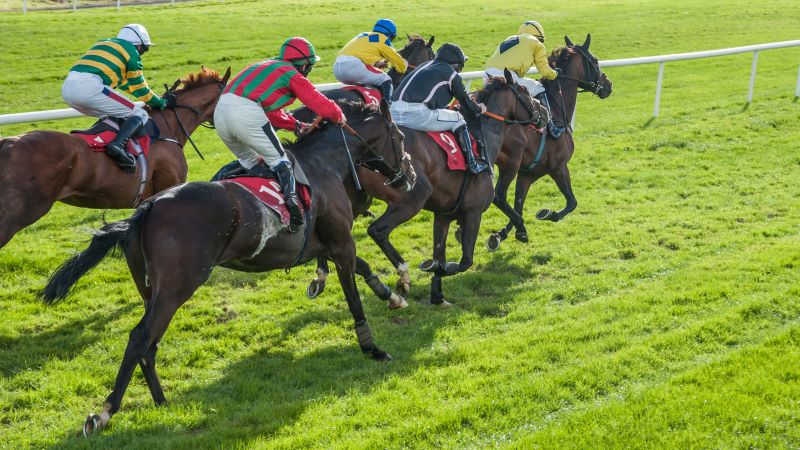
The fastest recorded speed for a horse is 55 miles per hour (88.5 km/hr). The record is held by the American Quarter Horse which excels at sprinting short distances but they can’t keep up that speed for longer than a quarter mile. [2] The Guinness world record for the fastest speed from the starting gate for a Thoroughbred is 43.97 miles per hour (77.6 km/hr) over two furlongs (0.25 mile or 0.4 km). [3] The average speed of a gallop is 25-30 miles per hour (40-48 km/hr). Modern Thoroughbred races are usually no longer than 1.5 miles (2.4 km) although in some countries such as those in the Middle East, races can be as long as 2.5 miles (4 km). [4]
How Far Can a Horse Go?
There is a modern sport called equestrian endurance in which horses and riders cover incredible distances. These endurance records give us a good idea of just how far and fast a horse can go. For example, in 2008, an Arab rider and his horse won the Sheikh Mohammed bin Rashid Al Maktoum Endurance Cup, setting a new record by completing the 99.4 mile (160 km) race in just under six and a half hours. [5] The thing to remember though is these horses are elite athletes and it is doubtful that the average horse could cover such distances so fast unless there is magic involved. In Robert Jordan’s “The Eye of the World” Moiraine uses her powers to take away the horses’ exhaustion although she still cautions they will have to rest them in the future.
An average horse can cover 20-30 miles (32-48 km) in a day without becoming exhausted. Pushing for more than that is detrimental to their health. A famous race held in 1892 that covered 350 miles (563 km) in 72 hours killed 13% of the horses entered. [6]
Writer’s Tip: I have read so many books in which the horses run full out for days on end. I want to see the realistic consequences of this catch up with the rider.
I hope this was helpful. Let me know if you have any questions or suggestions by using the Contact Me form on my website or writing a comment. I post every Friday and would be grateful if you would share my content.
If you want my blog delivered straight to your inbox every month along with exclusive content and giveaways please sign up for my email list.
Let’s get writing!
Copyright © 2020 Rebecca Shedd. All rights reserved.
 [1] https://www.myhorseuniversity.com/single-post/2017/09/25/Natural-and-Artificial-Gaits-of-the-Horse#:~:text=There%20are%20five%20natural%20gaits,Paint%20Horse%2C%20Appaloosa%2C%20etc.
 [2] https://en.wikipedia.org/wiki/Fastest_animals
 [3] "Fastest speed for a race horse". Guinness World Records. Retrieved 16 April 2015. https://en.wikipedia.org/wiki/List_of_leading_Thoroughbred_racehorses#cite_ref-3
 [4] https://en.wikipedia.org/wiki/Horse_gait
 [5] https://www.horsetalk.co.nz/news/2008/01/083.shtml#:~:text=An%20arab%20rider%20has%20bettered,six%20and%20a%20half%20hours.
 [6] https://www.zagoradeserthorse.com/general-information-about-horses/#:~:text=How%20Far%20Can%20a%20Horse,averaged%2031%20miles%20per%20day.
The Writer’s Guide to Types of Medieval Horses
Posted on December 11, 2020 6 Comments
People during the Middle Ages thought of horses differently than we do. Today horses are defined mainly by their breed, which indicates the common size, conformation, and types of work or sport they are best suited to. For example, if I am told a horse is a Thoroughbred, I expect it to be tall, leggy, athletic, and fast.
However, during the Middle Ages horses were usually characterized by their use and if a medieval equestrian were to look at our modern horses, they would probably start putting them into these categories.
Rouncey or Rounsey
An all-round general-purpose horse used for transport and war. Since they were not expensive, they were used by squires, men-at-arms, and poorer knights. At times they were used as pack horses but never as cart horses. [1] They were considered fast and agile. In 1327 in England, when a summons to war was sent out rounceys were specifically requested for swift pursuit. [2]
Hobby
Yes, they are not just a children’s toy. Hobby horses were lightweight mounts that were popular for skirmishing and often ridden by light cavalry known as Hobelars. They were developed in Ireland from Spanish or Barb stock and were used by both sides during the Wars of Scottish Independence. During the war, Edward I of England tried to prevent exports of the horses from Ireland to Scotland. Robert the Bruce used them for his guerilla warfare and mounted raids, covering up to 60-70 miles (97-113 km) in a day! [3]
Palfrey
A palfrey was a better-quality mount than a rouncey or a hobby horse, usually taller and finer-boned. A well-bred one could cost as much as a destrier. They were fashionable for riding and hunting with wealthier knights and nobles, especially since their ambling gait allowed them to smoothly cover long distances in relative comfort. [4] Palfreys were a popular choice for ladies because of their calm and dependable temperaments. [5]

Mai, Breviarium Grimani by Gerard Horenbout. Photo source.
Jennet
Another type of riding horse commonly used by ladies, but usually not as nice as a palfrey. They were bred in Spain from Arabian and Barb stock. [6]
Charger
Chargers, also known as coursers, were strong, fast, and light. [7] They were preferred for hunting and battle. [8] They were an economy option, quality but not top of the line.
Destrier
The destrier was the most valued medieval horse type and were renowned for their capabilities in warfare and the joust. They were well trained, tall, majestic, and strong and were always stallions because of their extra musculature and aggressiveness. They are referred to as “great horses” in contemporary sources. They were highly desired and prized by wealthy knights and the nobility although they were not common due to their cost. [9] The modern breeds that come the closest to the medieval destrier are Friesians and Andalusians. They were usually trained in special combat maneuvers such as the capriole, in which the horse leaps off the ground and kicks out with its back legs. Here is video of the horses and riders of the Spanish Riding School in Vienna performing some of these advanced maneuvers.
Writer’s Tip: I would love to read a book with a destrier using his combat training in a battle scene.

La batalla de San Romano by Paolo Uccello. Photo source.
Draft Horses
Draft horses, also known as affers and stotts in medieval English records, were used for plowing and pulling heavy loads because of their size and strength. Basically, they were the tractors and semi-trucks of their day. They were faster and more efficient than oxen, especially with the advent of the horse collar and horseshoes. Their common use in agriculture and heavy transport continued until the tractor and automobile began to replace them. [10]
Work Horses
A variety of working horses existed during the Middle Ages including cart horses, pack horses (also known as sumpters), and common riding horses such as hackneys, which could be used as pack horses. Generally, these horses were smaller than drafts, about 13-14 hands (52-56 in, 132-142 cms) but could pull weights up to 600 pounds (270 kg). [11]
This is a good video to show you the modern equivalent to these medieval types of horses.
I hope this was helpful. Let me know if you have any questions or suggestions by using the Contact Me form on my website or writing a comment. I post every Friday and would be grateful if you would share my content.
If you want my blog delivered straight to your inbox every month along with exclusive content and giveaways please sign up for my email list.
Let’s get writing!
Copyright © 2020 Rebecca Shedd. All rights reserved.
 [1] Hyland (1998), p. 222. https://en.wikipedia.org/wiki/Horses_in_the_Middle_Ages#cite_ref-22
 [2] Prestwich, p. 318. https://en.wikipedia.org/wiki/Horses_in_the_Middle_Ages#cite_ref-21
 [3] Hyland (1998), pp. 32, 14, 37. https://en.wikipedia.org/wiki/Horses_in_the_Middle_Ages#cite_ref-24
 [4] Bennett (1998). https://en.wikipedia.org/wiki/Horses_in_the_Middle_Ages#cite_ref-Bennett_(1998)_4-1
 [5] Oakeshott (1998), p. 14. https://en.wikipedia.org/wiki/Horses_in_the_Middle_Ages#cite_ref-Oakeshott14_23-1
 [6] Bennett, Deb (2004) "The Spanish Mustang: The Origin and Relationships of the Mustang, Barb, and Arabian Horse" Archived 6 May 2008 at the Wayback Machine. Frank Hopkins. Retrieved 2008-08-14.
 [7] Oakeshott (1998), p. 11. https://en.wikipedia.org/wiki/Horses_in_the_Middle_Ages#cite_ref-Oakeshott11_17-2
 [8] Hyland (1998), p. 221. https://en.wikipedia.org/wiki/Horses_in_the_Middle_Ages#cite_ref-19
 [9] Prestwich, p. 30. Gravett, p. 59. Eustach Deschamps, 1360, quoted by Oakeshott (1998), p. 11. Oakeshott (1998), p. 11. https://en.wikipedia.org/wiki/Horses_in_the_Middle_Ages#cite_ref-Oakeshott11_17-1
 [10] Claridge, Jordan (June 2017). "The role of demesnes in the trade of agricultural horses in late medieval England" (PDF). Agricultural History Review. 65 (1): 5. Dyer Making a Living p. 129.
 [11] Clark, pp. 27-28
The Writer’s Guide to Horse Basics
Posted on December 4, 2020 11 Comments

Humans and horses have a long history together so it’s no wonder we include them so much in our stories. Even Brandon Sanderson put them in the Stormlight Archive when he included no other real world animals. Unfortunately, there is so much misinformation about them. I am going to be starting with the basics today.
As always, magic is the exception to the rules. Because magic.
Body Parts
I’m going to spend very little time on this. Please reference the diagram below for the names of specific body parts.

Colors & Markings
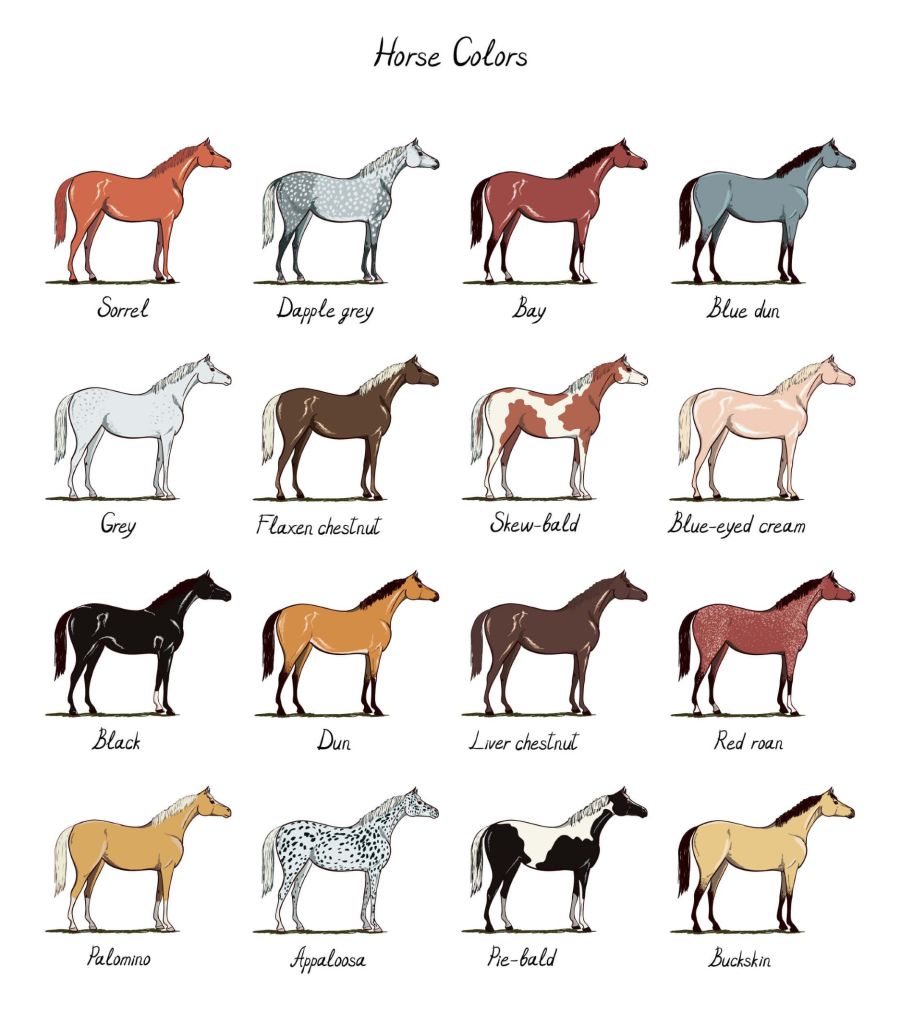
The names of horse colors have their own idiosyncrasies. Some of them make sense and others can be quite foreign. Since I’m familiar with them it always makes me winch when I see a horse given the wrong color name. No, Master Dennet from Dragon Age: Inquisition that Fereldan Forder is a bay not a chestnut.
Unless otherwise noted, the following colors would have brown eyes.
Black – Just what you’d expect.
Bay – A brown body with a black mane and tail and black legs.
Chestnut or Sorrel– A brown body with a matching brown mane and tail. This is the most common color among horses. A liver chestnut is a darker brown. A flaxen chestnut has a brown body with a tan or cream mane and tail.
Grey – This one is tricky. The color is judged by the color of the skin, not the hair. Obviously, a horse with a grey coat, mane and tail is a grey. However, one with a white coat, mane, and tail but with grey or black skin, which will be visible at the nose and around the eyes, is considered a grey. I know most of the time a horse with this coloring is called white but technically in the horse world white horses don’t exist. A fleabitten grey has a white coat with small grey or black dots. A dappled grey has a pattern of dark grey rings over a coat of lighter grey or white.
Albino – A horse with a genetic lack of pigment giving it a white coat, mane, and tail with pink skin. It’s also common for them to have blue or hazel eyes.
Cream or Cremello – A horse with a cream-colored body, mane, and tail and normally blue or light brown eyes. This color is caused by a dilution gene.
Dun – A tan or dark gold body with a black mane, tail, and legs. There are also red dun, black dun, blue dun, and bay dun depending on the genetics. The color commonly comes with a dark dorsal stripe and is the most primitive color according to prehistoric cave paintings.
Roan – A coat pattern with a mixing of colored and white hair. The mane, tail and lower legs are usually a solid color. There are multiple variations including red roan, blue roan, and strawberry roan.
Palomino – A light gold body with a white mane and tail.
Buckskin – A horse with a golden tan body and black mane, tail, and lower legs.
Pinto – A horse with large patches of white and another color. There are multiple variations such as piebald and skewbald.
Appaloosa – A breed as well as a color identified by their colorful spotted coats. The spotting can be over the whole animal or confined to a white patch.
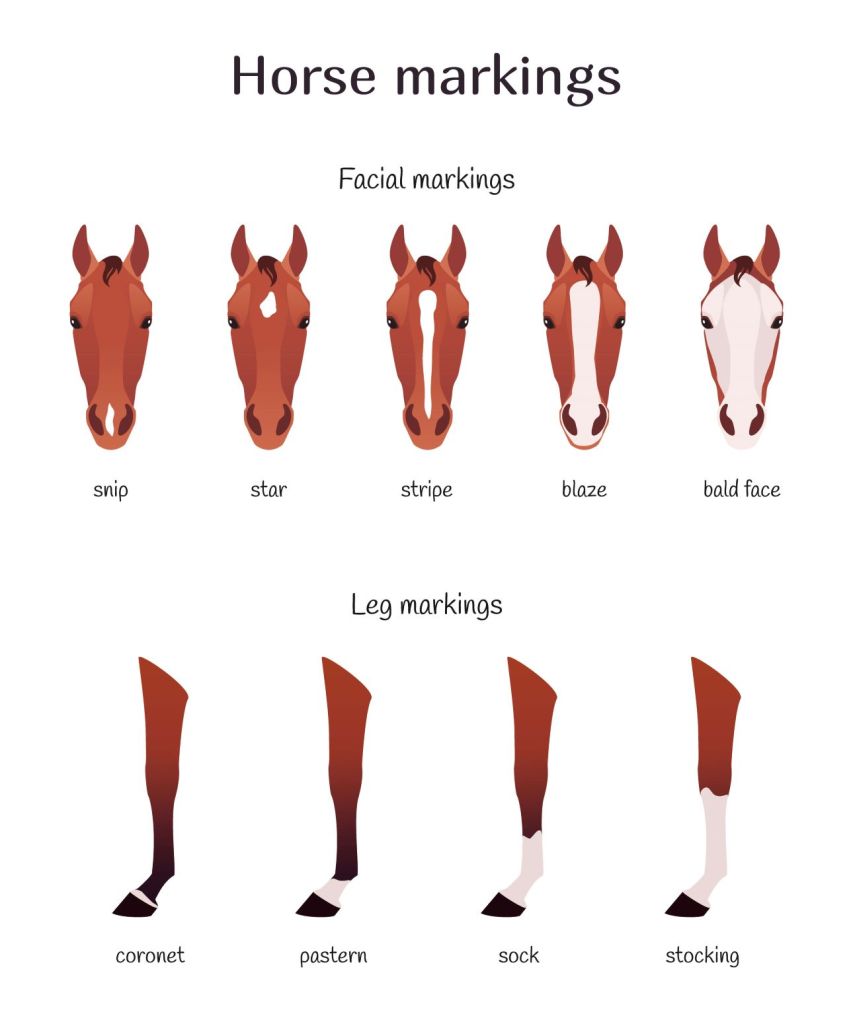
There are more colors than I listed above but I’ve covered the most common ones. The remainder are rarer. Horses also come with a variety of leg and face markings. Please reference the diagram below.
Genders
Stallion – An adult intact male horse.
Gelding – An adult nurtured or gelded male horse.
Mare – An adult female horse.
Foal – A baby horse of any gender under one year of age.
Colt – A male foal.
Filly – A female foal.
Yearling – A horse of either gender between the ages of one and two years old. After two, horses are referred to by their adult gender names.
Measuring Height
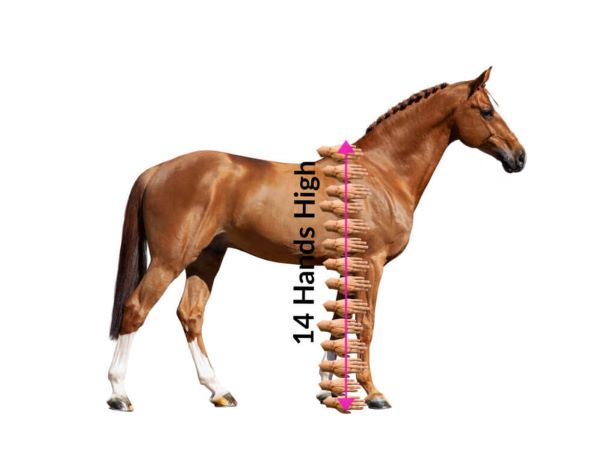
A height of a horse is measured from the ground, up the front leg to the withers, the bony bump where the neck meets the back. Horses are not measured to the top of the head. Traditionally, people used their flat palm, counting the number of “hands.” Today horses are still measured in hands, which has been standardized to four inches (10.16 cms).
A horse is 14.2 hands and taller while a pony is under 14.2 hands.
There has been debate about the size of medieval horses with some historians claiming them to be as tall as 18 hands. A review of literary, visual, and archaeological sources done by the Museum of London puts the average between 14-15 hands (56-60 in, 142-152 cms).
I hope this was helpful. Let me know if you have any questions or suggestions by using the Contact Me form on my website or writing a comment. I post every Friday and would be grateful if you would share my content.
If you want my blog delivered straight to your inbox every month along with exclusive content and giveaways please sign up for my email list.
Let’s get writing!
Copyright © 2020 Rebecca Shedd. All rights reserved.
 Rebecca Shedd - Author