The Writer’s Guide to Sailing Ships of the Ancient World

The history of the sailing ship is long and throughout it humans have developed many types of vessels. The builder’s needs and the advances in sailing technology achieved up to that point usually influenced the designs of sailing ships. This will not be an exhaustive list. There are too many types of sailing ships and variations on them to put in a single blog post. Today, I will start with the ships of the ancient world.
As always, magic is the exception to the rule. Because magic.
Austronesia & the South China Sea
The Austronesian vessels were the earliest ones to take to the open ocean between 3,000 to 1,500 BC. These people developed the catamaran and outrigger, most of which had crab claw sails. They used them to set up the first trade routes in the Indian Ocean, starting in at least 1500 BC and ranging from Japan to eastern Africa. [1] These sea routes were the precursor of the spice trade routes and were the maritime version of the Silk Road. [2]
The Austronesian design influenced the development of the Arab lateen sails and the kunlun bo or K’un-lun po (崑崙舶, lit. “ship of the Kunlun people”) of the Han Dynasty, which lasted from 206 BC to 220 AD.
The Mediterranean
The ancient Egyptians had single-masted, square-rigged vessels. Using both sails and oars, they navigated rivers and the Mediterranean Sea. We do not have a name for this type of vessel.
The Egyptians used squared-rigged vessels with a single mast but mainly kept to the rivers and the Mediterranean Sea. These vessels commonly used paddles or oars as well as sails. [3] The Minoans, the Phoenicians, the Greeks, and the Romans later used this style.
The Phoenicians, Assyrians, Greeks, and Romans used three types of galleys: bireme, trireme, and penteconter. They had both oars and sails and had reinforced bows for ramming. The bireme and trireme were mainly warships, and they used the penteconter for both war and trade. The names came from the rows of oars with biremes having two and triremes having three.
The polyreme was a type of heavy Roman warship like the bireme and trireme but with more rows of oars.

The Indian Ocean
India was trading with Mesopotamia using maritime routes as early as the 3rd millennium BCE but the first evidence of their use of sails is from 400-500 AD. [4] Most vessels involved in this trade route stayed in coastal waters, making cargo ships such as the dhow the most widely used. There were multiple routes between India and the Arabian peninsula, which meant that monopolies and blockades were more difficult.
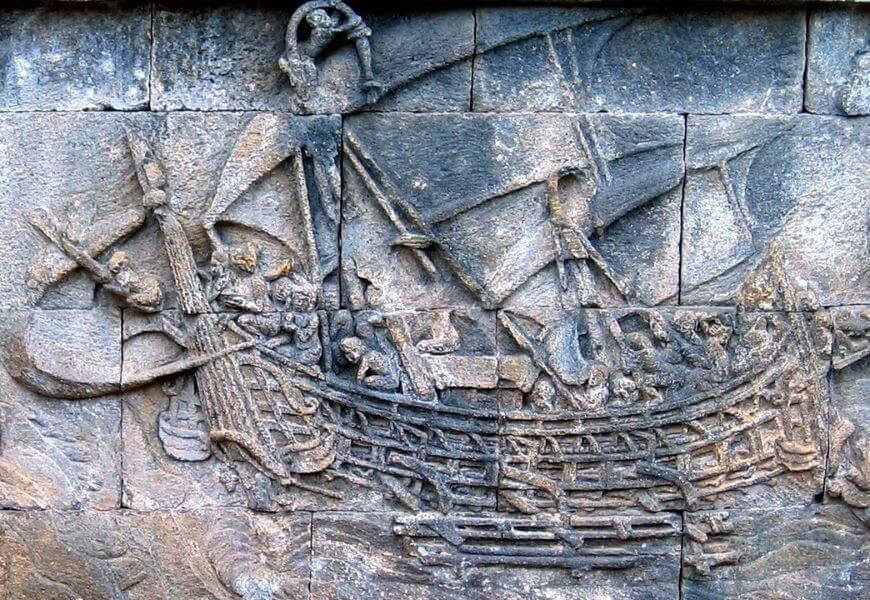
Several Indian kingdoms, such as Kalinga, used sailing ships as early as the 2nd century AD. Their use of the sail was likely developed from those of the Austronesian vessels. There are depictions of Javanese outriggers from the 8th century that were influenced the same way. [5]

The Atlantic Ocean
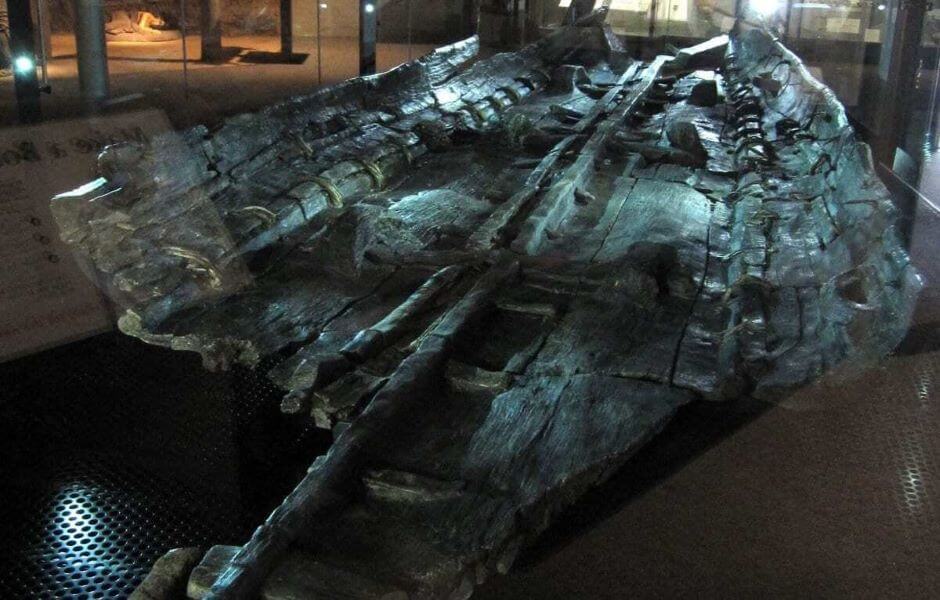
In 1996, a boat was unearthed in Dover, England. It was 9.5 m long x 2.1 m wide. Archeologists dated it to approximately 1600 B.C., possibly making it the oldest known seagoing boat. The boat builders made the hull of straight grained oak and used yew lashings. Between 4 to 16 paddlers propelled the boat. It was large enough to carry a significant amount of cargo and, with a strong crew, may have been able to travel 30 nautical miles in a day. [6]
The Vikings were well known for their longships, the first of which date back to between 500 and 300 B.C. [7] They were made of rounded cross-sections that were fastened with cord. These vessels were quick but had little carrying capacity. We have multiple examples of these ships because the Vikings used them in burials. Although originally designed for rivers, they were later used for long ocean voyages such as Leif Eric sends exploration of North America. They had both oars and sails for proportion.
China
The ships of ancient China were large, rectangular, barge like ships with multiple decks and cabins. The ships had ramparts and the ancient Chinese used them as floating fortresses. [8] They were commonly called ‘lou chuan’ or ‘castle ships.’ The first example of these ships is from the Spring and Autumn Period (722 BC–481 BC). This period also saw the introduction of the iconic junk, which would become the primary vessel of Chinese explorers.

I hope this was helpful. Let me know if you have questions or suggestions by using the Contact Me form on my website or by writing a comment. I post every Friday and would be grateful if you would share my content.
If you want my blog delivered straight to your inbox every month along with exclusive content and giveaways, please sign up for my email list here.
May you always find the right words.
Copyright © 2023 Rebecca Shedd. All rights reserved.
[1] Bellina, Bérénice (2014). "Southeast Asia and the Early Maritime Silk Road". In Guy, John (ed.). Lost Kingdoms of Early Southeast Asia: Hindu-Buddhist Sculpture 5th to 8th century. Yale University Press. pp. 22–25. ISBN 9781588395245.
[2] Bellina, Bérénice (2014). "Southeast Asia and the Early Maritime Silk Road". In Guy, John (ed.). Lost Kingdoms of Early Southeast Asia: Hindu-Buddhist Sculpture 5th to 8th century. Yale University Press. pp. 22–25. ISBN 9781588395245.
[3] From River to Sea: Evidence for Ancient Egyptian Seafaring Ships
[4] Pamulaparthy, Sweekar Bhushan. "Ancient Indian Ship". World History Encyclopedia. Retrieved 2022-12-06.
[5] Grice, Elizabeth (17 March 2004). "A strange kind of dream come true". The Telegraph. Archived from the original on 2022-01-12. Retrieved 3 November 2015.
[6] Canterbury Archaeological Trust: Buckland Anglo-Saxon Cemetery Archived May 9, 2008, at the Wayback Machine
[7] Pauline Asingh (2009). Grauballemanden. Gyldendal A/S. pp. 195–. ISBN 978-87-02-05688-4. Retrieved 2 July 2013.
[8] Needham, Volume 4, Part 3, 678–679
 Rebecca Shedd - Author

