The Writer’s Guide to Sailing Ships of the Age of Exploration
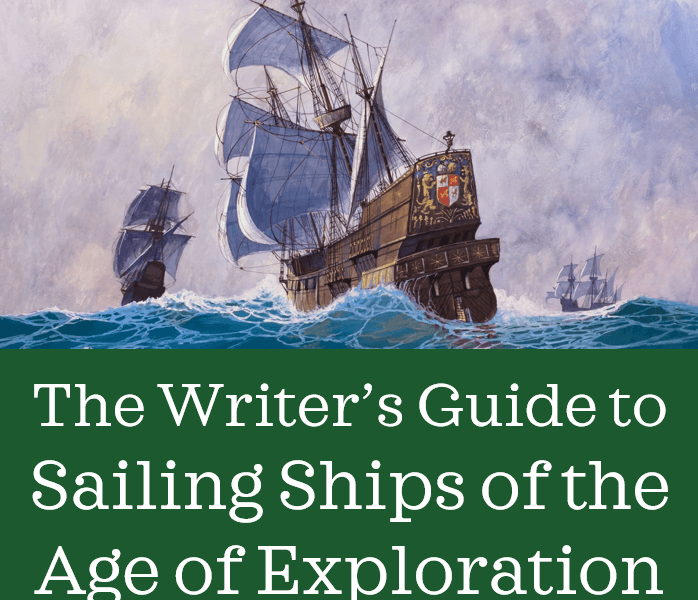
The Age of Exploration, also known as the Age of Discovery, was a time that saw a surge of explorers taking to the seas. From the 15th to 17th century, European explorers discovered and colonized multiple regions worldwide. This exploration would not have been possible without two technological advancements. The first was the magnetic compass, and the second was several styles of ships that could navigate the open seas far from land. Today I will cover the dominant style of ships from this time.
As always, magic is the exception to the rule. Because magic.
Carrack
The carrack is a type of three or four-masted sailing ship that was developed in Europe in the 14th century. It developed from the single-masted cog, which was used for trade in the Mediterranean and the Baltic. The carrack was larger, and its size made it stable in heavy seas and capable of carrying the provisions needed for long ocean voyages. This style of ship was developed and used, most notably in Portugal and Spain. The Portuguese carracks often had over 1,000 tons of displacement. [1] They were usually square-rigged on the foremast and mainmast with a lateen sail on the mizzenmast. They had a single cannon deck. One of the most famous carracks in history was the Santa Maria in which Christopher Columbus made his first voyage to the Americas in 1492.
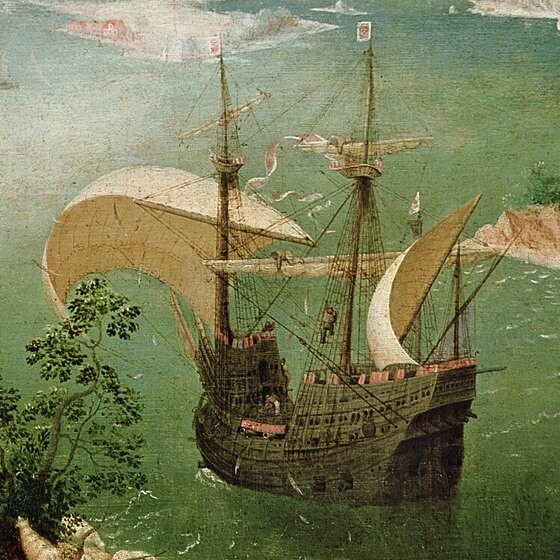
Caravel
The style originated in the 13th century along the coast of Galatia and Portugal. Similar Muslim craft used in the waters of the Iberian Peninsula may have influenced it. [2] The early caravels were only used in coastal waters and often only had a single mast with a lateen rig. Toward the end of the 15th century, the Portuguese developed a larger version of the caravan with a forecastle and stern castle. The foremast was rigged with a square sail which fared better on the open ocean, but the other masts kept their lateen rig, a style known as a “round caravel.” Some consider the caravel the forerunner of the galleon. The Nina and the Pinta, two of the ships that Christopher Columbus used on his 1492 expedition, are examples of caravels.
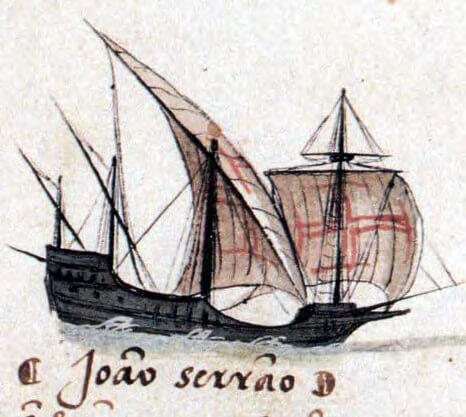
Galleon
The galleon developed from the carrack. The ship’s longer hull and lower forecastle improved its stability, speed, and maneuverability. Galleons had multiple decks and served as both cargo ships and military vessels. They existed alongside carracks and often served as escort and defense ships. They were cheaper to build than carracks but had up to two full cannon decks. Five gallons cost about the same as three carracks. The galleon was in widespread use from the 16th to the 18th centuries and was used as the primary vessel in the Anglo-Dutch Wars of the mid-1600s. [3] They had three or more masts with a lateen rig on the rear mast and square rigs on the foremast and mainmast. Galleons were mostly under 500 tons, although some such as the Manila gallons weighed up to 2,000 tons.

Junk
The junk was a style developed from Chinese riverboats with influences from other parts of Asia. [4] In later centuries, they became seafaring vessels. The main defining feature is the junk rig. However, there are depictions of Chinese ships from the 12th century with square sales. The junk originated between the 8th and 5th century BCE and was used to sail between islands and traverse rivers. It was in the 15th to the 17th centuries that the junk came into its own as a seafaring vessel. The largest ever built were possibly those of Admiral Zheng He for his expeditions in the Indian Ocean, which lasted from 1405 to 1433. Historians estimate that his biggest treasure ships were between 390 to 408 feet long (119–124 m) and 160 to 160 feet wide (49–51 m) and had multiple masts. [5] The Ming Dynasty banned all Chinese maritime trade in the mid-15th to the early 16th century, resulting in the loss of much shipbuilding knowledge. [6]

I hope this was helpful. Let me know if you have questions or suggestions by using the Contact Me form on my website or by writing a comment. I post every Friday and would be grateful if you would share my content.
If you want my blog delivered straight to your inbox every month along with exclusive content and giveaways, please sign up for my email list here.
May you always find the right words.
Copyright © 2023 Rebecca Shedd. All rights reserved.
[1] Braudel, F (1979). The Structures of Everyday Life. p. 423. ISBN 0060148454.
[2] Elbl, Martin (1985). The Portuguese caravel and European Shipbuilding: Phases of development and Diversity. Revista da Universidade de Coimbra. Vol. 33. Lisboa: Instituto de Investigação Científica Tropical. pp. 543–572.
[3] Lane, Kris E. Pillaging the Empire: Piracy in the Americas 1500–1750. M. E. Sharpe, 1998.
[4] Pham, Charlotte Minh-Hà L. (2012). "Unit 14: Asian Shipbuilding (Training Manual for the UNESCO Foundation Course on the Protection and Management of the Underwater Cultural Heritage)". Training Manual for the UNESCO Foundation Course on the Protection and Management of Underwater Cultural Heritage in Asia and the Pacific. Bangkok: UNESCO Bangkok, Asia and Pacific Regional Bureau for Education. ISBN 978-92-9223-414-0.
[5] Levathes, Louise (1996). When China Ruled the Seas: The Treasure Fleet of the Dragon Throne, 1405-1433. New York : Oxford University Press. p.80
[6] Heng, Derek (2019). "Ships, Shipwrecks, and Archaeological Recoveries as Sources of Southeast Asian History". Oxford Research Encyclopedia of Asian History: 1–29. doi:10.1093/acrefore/9780190277727.013.97. ISBN 9780190277727.
 Rebecca Shedd - Author


#/media/File:Guangzhou,_Chinese_Boats_by_Lai_Afong,_c%D0%B0_1880.jpg)