Writer’s Deep Dive: Frigates

Unlike most of the other ships I have covered, the frigate was a warship first and foremost.
Now, let’s dive in!
The frigate was a full-rigged ship, built for speed and maneuverability, making it ideal for scouting, escorting, and patrolling. They could carry six months’ worth of stores, giving them a very long range. During a sea battle, commanders would station them away from the action with a clear line of sight to the flagship, repeating its signals. [1]
Throughout their history, frigates were a desirable post in the Navy. They often saw action, which meant a greater chance for glory, promotion, and prize money. Also, governments kept them in service during peacetime because they were more economical than larger ships. Frigates are popular among authors because of their relative freedom compared to ships-of-the-line. Examples include C.S. Forester’s Horatio Hornblower series and the movie Master and Commander: The Far Side of the World.
Early History
The frigate is descended from lighter galley-type warships developed in the Mediterranean in the 15th century. These ships used oars and sails and were primarily built for speed and maneuverability. [2] During the Eighty Years War, Protestant rebels from the southern Netherlands used frigates to attack the shipping of the Dutch and their allies. They chose the frigate because of its speed and maneuverability.
The Dutch Republic was the first navy to build larger ocean-going frigates. In their struggle against the Spanish, speed and a shallow draft for the waters around the Netherlands was critical. The first of these larger frigates were built around 1600 in Holland. The Dutch almost completely stopped using heavy ships and adopted lighter frigates by the end of the Eighty Years’ War. After the Battle of the Downs in 1639, frigates became the preferred choice for navies after seeing the Dutch’s success. Most of the ships built by the Commonwealth of England in the 1650s were frigates. As frigates became bigger, more decks were added. This style was known as a great frigate and could carry up to 60 guns. The long hull design led to the rise in broadside tactics and naval warfare.

The Classic Frigate
The classic or true frigate came into its own during the Napoleonic wars. During the War of Austrian Succession (1740-1748), the British Navy took some French frigates and liked them so much that they created their own. One of these was the French built Médée of 1740. The first British frigates had 28 guns, including an upper deck battery. The classic frigate was square-rigged and only had one gun deck. This design meant that even in rough seas, a true frigate could bring all her guns to bear against two deckers that often could not open their lower deck gun ports. The first British frigates had 28 guns, including an upper deck battery of 24 nine-pounder guns. Later designs had 32 or 36 guns, including an upper deck battery of 26 12-pounder guns.
The Heavy Frigate
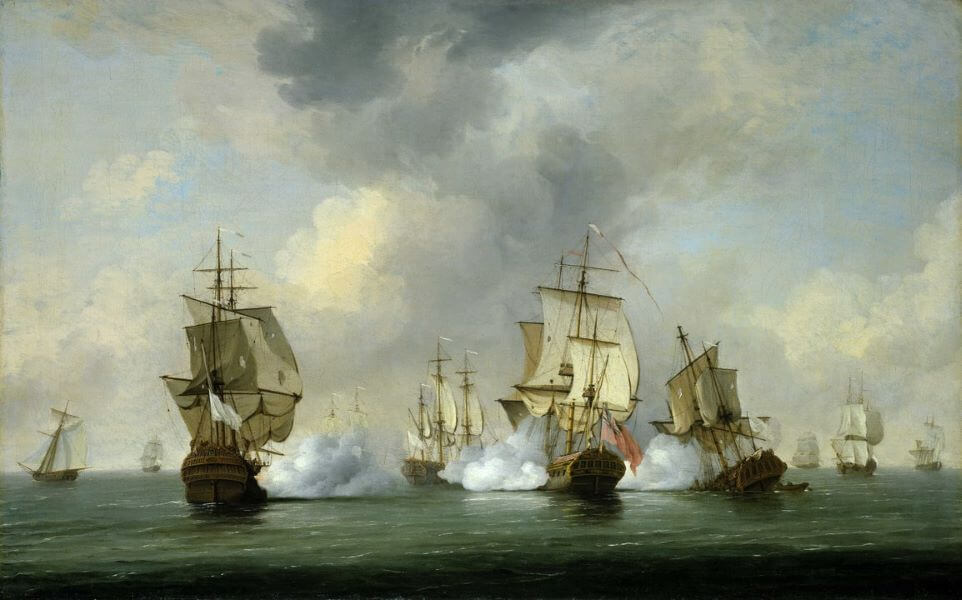
In 1778, the British admiralty introduced a heavy frigate with a main battery of 28 18-pounder guns. The British made this move because the French and the Spanish had built up their navies. The French followed suit in 1781 with an 18-pounder frigate. By the Napoleonic Wars, the 18-pounder frigate was the standard. The British produced two versions: a 38 gun and a smaller 36 gun frigate.
The Super Heavy Frigate
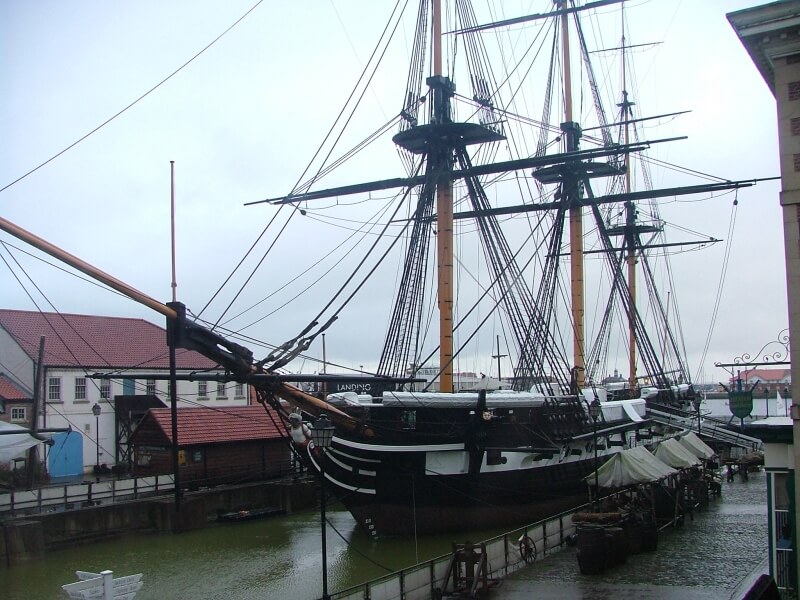
In 1782, the Swedish Navy introduced the first super heavy frigates that had 24 pounder long guns. In the 1790s, the French built several super heavy frigates and modified a few older ships into heavy frigates. The British followed suit and modified three of their smaller 64 gun battleships into super heavy frigates including the HMS Indefatigable. In 1797 the new United States had three super heavy frigates including the USS Constitution. [3] After losses in the War of 1812, the Royal Navy ordered British frigates to never engage American frigates at any less than a 2 to 1 advantage. The builders constructed the Constitution and her sister ships, President and United States, using live oak which made their hulls resistant to cannon shot. [4] This is the reason the USS Constitution is known as Old Ironsides.

Modern Frigates
With the adoption of steam power in the 19th century, multiple navies experimented with paddle frigates. The first ironclads were classified as frigates because of the number of guns they carried. Starting in the mid-1840s there were screw frigates, first built of wood and later of iron that continued to perform the traditional role of the frigate into the late 19th century. The term frigate stayed in use until the 1880s, when iron hulled warships began being designated as battleships or armored cruisers. The term frigate was readopted during World War II by the British Navy to describe an anti-submarine escort vessel that was larger than a corvette but smaller than a destroyer. Modern frigates are included in multiple navies around the world, including the United States, Canada, and the UK.

I hope this was helpful. Let me know if you have questions or suggestions by using the Contact Me form on my website or by writing a comment. I post every Friday and would be grateful if you would share my content.
If you want my blog delivered straight to your inbox every month along with exclusive content and giveaways, please sign up for my email list here.
May you always find the right words.
Copyright © 2023 Rebecca Shedd. All rights reserved.
[1] Encyclopædia Britannica. Vol. 17. p. 469.
[2] Henderson, James: Frigates Sloops & Brigs. Pen & Sword Books, London, 2005. ISBN 1-84415-301-0.
[3] USS Constitution launched in 1797.HMS Victory is the oldest commissioned (put on active duty) vessel since 1778 by 21 years, but she has been in dry dock since 1922.
[4] Archibald, Roger. 1997. Six ships that shook the world. American Heritage of Invention & Technology 13, (2): 24.
 Rebecca Shedd - Author


.jpg)