Writer’s Deep Dive: Sextant

The sextant is one of the most easily recognizable and yet least understood navigational instruments. Today I will explain how to take a reading with the sextant and the function of all its pieces.
Now, let’s dive in!
The Basics
The basic principles of the sextant were found in the unpublished writings of Isaac Newton but were first implemented around 1731 by John Hadley and Thomas Godfrey.
The sextant measures the angular distance between two visible objects. Often one of those objects is the horizon, and the other is the sun or the north star. However, the sextant can also measure the distance between two objects, such as the moon and another celestial body, such as a star or planet. This can determine Greenwich mean time and thus longitude. You can calculate the latitude by noting the time of a sighting and measuring the angle. The distance of a landmark can be determined by sighting the height of it. When held horizontally, a sextant can measure angles between objects on a chart. Unlike older tools, you can use the sextant during the day or at night. Because a sextant measures relative angle, it does not need to be completely steady, meaning that you can use it on a moving ship.
The frame of a sextant is marked with angles. You move the index bar to take a reading on those angles. Traditional sextants have half horizon mirrors, so one mirror shows the horizon and the other shows the celestial body being cited. Both objects appear bright and clear, meaning that you can use the sextant at night and in haze. Most sextants have shade glasses to protect the user’s eyes from looking directly at the sun.
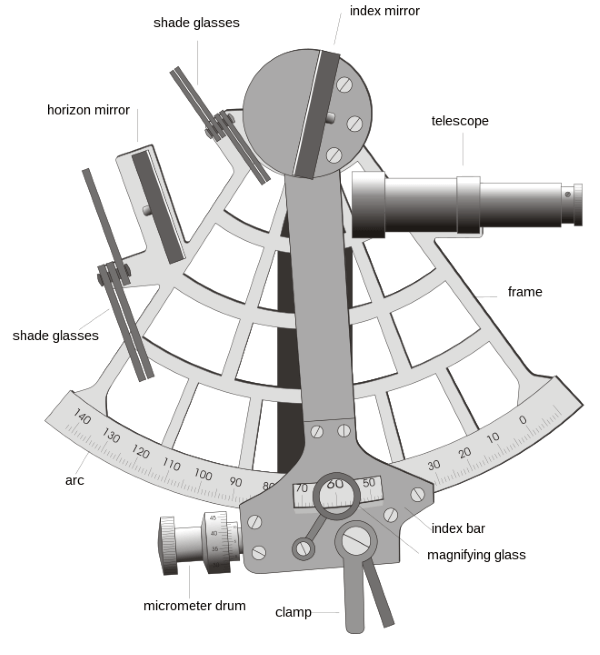
Sighting, shooting, or taking a sight is how people refer to taking a reading with a sextant. First, point the sextant at the horizon. Then rotate the index bar until the celestial body being cited appears in the second half of the mirror. Then, line up the bottom of the celestial object with the horizon, release the clamp, and swing the sextant side to side to verify alignment. The user can then read the angle that is shown by the arrow on the index bar.

The readings for a sextant are sometimes subject to index errors. This is due to slight misalignments with the mirrors. You can adjust calculations to ensure the accuracy of the reading. Adjustments for height above the water, light bending, and shift in position of the celestial body are usually necessary. Changes in temperature can warp the ark of the sextant, creating inaccuracies. Mariners originally made most sextants of brass because it expands less than other materials although it was heavier.
Users can determine their location on earth by using trigonometric calculations and nautical almanac data after correcting their reading.
The Write Angle
There are many ways that you can use a sextant in your stories. Below are just a few.
Navigational Tool – The sextant was an essential navigation tool in history. It was useful for people who explored uncharted territories like sailors, pilots, and explorers without GPS.
Historical Setting – If sextants were commonly used in the specific historical period in which your story is set, it can serve as a hallmark for the era and illustrate the challenges of navigation in the past.
Survival Story – If your character is in a survival situation, such as after a shipwreck, a sextant can be a lifeline for them to find their way to safety. If they struggle with using the instrument accurately, it can add a layer of tension and hope. If there is more than one survivor, they can disagree about how to use a sextant and whether each other’s readings are accurate.
Character – Showing a character that is competent at using a sextant or struggling can add depth and reveal some of their skills and back story. If your character is based on a historical figure such as a famous explorer or scientist, their use of the sextant can add depth and authenticity to your story.
Mystery – Maybe your character stumbles upon an old sextant with cryptic markings or coordinates that are the beginning of an adventure.
I hope this was helpful. Let me know if you have questions or suggestions by using the Contact Me form on my website or by writing a comment. I post every Friday and would be grateful if you would share my content.
If you want my blog delivered straight to your inbox every month along with exclusive content and giveaways, please sign up for my email list here.
May you always find the right words.
Copyright © 2023 Rebecca Shedd. All rights reserved.
 Rebecca Shedd - Author

