

The Writer’s Guide to Maritime Navigation
Posted on November 24, 2023 Leave a Comment
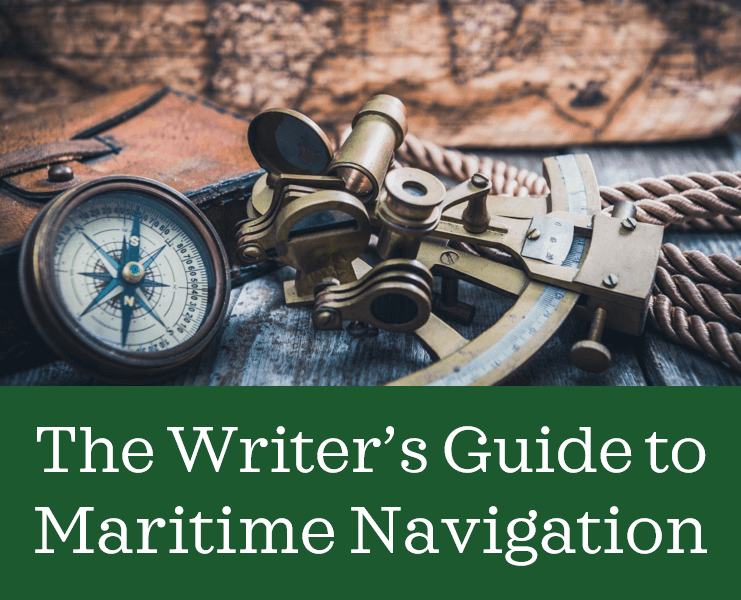
Over the last couple of weeks, I have covered different ships and a large span of maritime history. However, all these ships mean nothing if you do not know how to get where you are going. Today I will cover maritime navigation. I will mainly focus on navigation before satellite and radio.
As always, magic is the exception to the rule. Because magic.
Latitude and Longitude
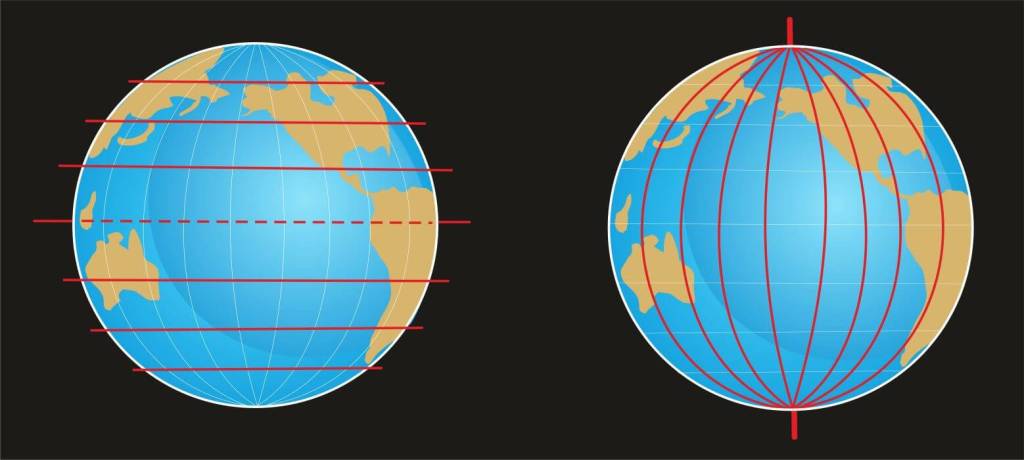
Latitude is the distance north to south around the globe and is depicted as horizontal lines on maps of the Earth. It is usually expressed in degrees with the equator being 0 degrees. Mariners calculated latitude in the northern hemisphere by sighting the sun, moon, or north star with a sextant.
Longitude, the vertical lines on your map, dictate east-to-west distances from the prime meridian or Greenwich meridian. Longitude is also expressed in degrees ranging from 0 to 180 degrees east to west. Longitude is much harder to calculate than latitude because you must know the exact time that you are from Greenwich mean time. This requires hyper accurate timepieces which were not available until the late 18th century and not affordable until the 19th century.
Coastal Navigation
Our earliest seafaring ancestors followed the coast. With the shoreline in sight, it was harder to get lost than venturing out into open waters.
Dead Reckoning
Early mariners navigated by using landmarks, memory, observation, and information passed down by others. A variation of this type of navigation is known as dead reckoning. A ship captain would point his vessel in the direction that he wished to go and try to hold a straight line. He would estimate his location given the speed of the ship. This is not the best navigation method because any steering error can take the vessel wildly off course.
Celestial Navigation
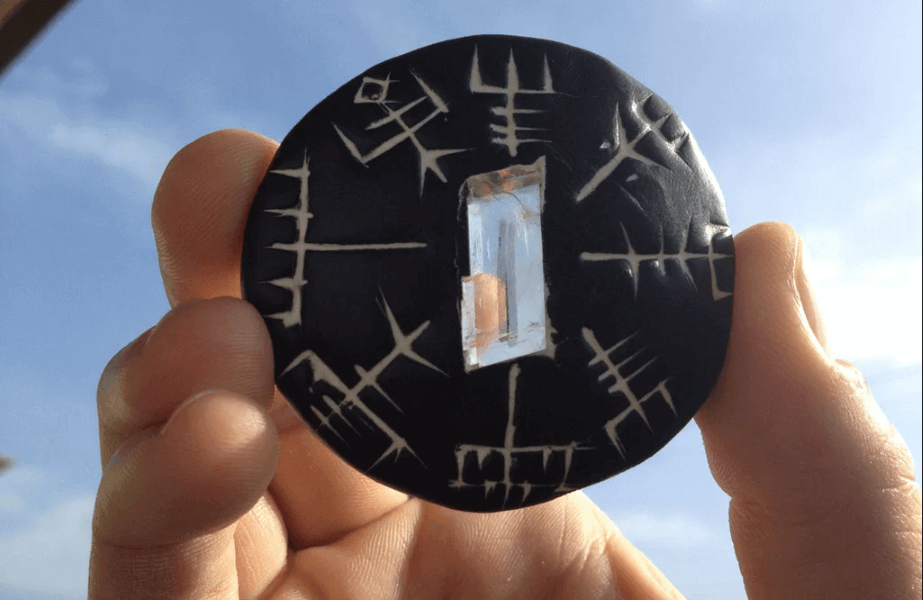
Celestial navigation is based on the observation of the sun, moon, and stars. Sailors would use the sun to set an east or west heading. The North Star was used heavily by early mariners at night. Ancient Vikings are rumored to use a special type of crystal known as a sunstone to locate the sun even on a cloudy day and then utilize a primitive compass known as a sunboard to set their heading. If you are interested in learning more there was a fantastic episode of Expedition Unknown that covers this topic.
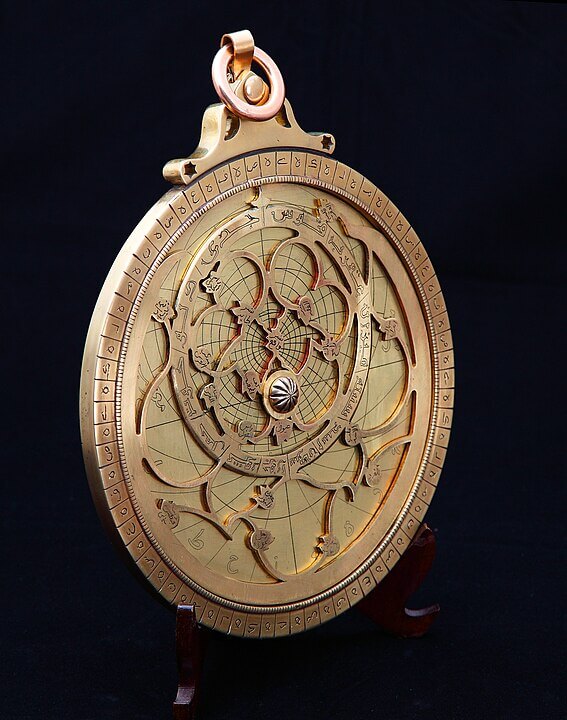
Astrolabe
An astrolabe is an instrument that serves as a star chart and a physical model of visible heavenly bodies. It is usually a metal disc with a pattern of wire cut outs and perforations that allow the user to accurately calculate astronomical positions. It can measure the altitude above the horizon of a celestial body and can identify stars or planets to determine latitude. Although it is less reliable in rough seas. The astrolabe was used widely during the Islamic Golden Age.
Compasses
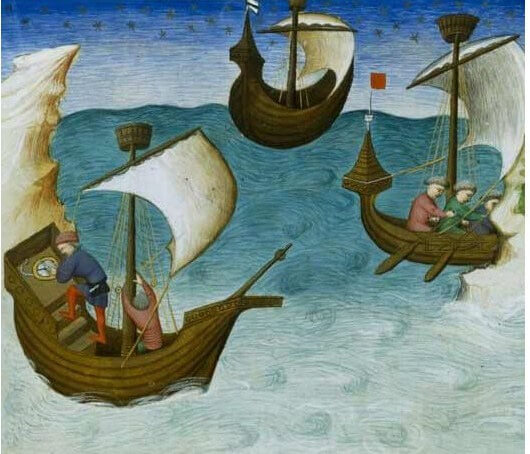
The compass uses a magnetized needle to determine magnetic north. They also show angles in degrees with N corresponding to 0 degrees. This allows the compass to show bearings in degrees. The Han Chinese developed the first compass using lodestones. [1] The earliest representation of a compass used aboard ship was from an illustration dating to 1403.
Sextant
The sextant is an instrument that measures the altitude of an object. The sextant measures the angle and time, which can calculate the latitude. I will go into further detail in my next blog post.
I hope this was helpful. Let me know if you have questions or suggestions by using the Contact Me form on my website or by writing a comment. I post every Friday and would be grateful if you would share my content.
If you want my blog delivered straight to your inbox every month along with exclusive content and giveaways, please sign up for my email list here.
May you always find the right words.
Copyright © 2023 Rebecca Shedd. All rights reserved.
[1] Lowrie, William (2007). Fundamentals of Geophysics. London: Cambridge University Press. pp. 281. ISBN 978-0-521-67596-3. Early in the Han Dynasty, between 300–200 BC, the Chinese fashioned a rudimentary compass out of lodestone ... the compass may have been used in the search for gems and the selection of sites for houses ... their directive power led to the use of compasses for navigation

Writer’s Deep Dive: Frigates
Posted on November 10, 2023 Leave a Comment

Unlike most of the other ships I have covered, the frigate was a warship first and foremost.
Now, let’s dive in!
The frigate was a full-rigged ship, built for speed and maneuverability, making it ideal for scouting, escorting, and patrolling. They could carry six months’ worth of stores, giving them a very long range. During a sea battle, commanders would station them away from the action with a clear line of sight to the flagship, repeating its signals. [1]
Throughout their history, frigates were a desirable post in the Navy. They often saw action, which meant a greater chance for glory, promotion, and prize money. Also, governments kept them in service during peacetime because they were more economical than larger ships. Frigates are popular among authors because of their relative freedom compared to ships-of-the-line. Examples include C.S. Forester’s Horatio Hornblower series and the movie Master and Commander: The Far Side of the World.
Early History
The frigate is descended from lighter galley-type warships developed in the Mediterranean in the 15th century. These ships used oars and sails and were primarily built for speed and maneuverability. [2] During the Eighty Years War, Protestant rebels from the southern Netherlands used frigates to attack the shipping of the Dutch and their allies. They chose the frigate because of its speed and maneuverability.
The Dutch Republic was the first navy to build larger ocean-going frigates. In their struggle against the Spanish, speed and a shallow draft for the waters around the Netherlands was critical. The first of these larger frigates were built around 1600 in Holland. The Dutch almost completely stopped using heavy ships and adopted lighter frigates by the end of the Eighty Years’ War. After the Battle of the Downs in 1639, frigates became the preferred choice for navies after seeing the Dutch’s success. Most of the ships built by the Commonwealth of England in the 1650s were frigates. As frigates became bigger, more decks were added. This style was known as a great frigate and could carry up to 60 guns. The long hull design led to the rise in broadside tactics and naval warfare.

The Classic Frigate
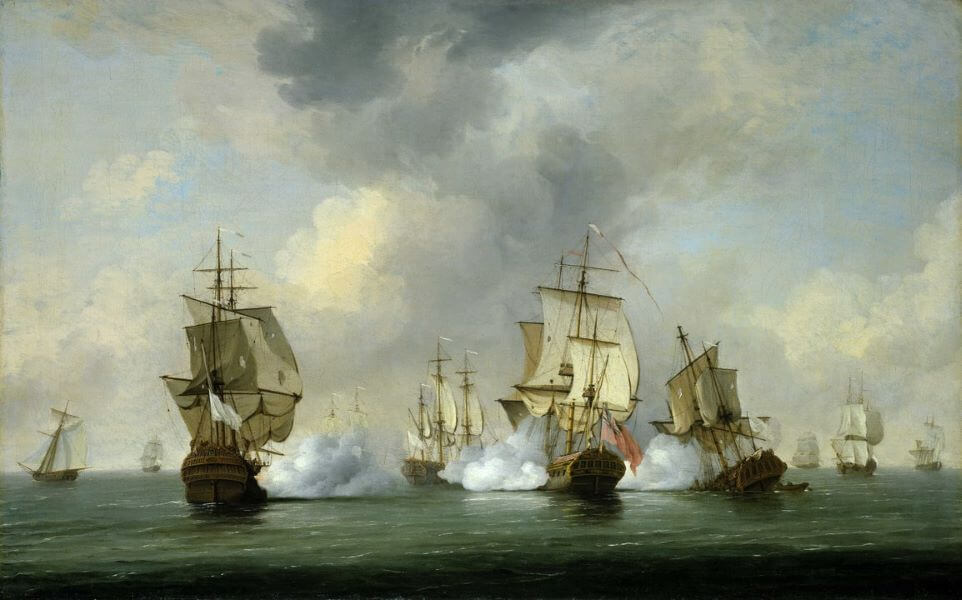
The classic or true frigate came into its own during the Napoleonic wars. During the War of Austrian Succession (1740-1748), the British Navy took some French frigates and liked them so much that they created their own. One of these was the French built Médée of 1740. The first British frigates had 28 guns, including an upper deck battery. The classic frigate was square-rigged and only had one gun deck. This design meant that even in rough seas, a true frigate could bring all her guns to bear against two deckers that often could not open their lower deck gun ports. The first British frigates had 28 guns, including an upper deck battery of 24 nine-pounder guns. Later designs had 32 or 36 guns, including an upper deck battery of 26 12-pounder guns.
The Heavy Frigate
In 1778, the British admiralty introduced a heavy frigate with a main battery of 28 18-pounder guns. The British made this move because the French and the Spanish had built up their navies. The French followed suit in 1781 with an 18-pounder frigate. By the Napoleonic Wars, the 18-pounder frigate was the standard. The British produced two versions: a 38 gun and a smaller 36 gun frigate.
The Super Heavy Frigate
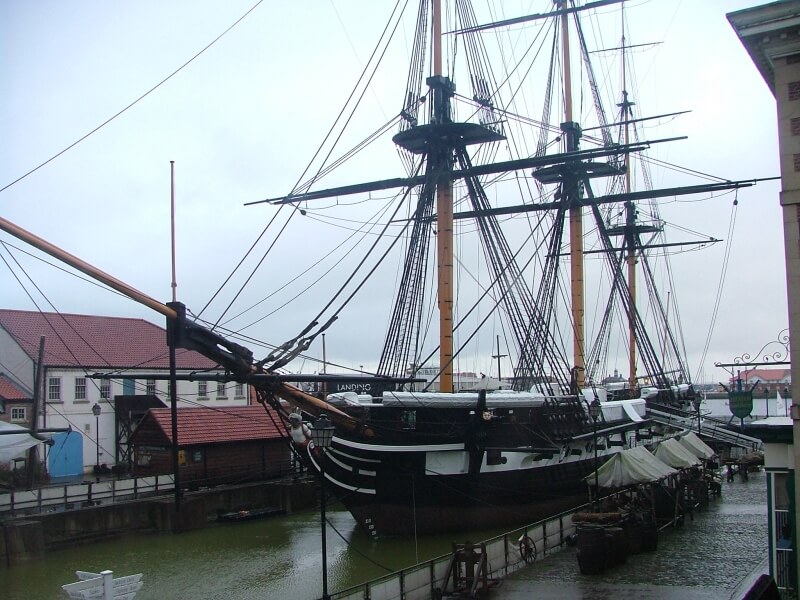
In 1782, the Swedish Navy introduced the first super heavy frigates that had 24 pounder long guns. In the 1790s, the French built several super heavy frigates and modified a few older ships into heavy frigates. The British followed suit and modified three of their smaller 64 gun battleships into super heavy frigates including the HMS Indefatigable. In 1797 the new United States had three super heavy frigates including the USS Constitution. [3] After losses in the War of 1812, the Royal Navy ordered British frigates to never engage American frigates at any less than a 2 to 1 advantage. The builders constructed the Constitution and her sister ships, President and United States, using live oak which made their hulls resistant to cannon shot. [4] This is the reason the USS Constitution is known as Old Ironsides.

Modern Frigates
With the adoption of steam power in the 19th century, multiple navies experimented with paddle frigates. The first ironclads were classified as frigates because of the number of guns they carried. Starting in the mid-1840s there were screw frigates, first built of wood and later of iron that continued to perform the traditional role of the frigate into the late 19th century. The term frigate stayed in use until the 1880s, when iron hulled warships began being designated as battleships or armored cruisers. The term frigate was readopted during World War II by the British Navy to describe an anti-submarine escort vessel that was larger than a corvette but smaller than a destroyer. Modern frigates are included in multiple navies around the world, including the United States, Canada, and the UK.

I hope this was helpful. Let me know if you have questions or suggestions by using the Contact Me form on my website or by writing a comment. I post every Friday and would be grateful if you would share my content.
If you want my blog delivered straight to your inbox every month along with exclusive content and giveaways, please sign up for my email list here.
May you always find the right words.
Copyright © 2023 Rebecca Shedd. All rights reserved.
[1] Encyclopædia Britannica. Vol. 17. p. 469.
[2] Henderson, James: Frigates Sloops & Brigs. Pen & Sword Books, London, 2005. ISBN 1-84415-301-0.
[3] USS Constitution launched in 1797.HMS Victory is the oldest commissioned (put on active duty) vessel since 1778 by 21 years, but she has been in dry dock since 1922.
[4] Archibald, Roger. 1997. Six ships that shook the world. American Heritage of Invention & Technology 13, (2): 24.

The Writer’s Guide to Sailing Ships of the 18th & 19th Centuries
Posted on October 27, 2023 Leave a Comment
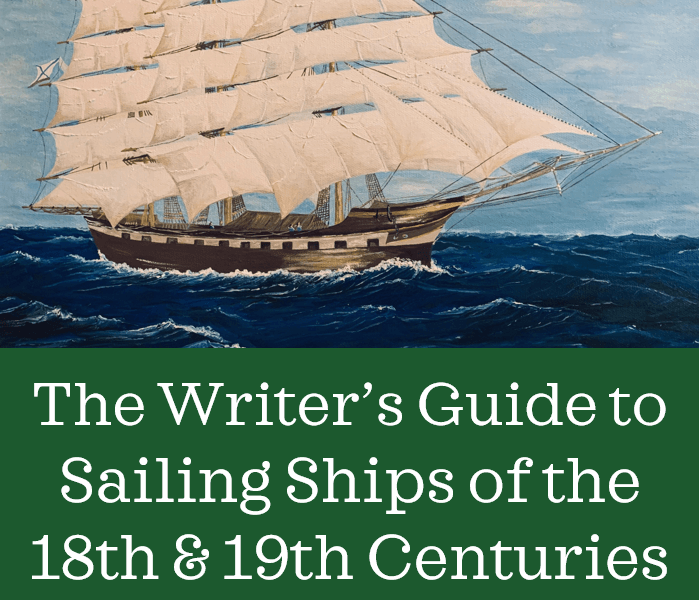
The advancements in sailing ships that occurred during the Age of Exploration from the 15th to the 17th centuries continued into the 18th and 19th centuries. We also known this period as the Age of Sail. Ships became faster, better armed, and more complex in their construction. It was during this time that iconic ships such as the schooner and the clipper came onto the scene. The Age of Sail would end with the introduction of steamships.
As always, magic is the exception to the rule. Because magic.
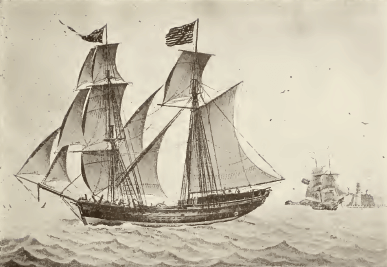
Brigantine
The brigantine is a two-masted ship that developed in the Mediterranean and Northern Europe. Their defining feature is a gaff sail on the second mast, which is usually taller than the first. There are records of this type of vessel going back to the 16th century. Several nations adopted this style of ship in the Atlantic in the 17th century. It was especially popular in the British colonies in North America before 1775. It was fast and maneuverable, which made it popular for piracy, espionage, and reconnaissance. Brigantines ranged in size from 30 to 150 tons.
Brig
The brig developed as a variation of the brigantine. It has two square rig masts instead of one. This improves its sailing, power, and maneuverability. The brig, which originated in the second half of the 18th century, served as small merchant vessels and warships into the latter part of the 19th century. Eventually, schooners replaced them. Although they were fast and maneuverable, they required a large crew to manage their sails, although fewer than the brigantine. [1] James Cook’s ship, HMS Grenfell, started as a schooner but was later converted into a brigantine. Another famous brig was the HMS Beagle, which was used as a survey vessel by Charles Darwin.

Schooner
Although there is evidence of the schooner from the early 17th century, they came into their own as ocean-crossing ships in the 18th century. This design has a fast hull and a good ability to windward. They were popular among privateers, blockade runners, slavers, and opium dealers. They were also used as packet boats because of their speed in carrying passengers and goods. People often used them for oceanic voyages besides their use in coastal waters. They required a smaller crew than most ships their size. [2]

Clipper
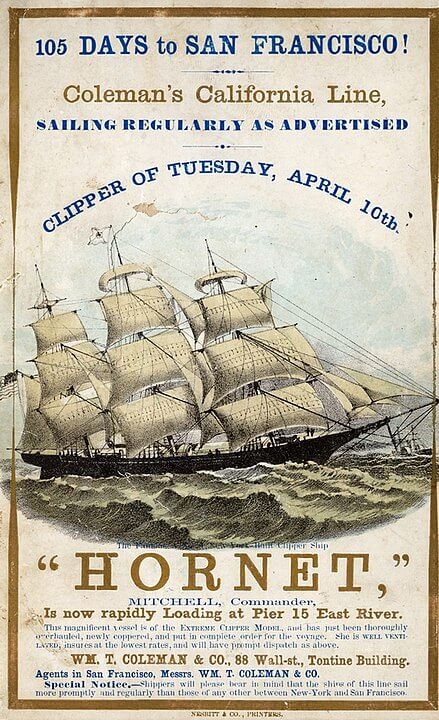
The clipper ship was designed for speed. They were not limited to any specific sail plan and could be rigged as schooners, brigs, or brigantines. At their height, clippers sailed all over the world but were primarily used to carry tea and opium between the United Kingdom and China, in the transatlantic trade, and in the New York to San Francisco route during the California Gold Rush. The height of the clipper era began in 1843 when there was a need for fast passage to the gold fields in California and Australia. They do not have a large capacity for carrying cargo but were designed to carry their cargo or passengers quickly. They were also used to quickly carry perishable goods such as fruit.[3] They are often narrow for their length and small by 19th century standards. The first clippers were built in Baltimore before the American Revolution. They were small, usually less than 200 tons.[4] The popularity of the clipper ship began to fade in late 1853 due to a slump in trade. The only intact clipper ship today is the Cutty Sark.
Windjammers
Windjammers were iron-hulled sailing ships that bridged the gap between the Age of Sail and the Age of Steam. They carried bulk cargo long distances in the 19th and early 20th centuries. They were the largest merchant ships ever built. The first windjammers were built in the 1870s and they were attractive because they kept their schedules regardless of the wind. They also did not need a large crew and could have as few as 14 men. Commercial use of iron-hulled sailing ships continued until the 1950s, although they began disappearing in the 1920s. They carried cargo from remote ports where fuel and water were unavailable and did not have to take up space with coal or fresh water. The tallest sailing ship ever built was the five-masted Prussian, which was a windjammer.

I hope this was helpful. Let me know if you have questions or suggestions by using the Contact Me form on my website or by writing a comment. I post every Friday and would be grateful if you would share my content.
If you want my blog delivered straight to your inbox every month along with exclusive content and giveaways, please sign up for my email list here.
May you always find the right words.
Copyright © 2023 Rebecca Shedd. All rights reserved.
[1] R.M. Ballantyne. "Man on the Ocean". Archived from the original on 2006-10-11. Retrieved 2007-01-12.
[2] "Schooner" . Encyclopædia Britannica (11th ed.). 1911.
[3] MacGregor, David R (1988). Fast Sailing Ships, their design and construction, 1775–1875 (2nd ed.). London: Conway Maritime Press. ISBN 0-87021895-6.
[4] Clark, Arthur Hamilton (1912). The Clipper Ship Era: An Epitome of Famous American and British Clipper Ships, Their Owners, Builders, Commanders, and Crews, 1843–1869. G.P. Putnam's Sons. The Clipper Ship Era.

The Writer’s Guide to Sailing Ships of the Age of Exploration
Posted on October 13, 2023 Leave a Comment
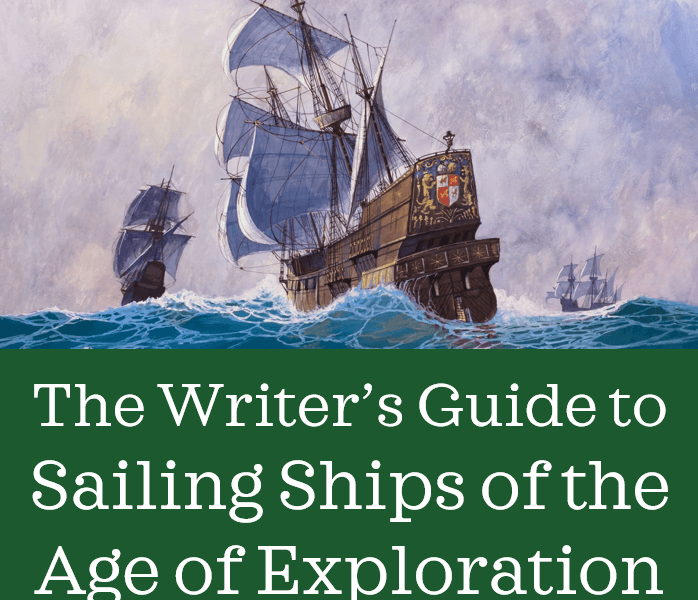
The Age of Exploration, also known as the Age of Discovery, was a time that saw a surge of explorers taking to the seas. From the 15th to 17th century, European explorers discovered and colonized multiple regions worldwide. This exploration would not have been possible without two technological advancements. The first was the magnetic compass, and the second was several styles of ships that could navigate the open seas far from land. Today I will cover the dominant style of ships from this time.
As always, magic is the exception to the rule. Because magic.
Carrack
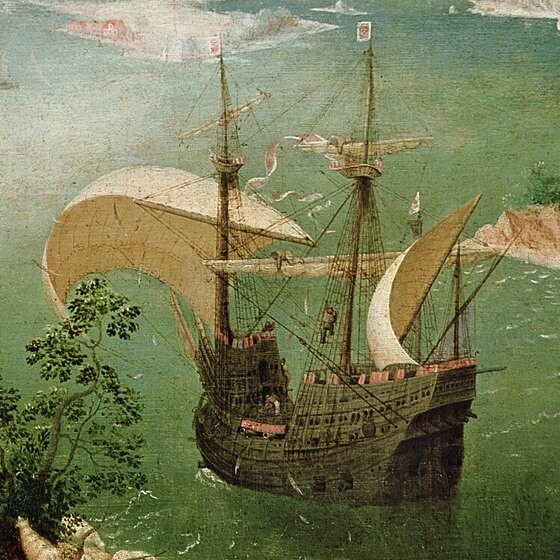
The carrack is a type of three or four-masted sailing ship that was developed in Europe in the 14th century. It developed from the single-masted cog, which was used for trade in the Mediterranean and the Baltic. The carrack was larger, and its size made it stable in heavy seas and capable of carrying the provisions needed for long ocean voyages. This style of ship was developed and used, most notably in Portugal and Spain. The Portuguese carracks often had over 1,000 tons of displacement. [1] They were usually square-rigged on the foremast and mainmast with a lateen sail on the mizzenmast. They had a single cannon deck. One of the most famous carracks in history was the Santa Maria in which Christopher Columbus made his first voyage to the Americas in 1492.
Caravel
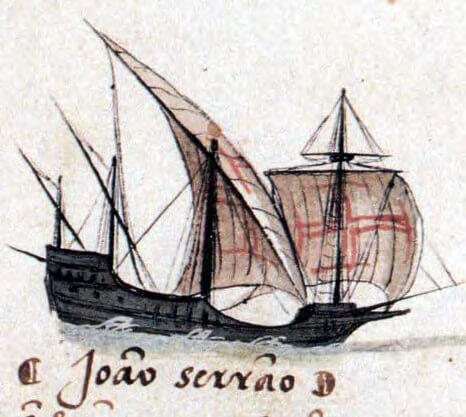
The style originated in the 13th century along the coast of Galatia and Portugal. Similar Muslim craft used in the waters of the Iberian Peninsula may have influenced it. [2] The early caravels were only used in coastal waters and often only had a single mast with a lateen rig. Toward the end of the 15th century, the Portuguese developed a larger version of the caravan with a forecastle and stern castle. The foremast was rigged with a square sail which fared better on the open ocean, but the other masts kept their lateen rig, a style known as a “round caravel.” Some consider the caravel the forerunner of the galleon. The Nina and the Pinta, two of the ships that Christopher Columbus used on his 1492 expedition, are examples of caravels.
Galleon
The galleon developed from the carrack. The ship’s longer hull and lower forecastle improved its stability, speed, and maneuverability. Galleons had multiple decks and served as both cargo ships and military vessels. They existed alongside carracks and often served as escort and defense ships. They were cheaper to build than carracks but had up to two full cannon decks. Five gallons cost about the same as three carracks. The galleon was in widespread use from the 16th to the 18th centuries and was used as the primary vessel in the Anglo-Dutch Wars of the mid-1600s. [3] They had three or more masts with a lateen rig on the rear mast and square rigs on the foremast and mainmast. Galleons were mostly under 500 tons, although some such as the Manila gallons weighed up to 2,000 tons.

Junk
The junk was a style developed from Chinese riverboats with influences from other parts of Asia. [4] In later centuries, they became seafaring vessels. The main defining feature is the junk rig. However, there are depictions of Chinese ships from the 12th century with square sales. The junk originated between the 8th and 5th century BCE and was used to sail between islands and traverse rivers. It was in the 15th to the 17th centuries that the junk came into its own as a seafaring vessel. The largest ever built were possibly those of Admiral Zheng He for his expeditions in the Indian Ocean, which lasted from 1405 to 1433. Historians estimate that his biggest treasure ships were between 390 to 408 feet long (119–124 m) and 160 to 160 feet wide (49–51 m) and had multiple masts. [5] The Ming Dynasty banned all Chinese maritime trade in the mid-15th to the early 16th century, resulting in the loss of much shipbuilding knowledge. [6]

I hope this was helpful. Let me know if you have questions or suggestions by using the Contact Me form on my website or by writing a comment. I post every Friday and would be grateful if you would share my content.
If you want my blog delivered straight to your inbox every month along with exclusive content and giveaways, please sign up for my email list here.
May you always find the right words.
Copyright © 2023 Rebecca Shedd. All rights reserved.
[1] Braudel, F (1979). The Structures of Everyday Life. p. 423. ISBN 0060148454.
[2] Elbl, Martin (1985). The Portuguese caravel and European Shipbuilding: Phases of development and Diversity. Revista da Universidade de Coimbra. Vol. 33. Lisboa: Instituto de Investigação Científica Tropical. pp. 543–572.
[3] Lane, Kris E. Pillaging the Empire: Piracy in the Americas 1500–1750. M. E. Sharpe, 1998.
[4] Pham, Charlotte Minh-Hà L. (2012). "Unit 14: Asian Shipbuilding (Training Manual for the UNESCO Foundation Course on the Protection and Management of the Underwater Cultural Heritage)". Training Manual for the UNESCO Foundation Course on the Protection and Management of Underwater Cultural Heritage in Asia and the Pacific. Bangkok: UNESCO Bangkok, Asia and Pacific Regional Bureau for Education. ISBN 978-92-9223-414-0.
[5] Levathes, Louise (1996). When China Ruled the Seas: The Treasure Fleet of the Dragon Throne, 1405-1433. New York : Oxford University Press. p.80
[6] Heng, Derek (2019). "Ships, Shipwrecks, and Archaeological Recoveries as Sources of Southeast Asian History". Oxford Research Encyclopedia of Asian History: 1–29. doi:10.1093/acrefore/9780190277727.013.97. ISBN 9780190277727.

The Writer’s Guide to Sailing Ships of the Ancient World
Posted on September 29, 2023 Leave a Comment

The history of the sailing ship is long and throughout it humans have developed many types of vessels. The builder’s needs and the advances in sailing technology achieved up to that point usually influenced the designs of sailing ships. This will not be an exhaustive list. There are too many types of sailing ships and variations on them to put in a single blog post. Today, I will start with the ships of the ancient world.
As always, magic is the exception to the rule. Because magic.
Austronesia & the South China Sea
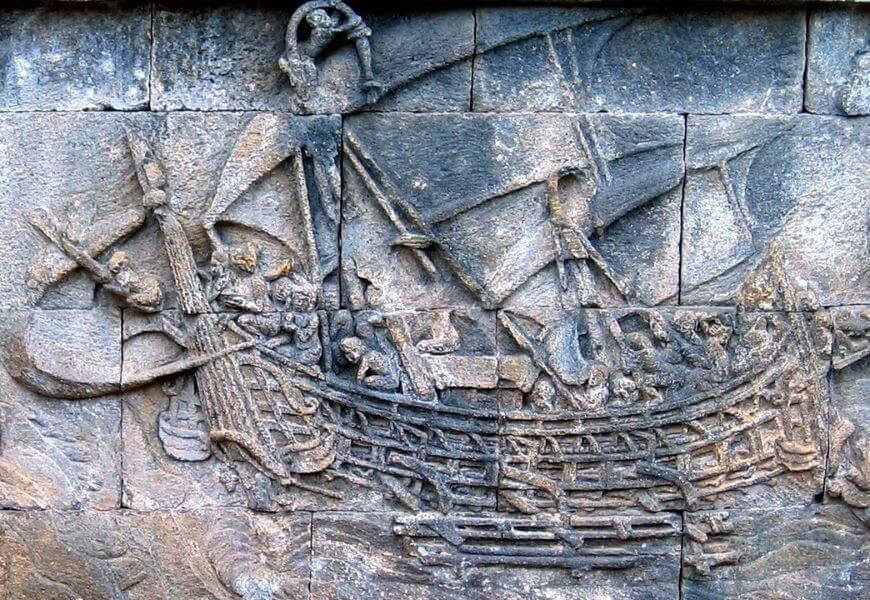
The Austronesian vessels were the earliest ones to take to the open ocean between 3,000 to 1,500 BC. These people developed the catamaran and outrigger, most of which had crab claw sails. They used them to set up the first trade routes in the Indian Ocean, starting in at least 1500 BC and ranging from Japan to eastern Africa. [1] These sea routes were the precursor of the spice trade routes and were the maritime version of the Silk Road. [2]
The Austronesian design influenced the development of the Arab lateen sails and the kunlun bo or K’un-lun po (崑崙舶, lit. “ship of the Kunlun people”) of the Han Dynasty, which lasted from 206 BC to 220 AD.
The Mediterranean
The ancient Egyptians had single-masted, square-rigged vessels. Using both sails and oars, they navigated rivers and the Mediterranean Sea. We do not have a name for this type of vessel.
The Egyptians used squared-rigged vessels with a single mast but mainly kept to the rivers and the Mediterranean Sea. These vessels commonly used paddles or oars as well as sails. [3] The Minoans, the Phoenicians, the Greeks, and the Romans later used this style.
The Phoenicians, Assyrians, Greeks, and Romans used three types of galleys: bireme, trireme, and penteconter. They had both oars and sails and had reinforced bows for ramming. The bireme and trireme were mainly warships, and they used the penteconter for both war and trade. The names came from the rows of oars with biremes having two and triremes having three.
The polyreme was a type of heavy Roman warship like the bireme and trireme but with more rows of oars.

The Indian Ocean
India was trading with Mesopotamia using maritime routes as early as the 3rd millennium BCE but the first evidence of their use of sails is from 400-500 AD. [4] Most vessels involved in this trade route stayed in coastal waters, making cargo ships such as the dhow the most widely used. There were multiple routes between India and the Arabian peninsula, which meant that monopolies and blockades were more difficult.
Several Indian kingdoms, such as Kalinga, used sailing ships as early as the 2nd century AD. Their use of the sail was likely developed from those of the Austronesian vessels. There are depictions of Javanese outriggers from the 8th century that were influenced the same way. [5]

The Atlantic Ocean
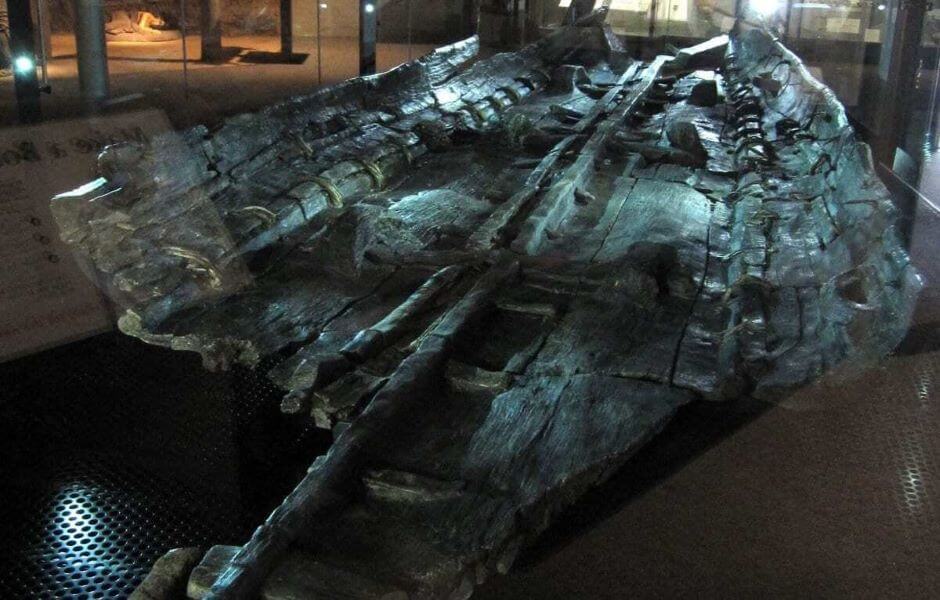
In 1996, a boat was unearthed in Dover, England. It was 9.5 m long x 2.1 m wide. Archeologists dated it to approximately 1600 B.C., possibly making it the oldest known seagoing boat. The boat builders made the hull of straight grained oak and used yew lashings. Between 4 to 16 paddlers propelled the boat. It was large enough to carry a significant amount of cargo and, with a strong crew, may have been able to travel 30 nautical miles in a day. [6]
The Vikings were well known for their longships, the first of which date back to between 500 and 300 B.C. [7] They were made of rounded cross-sections that were fastened with cord. These vessels were quick but had little carrying capacity. We have multiple examples of these ships because the Vikings used them in burials. Although originally designed for rivers, they were later used for long ocean voyages such as Leif Eric sends exploration of North America. They had both oars and sails for proportion.
China
The ships of ancient China were large, rectangular, barge like ships with multiple decks and cabins. The ships had ramparts and the ancient Chinese used them as floating fortresses. [8] They were commonly called ‘lou chuan’ or ‘castle ships.’ The first example of these ships is from the Spring and Autumn Period (722 BC–481 BC). This period also saw the introduction of the iconic junk, which would become the primary vessel of Chinese explorers.

I hope this was helpful. Let me know if you have questions or suggestions by using the Contact Me form on my website or by writing a comment. I post every Friday and would be grateful if you would share my content.
If you want my blog delivered straight to your inbox every month along with exclusive content and giveaways, please sign up for my email list here.
May you always find the right words.
Copyright © 2023 Rebecca Shedd. All rights reserved.
[1] Bellina, Bérénice (2014). "Southeast Asia and the Early Maritime Silk Road". In Guy, John (ed.). Lost Kingdoms of Early Southeast Asia: Hindu-Buddhist Sculpture 5th to 8th century. Yale University Press. pp. 22–25. ISBN 9781588395245.
[2] Bellina, Bérénice (2014). "Southeast Asia and the Early Maritime Silk Road". In Guy, John (ed.). Lost Kingdoms of Early Southeast Asia: Hindu-Buddhist Sculpture 5th to 8th century. Yale University Press. pp. 22–25. ISBN 9781588395245.
[3] From River to Sea: Evidence for Ancient Egyptian Seafaring Ships
[4] Pamulaparthy, Sweekar Bhushan. "Ancient Indian Ship". World History Encyclopedia. Retrieved 2022-12-06.
[5] Grice, Elizabeth (17 March 2004). "A strange kind of dream come true". The Telegraph. Archived from the original on 2022-01-12. Retrieved 3 November 2015.
[6] Canterbury Archaeological Trust: Buckland Anglo-Saxon Cemetery Archived May 9, 2008, at the Wayback Machine
[7] Pauline Asingh (2009). Grauballemanden. Gyldendal A/S. pp. 195–. ISBN 978-87-02-05688-4. Retrieved 2 July 2013.
[8] Needham, Volume 4, Part 3, 678–679
 Rebecca Shedd - Author

.jpg)


.jpg)


#/media/File:Guangzhou,_Chinese_Boats_by_Lai_Afong,_c%D0%B0_1880.jpg)

