
The Writer’s Guide to Arrows: Part 2
Posted on November 27, 2020 6 Comments
Fire Arrows & Removing Arrows
Today I’m going to be tackling two topics regarding arrows that are rife with misinformation but included repeatedly in books, TV and movies.
As always, magic is the exception to the rules. Because magic.
Fire Arrows
Why am I giving fire arrows their own section? Because it’s complicated.
Yes, there is historical evidence for the use of incendiary arrows. There are accounts of flaming arrows used by both sides during the siege of Lachish in 701 BC. [1] The Romans developed iron boxes and tubes which they filled with flammable substances and attached to arrows. However, they had to be shot from lighter poundage bows or the flame would go out. [2] The Spanish attacking the Moorish town of Oran in 1404 used bolts and quarrels dipped in tar according to the writer Gutierre Diaz de Gamez. [3] Fire-darts were used during the British Civil Wars in the 17th century against enemy soldiers and property. The arrows had a flammable substance attached to the shaft close to the arrowhead and were shot from a bow or musket. The Royalists used them against thatched houses in Chester and the town of Lyme Regis. [4]
The main problem with fire arrows is trying to get them to the target while still on fire all without burning the archer’s hand or bow. The primary idea shown in movies and television seems to be to wrap the arrowhead or just behind it, with rags soaked in pitch or another flammable substance. Unfortunately, most shots of any length will put out the flame not to mention the danger of the fire damaging the wooden arrow shaft. Arrowheads with cages to hold coals were developed but the biggest problem with them is that the bodkin point has to be shortened to prevent the arrowhead from being too forward heavy, lessened its penetrative power. If a thicker arrow shaft is used to compensate, the arrow can become too heavy to go far at all. For a more in depth look at these issues, I recommend Lindybeige’s video here. I will say I have seen fire arrows shot and usually they cannot go further than a few feet without going out.
Probably my biggest gripe about fire arrows in literature and cinema is how they are used. Let me set the scene: An army sneaks up on their enemy at night and decides to launch a surprise attack. Their first volley is flaming arrows which are highly visible in the dark thus alerting their opponent and indicating their location. It makes more sense to fire volleys of regular arrows, which are pretty much invisible in the dark. Think of how devastating that would be! However, I will say that if the point of the fire arrows is to set fire to highly flammable materials like thatch and the archers aren’t having to shoot a long distance then I think that fire arrows are actually a plausible option.
Writer’s Tip: I would love to see a scene in a book where regular arrows are shot at an enemy in the dark.
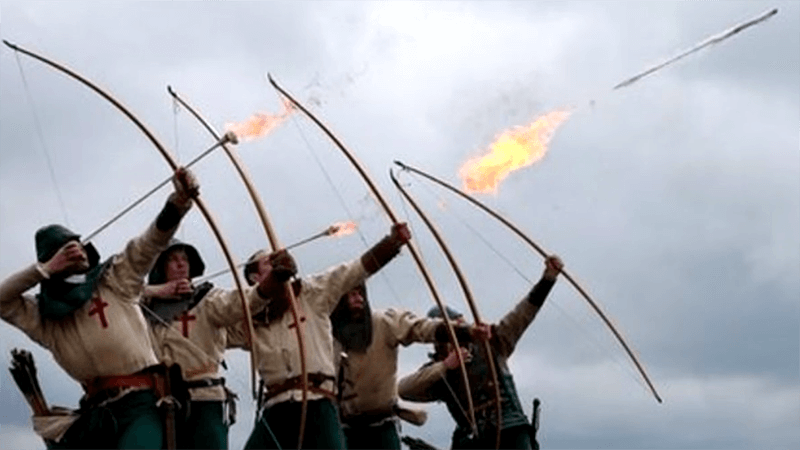
Notice that the arrow that’s been loosed has left its flame behind. Photo source.
Removing Arrows
Of course, if arrows are being shot in your book there is a high likelihood that a character of yours will have to deal with removing one. The challenge with arrow injuries is that they have the cutting damage of a knife plus the impact and penetration damage of a bullet.
There are only two methods of removal: pulling the arrow out or pushing it through. Which methods works best is determined by the location of the arrow, the depth of penetration and the type of arrowhead. The consensus seems to be if the arrow isn’t stuck in bone or if pushing it through will not damage internal organs or other sensitive structures, especially if the arrowhead has flanges or barbs, that it’s the best option. Otherwise, it has to be pulled out, requiring the wound to be expanded.
Since most people nowadays aren’t being shot with arrows there is not a lot of modern medical literature on their removal and the treatment of the resulting wound. Although there has apparently been a rise in cases thanks to the increasing popularity of archery as a sport. If you’re interested in a modern example, I suggest this article documenting the case of a 35-year-old man shot in the base of the skull. The removal was successful and the patient had no complications. I warn you there are some disturbing images in the article.
The ancient Greek healer Diocles of Carystus wrote of both methods of extraction. He developed a tool named the spoon of Diocles, which was used to remove the injured eye of Phillip II of Macedonia. [5]
During the battle of Shrewsbury in 1403, Henry, prince of Wales, who later became Henry V of England, was struck in the face by a bodkin-tipped arrow. The arrow shaft was removed but the arrowhead remained lodged in the bone of Henry’s skull. The Physician General John Bradmore removed the arrowhead using honey, alcohol, and a surgical instrument he designed himself. For a more in-depth look, I recommend this video.
One of the best historical resources on treating arrows wounds is a 19th century surgical encyclopedia by US Lieutenant Colonel J.H. Bill. In it he discusses both the pushing and pulling methods of removal based on depth and whether the arrowhead was lodged in the bone (determined by gently twisting). All his methods are done by feel, without the help of modern imaging. Most of the causes of death in his cases are due to infection such as peritonitis from the arrow piercing the abdominal cavity but he also lists pneumonia, encephalitis, compression of the brainstem, empyema, tetanus, and shock. [6] Here is the link to Dr. Bill’s work, which is a fantastic resource.

I hope this was helpful. Let me know if you have any questions or suggestions by using the Contact Me form on my website or writing a comment. I post every Friday and would be grateful if you would share my content.
If you want my blog delivered straight to your inbox every month along with exclusive content and giveaways please sign up for my email list.
Let’s get writing!
Copyright © 2020 Rebecca Shedd. All rights reserved.
 [1] Grant, p. 17. https://en.wikipedia.org/wiki/Early_thermal_weapons
 [2] Nossov, pp. 190–191. https://en.wikipedia.org/wiki/Early_thermal_weapons
 [3] Diaz de Gamez, p. 90. https://en.wikipedia.org/wiki/Early_thermal_weapons
 [4] Stephen Porter, Destruction in the English Civil Wars, 1997, p. 50.
 [5] "Ancient Medical Instruments". Retrieved 26 June 2015. https://en.wikipedia.org/wiki/Spoon_of_Diocles
 [6] Bill JH. International Encyclopedia of Surgery: A Systematic Treatise on the Theory and Practice of Surgery By Authors of Various Nations. Vol. 2. New York: William Wood & Co; 1882. Sabre and bayonet wounds; arrow wounds; pp. 101–117. https://www.ncbi.nlm.nih.gov/pmc/articles/PMC5999391/#REF3
The Writer’s Guide to Arrows: Part 1
Posted on November 20, 2020 4 Comments
Types & Construction
I’ve been spending a lot of time discussing bows but of course the bow is pretty worthless without arrows, which we will be diving into today. Just like bows, modern arrows differ significantly from historical arrows.
As always, magic is the exception to the rules. Because magic.
Arrow Terminology
Shaft – The wooden dowel that makes up on the body of an arrow. Modern arrows are also made of aluminum.
Nock – A notch in the back of the arrow that allows it to be set on the string. To nock, means to put an arrow on the string in preparation to fire, basically “loading” the bow.
Fletching – The feathers at the back end of the arrow that help steady it in flight.
Index or cock feather – On an arrow with three fletches, the one that faces the archer when nocked. It’s common for it to be a different color from the other two.
Arrowhead or Tip – The metal end of the arrow that penetrates the target.
Arrow Shafts
The average length of a modern arrow is 28 inches (71 cm). When Henry VIII’s flag ship, the Mary Rose, was discovered, it carried over 3,500 arrows. [1] They ranged in length from 24-33 inches (61-83 cms) with the average being 30 inches (76 cms).
Most modern arrows are around 5/16 – 11/32 inches or roughly 0.32 inches (0.81 cms) in diameter. By comparison, the war arrows or livery arrows found on the Mary Rose ranged from ½ – 3/8” inches (1.27-0.95 cms). Imagine that coming off a 185 pound (84 kg) bow! It would definitely have some punching power.
Types of Arrowheads
Most arrowheads were made of iron, which wasn’t good at keeping a sharp cutting edge. However, making arrowheads of steel got expensive. There are medieval records talking about “steeled” arrowheads. While historians aren’t totally sure what that means, the general consensus is that they were case hardened. The process of case hardening involves baking metal at high heat for hours which impregnates the iron with a layer of carbon, making it substantially harder. [2]
There were multiple types of arrowheads during the Middle Ages, each designed for a different purpose.
Probably the most widely known one is the broadhead, which has been used since ancient times for hunting. It usually has two to four broad blades, which make it ideal for cutting. Another benefit to this shape was that pulling it out caused even more damage. A swallowtail is a larger version of the broadhead used against game and horses.
With the advent of better armor, the bodkin became more widely used in warfare. It’s a needle-shape arrowhead which gave it a better chance of finding a hole through chainmail. Later into the Middle Ages, the bodkin became thicker and shorter as plate armor became more common.
Leaf-shaped arrowheads are an ancient design that was still in use throughout the medieval period. They are similar in shape to a broadhead but lack the “wings.”
There is some documentation of whistling or signal arrows from the Middle Ages.
I recommend this video by Tod’s Workshop in which he discusses six types of arrowheads.

How They Are Made
How arrows were made in the Middles Ages varies somewhat from how traditional arrows are made today.
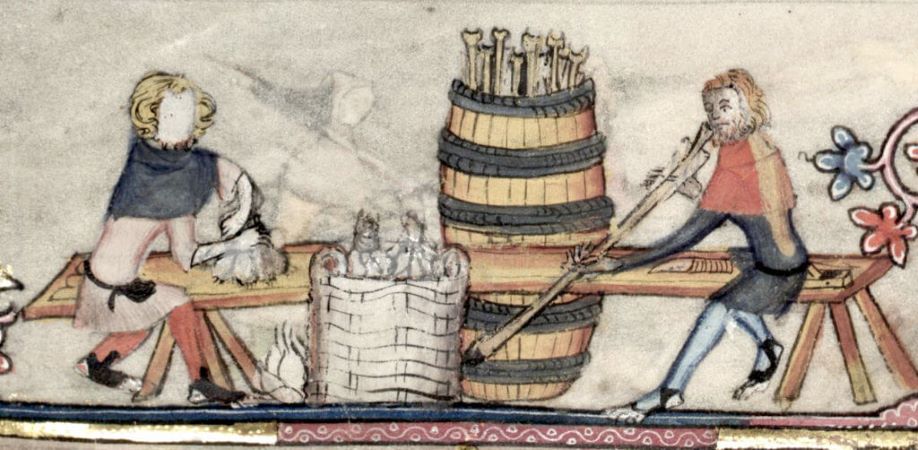
The body of the arrow began as a square section of wood which was turned on a jig to round them into dowel-like shafts. Then they were sanded until smooth. Types of wood used included black popular, beech, ash, and hazel.
The arrowheads were forged with a cap that slipped over the end of the shaft. It was held in place with hide glue. [3]
Fletchings were made from swan or goose feathers since they were the only feathers long and strong enough to withstand flight. [4] Today, turkey feathers are the standard. The fletching was attached using the same hide glue, sometimes mixed with beeswax or other components. Today a fletching gig is used to hold the feathers in place while the glue dries. However, there is little historical evidence that fletching gigs existed in the Middle Ages. It’s possible but we just don’t know. However, we do know that the fletching was normally wrapped with linen or silk thread to keep the feathers in place. This was important since hide glue is not water resistant. [4] There were several popular shapes for fletching including triangular, parabolic and parallelogram.
Lastly, a notch would be cut into the end of the arrow to form the nock.
I hope this was helpful. Let me know if you have any questions or suggestions by using the Contact Me form on my website or writing a comment. I post every Friday and would be grateful if you would share my content.
If you want my blog delivered straight to your inbox every month along with exclusive content and giveaways please sign up for my email list.
Let’s get writing!
Copyright © 2020 Rebecca Shedd. All rights reserved.
[1] https://leatherworkingreverendsmusings.wordpress.com/research/arrows/mary-rose/#:~:text=Over%203500%20arrows%20were%20found,was%20810mm%20(32%20inches).
[2] https://www.youtube.com/watch?v=McnKrV0aDjo
[3] https://en.wikipedia.org/wiki/Arrowhead
[4] https://www.bow-international.com/features/arrows-in-the-middle-ages/#:~:text=Arrow%20shafts%20from%20the%20high,wood%20with%20a%20small%20saw.
The Writer’s Guide to Bows: Part 5
Posted on November 13, 2020 4 Comments

Miscellaneous
This is the last in my series on bows before we move on to arrows. Today we are busting myths! There is so much misinformation being spread by books, television, and movies. Some of it’s completely false while the rest is true of modern bows but not traditional or historical bows.
As always, magic is the exception to the rules. Because magic.
Holding at Full Draw
I have seen multiple scenes in movies and television shows where an archer is holding their bow at full draw for minutes on end. At the end of season three of Game of Thrones, Ygritte confronts Jon Snow, aiming an arrow at him. She holds at full draw for 1:18 before releasing!
While not impossible, especially with a lighter poundage bow, holding full draw for an extended time becomes difficult because of two factors: draw weight and stacking. If the draw weight (pounds of pressure at full draw) is high, such as a traditional English longbow that ranged from 100-185 pounds (45-84 kg), it would require tremendous strength to hold the string back for any length of time. Stacking is the increase in weight as the bowstring is pulled back. On average, this is an increase of 2-3 pounds (0.9-1.3 kg) per inch (2.54 cm). [1]
Modern compound bows have a let-up point at which the string resistance decreases dramatically. An archer with this type of bow can stay at full draw for minutes on end. However, most depictions of holding at full draw in literature and film involve either a longbow or a recurve.

Effectiveness Against Armor
I covered effectiveness in my first post on writing medieval armor which you can find here. As the bow became more widely used in warfare, armor was developed to protect against it. Early armor only offered partial protection while a full suit of 15th century plate had few spots an arrow could penetrate. By contrast, the peasant wearing a gambeson will be less protected. If you are interested in the effectiveness of a specific type of armor, I recommend you check out my posts on gambesons, chainmail, plate, and brigandine.
Below is one of my favorite quotes about the power of the 12th century Welsh longbow by Gerald of Wales. The wars with the Welsh were the first time the longbow was used to great effect in war and the armor worn by the English wasn’t rated against it.
“[I]n the war against the Welsh, one of the men of arms was struck by an arrow shot at him by a Welshman. It went right through his thigh, high up, where it was protected inside and outside the leg by his iron chausses, and then through the skirt of his leather tunic; next it penetrated that part of the saddle which is called the alva or seat; and finally it lodged in his horse, driving so deep that it killed the animal.[2]”

Bows Have to Be Unstrung
It is essential when a bow is not in use for it be unstrung. If left strung for too long then it will lose its spring, causing a decrease in the draw weight. The power of a bow comes from a bent bow trying to be straight again. One that is strung for too long will start to permanently take on that bend.
Wet Bowstrings
It is incredibly important to keep the bowstring dry. A wet string stretches, causing your shots to fall short. During the Middle Ages, if there was any risk of rain or damp, an archer would remove the string and place it in an oiled bag or under his helmet. Points to Robert Jordan for including this detail in “The Eye of the World.”
Dry Fire
A dry fire is when the bowstring is pulled back either partially or fully then released without an arrow. This is the greatest sin in archery. Dry firing a bow can damage or even snap or shatter it or cause the string to break. The reason it is so bad is because the kinetic energy generated by drawing which normally goes into the arrow to propel it forward instead slams back into the bow.
Writer’s Tip: Having a character dry fire a bow could be a way of showing what a novice they are, especially if other more experienced characters around them react in horror.
I hope this was helpful. Let me know if you have any questions or suggestions by using the Contact Me form on my website or writing a comment. I post every Friday and would be grateful if you would share my content.
If you want my blog delivered straight to your inbox every month along with exclusive content and giveaways please sign up for my email list.
Let’s get writing!
Copyright © 2020 Rebecca Shedd. All rights reserved.
[1] https://archeryboss.com/guides-info/archery-stacking
[2] Weapon 030 - The Longbow, Osprey, p. 66, 12 At the time, 1191, this would be mail chausses, and the story is that having had one leg shot through and pinned to the saddle by an arrow, the knight wheeled his horse around, only to receive a second arrow, which nailed the other leg in the same fashion.
https://en.wikipedia.org/wiki/English_longbow
The Writer’s Guide to Bows: Part 4
Posted on November 6, 2020 46 Comments

Use in Battle & Construction
Today I will be covering the use of bows in battle as well as maintenance and construction. There is a lot more to using archers in battle then lining them up and having them shoot. Also, the tactics used in an open field battle are different from the siege of a castle or city.
As always, magic is the exception to the rules. Because magic.
Use in Battle
Archers were an important part of most medieval armies. They could cause damage to the enemy before they even reached your lines. Once the enemy forces closed to melee distance, the infantry would either move in front of the archers or the archers would fall back. During the Battle of Hastings in 1066, William of Normandy opened the battle by placing is archers on the front line and had them shoot into the English shield wall. His initial plan was to then bring up the infantry to engage at close combat. [1] This tactic was repeated in 1415 during the Battle of Agincourt by King Henry V of England. The center front line and the flanks were made up of archers with the men-at-arms and knights held back in reserve in the center. [2]
Battle Formations
There were three main archery formations used in open field battles throughout medieval Europe.
First was the line. This formation provided a large volume of fire, especially if there were multiple ranks and the archers were shooting ranged volleys.
Next was the enfilade, a V-shaped formation with the wings closest to the enemy and the center point the furthest away. Two enfilades could be used together, creating a W shape. In several medieval battles, such as the Battle of Crécy in 1346, multiple enfilades were used.
Last was the defilade, essentially the reverse of the enfilade with the point of the V closest to the enemy.
Both the enfilade and defilade were incredibly effective on sloping or uneven ground.
When using archers to defend a castle or city, they would either shoot through arrow loops or slits or between the merlons, a space called the crenel, of a battlement. Both features provided them with an excellent field of fire while making it hard for the enemy to hit them.

Quivers
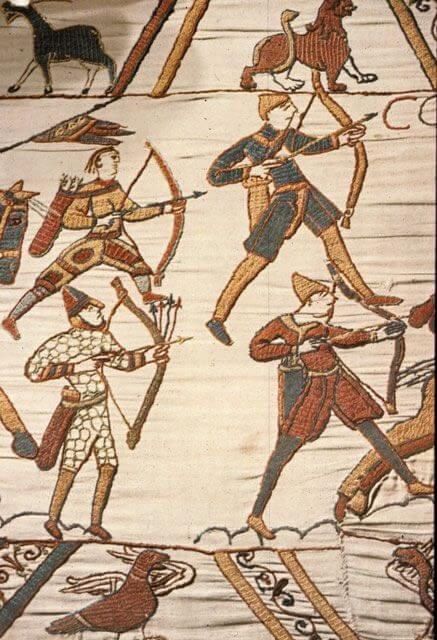
Most of the depictions of quivers from medieval Europe show a belt quiver, such as on the Bayeaux tapestry. Across various sources it is shown in multiple positions, hanging straight at the side, across the small of the back and on both the right and the left as well as canted forward and backward. [3] As well there are depictions of arrows stuck through the belt. Medieval archers also used an arrow bag which was a simple drawstring cloth sack with a leather spacer in the top to keep the arrows separated that could be closed to protect them from dirt and rain.
During medieval battles it was common for archers to stick their arrows in the ground in front of them, their supply replenished by young boys acting as the medieval equivalent of power monkeys. This had the added benefit of dirtying the arrowhead, increasing the likelihood of infection.
Despite popular depictions of Robin Hood with a back quiver, this type of quiver was quite rare in medieval Europe. [4]
War arrows were usually bundled into sheaves of 24 arrows. It was common for archers to go through thousands of sheaves in a battle. To give you an idea of the numbers involved, between 1341 and 1359 the English crown ordered 51,350 sheaves. That’s 1,232,400 arrows! [5]

Maintenance
Like all pieces of equipment maintenance is essential for a bow to operate at peak efficiency. It is important to warm up the bow before stringing it. This involves rubbing up and down the limbs to create heat by friction. Once the bow is strung, some half draws and then several full draws are done to further warm the wood fibers, easing down after each one. If a bow is not warmed up before it is strung, it can snap. I have seen it happen.
Another important task is to keep the string waxed. This will hold the fibers together and help prevent fraying. Wax usually came in a block or a tube in modern times, which would be rubbed up and down the string then smoothed in with the fingers. It’s important to use the heat of your fingers or friction to get the wax to melt into the string. The string would also have to be replaced regularly as it stretched out or frayed.
How They Were Made
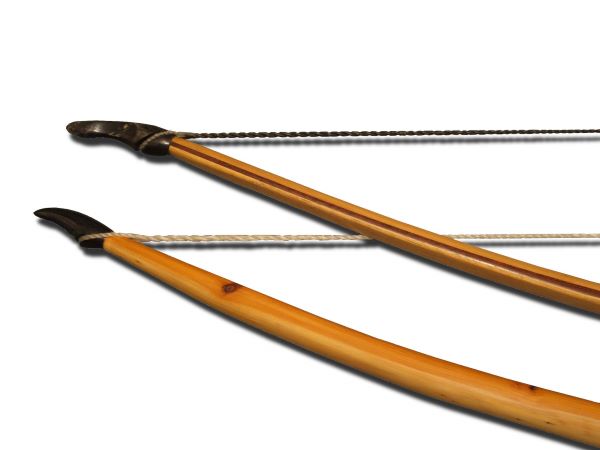
The most popular wood for longbows was yew although elm, oak, hickory, ash, hazel, and maple were also used. Most were self bows made of a single piece of wood and in the case of recurves, the ends were shaped by heat or force. [6] The other method of construction was lamination, done by gluing different pieces of wood together. Laminated or composite recurves were the standard weapon of Roman imperial archers and have been found on multiple sites throughout the empire.
A bowyer was a craftsman who made bows. To make a self bow, he would select a stave and set it in the clamp of a bowyer’s bench, which would hold it steady while he carved it into shape with a draw knife. In medieval England, a bowyer could reportedly crank out a longbow in as little as two hours. [7] Modern traditional bowyers average between 2-40 hours depending on whether power tools are used. Although if you include the time to dry the staves, that time increases to years. [7] If you want a step-by-step of the making of a longbow with mostly traditional methods, I suggest this video.

I hope this was helpful. Let me know if you have any questions or suggestions by using the Contact Me form on my website or writing a comment. I post every Friday and would be grateful if you would share my content.
If you want my blog delivered straight to your inbox every month along with exclusive content and giveaways please sign up for my email list.
Let’s get writing!
Copyright © 2020 Rebecca Shedd. All rights reserved.
[1] Bennett Campaigns of the Norman Conquest p. 41
https://en.wikipedia.org/wiki/Battle_of_Hastings#Dispositions_of_forces_and_tactics
[2] Sumption, Jonathan (2015). The Hundred Years War IV: Cursed Kings. London: Faber & Faber. ISBN 978-0-571-27454-3.
https://en.wikipedia.org/wiki/Battle_of_Agincourt#English_deployment
[3] https://en.wikipedia.org/wiki/Quiver
[4] Gerry Embleton; Clive Bartlett (1995). English Longbowman 1330-1515Ad (Warrior, No 11). Osprey Publishing (UK). p. 28. ISBN 1-85532-491-1.
https://en.wikipedia.org/wiki/Quiver
[5] Wadge, Richard (2007). Arrowstorm. Stroud: Spellmount. pp. 160–1. ISBN 978-1-86227-388-7.
https://en.wikipedia.org/wiki/English_longbow#Arrows
[6] https://en.wikipedia.org/wiki/Recurve_bow
[7] https://en.wikipedia.org/wiki/Bowyer
The Writer’s Guide to Bows: Part 3
Posted on October 30, 2020 1 Comment

Poundage, Range, Rate of Fire & Training
In the third part of my five-part series on bows, I will be covering some more bits of critical information if you are writing an archer, especially if you’re doing a battle scene.
As always, magic is the exception to the rules. Because magic.
Poundage
Probably one of the biggest differences between historical bows and modern bows is poundage. By poundage, I mean the amount of weight the bow is exerting on the string when it is at full draw. The standard modern draw length is 28 inches (71 cm).
The draw weights of most modern longbows and recurves are in the 25-60 pound (11-27 kg) range. In 1971, the wreck of King Henry VIII of England’s flag ship, the Mary Rose, was discovered. The ship sank during the battle of Solent on July 19th, 1545. In the hold were 170 English longbows, almost 4,000 arrows and various other archery artifacts. The draw weights ranged from 100-185 pounds (45-84 kg)! [1] It took a lot of strength to pull one of these bows. Another indicator of the immense weight of medieval bows are the deformities seen in the skeletons of longbow archers from the period. They have enlarged left arms and most have osteophytes (bony projections along the joint margins) on the left wrist and shoulder and right fingers. [2]
Writer’s Tip: It would be wonderful to see a depiction of a real war bow. Unfortunately, books, movies and television tend to portray the bow as a weak person’s weapon.

Range
King Henry VIII set a minimum practice range for adults in 1542 of 220 yards (201 m). The longest recorded longbow shot was 345 yards (315 m) in the 16th century at Finsbury Fields in London. In 2012, Joe Gibbs, a well-known English longbowman, shot a 2.25-ounce (64 g) livery arrow 292 yards (267 m) using a yew bow with a 170 pound (77 kg) draw weight. [3] If you want to see Joe Gibbs in action with his 160-pound longbow, I suggest this video from Tod’s Workshop.
Rate of Fire
I can say from experience that a competent longbow archer can shoot at a rate of up to twelve arrows per minute with relatively good accuracy. The heavier the poundage of the bow, the less that rate is sustainable, however. An author in Tudor England expected a longbowman to be able to fire eight shots in the same amount of time a musket shot five. [4] However, the rate of fire could also be limited by the number of arrows available. It would not do to run out of arrows before the end of a battle!
Training
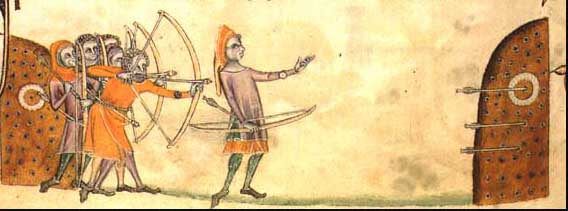
The English archers became renowned for their skills, due in large part to compulsory practice. A law passed in 1252 required all Englishmen aged 15 to 60 to own a bow and arrows. Another law passed in 1363 required them to practice archery for two hours every Sunday. [5] This law is still on the books so if you are a man living in England over the age of 14 legally you should be at the archery range every Sunday.
Despite the simplicity of shooting a bow, it takes time and consistent practice to become good. Being proficient at archery was also patriotic because it meant a man could help defend the kingdom if it went to war not to mention being able to supplement your diet with fresh game.
I hope this was helpful. Let me know if you have any questions or suggestions by using the Contact Me form on my website or writing a comment. I post every Friday and would be grateful if you would share my content.
If you want my blog delivered straight to your inbox every month along with exclusive content and giveaways please sign up for my email list.
Let’s get writing!
Copyright © 2020 Rebecca Shedd. All rights reserved.
[1] https://archeryhistorian.com/the-mary-rose-longbows/
[2] Dr. A.J. Stirland. Raising the Dead: the Skeleton Crew of Henry VIII's Great Ship the Mary Rose. (Chichester 2002) As cited in Strickland & Hardy 2005, p. https://en.wikipedia.org/wiki/English_longbow
[3] Loades 2013, p. 65. https://en.wikipedia.org/wiki/English_longbow#Range
[4] A right exelent and pleasaunt dialogue, betwene Mercury and an English souldier contayning his supplication to Mars: bevvtified with sundry worthy histories, rare inuentions, and politike deuises. wrytten by B. Rich: gen. 1574. Published 1574 by J. Day. These bookes are to be sold [by H. Disle] at the corner shop, at the South west doore of Paules church in London. https://bowvsmusket.com/2015/07/14/barnabe-rich-a-right-exelent-and-pleasaunt-dialouge-1574/ accessed 21 April 2016. https://en.wikipedia.org/wiki/English_longbow#Shooting_rate
[5] http://www.lordsandladies.org/the-butts.htm
The Writer’s Guide to Bows: Part 2
Posted on October 23, 2020 1 Comment
Stringing & Shooting
Today is my second part in my five-part series on bows. I will be covering more of the basics of shooting so that you are better equipped to write about them in your fiction.
If you have the chance, I highly encourage you to try archery out for yourself. Experience is really the best teacher and there will be a lot of first-hand detail that you can pour into your writing. If you are specifically looking for information to write medievalesque fantasy or historical fiction, I suggest you stay away from modern compound bows. The experience of shooting one is substantially different from shooting a traditional longbow or recurve.
As always, magic is the exception to the rules. Because magic.
Stringing a Bow
Before you can shoot a bow, it must be strung. Bows should always be unstrung when not in use. If they are left strung, they will lose their power as the wood permanently takes on the bend. The power of the bow comes from a bent bow trying to be straight or mostly straight.
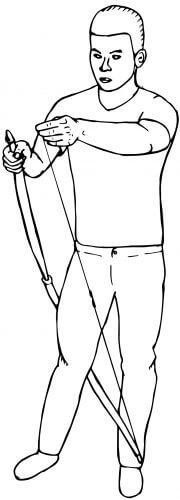
There are a couple ways of stringing a bow. One is putting one tip against the inside of your foot and pulling up while you slide the string into the notch with your other hand. Another method is to step through the bow, bending one limb forward while you slide the string up with your other hand. There are modern bow-stringers but I have yet to see evidence of anything like them being used in history.

How to Shoot a Bow
Most archers are righthanded so the following description is for righthanded shooting. Shooting lefthanded is simply the reverse of this description.
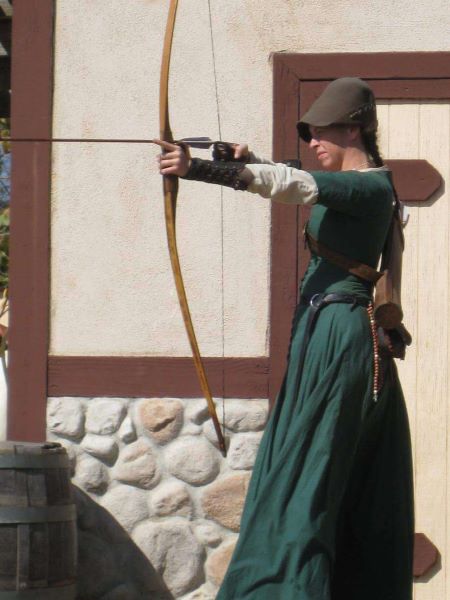
Before shooting, it’s important to make sure none of your clothing will interfere with drawing or releasing the string. Loose, long, or billowy sleeves can get caught up in the string as you’re firing, dissipating all the energy of the shot and causing the arrow to not leave the string or not go far. Sleeves were usually tucked or tied back unless they were slim and fitted. It was common to use an archer’s glove that covers your forearm, protecting from the string if it hits. Finger tabs or gloves were also frequently worn on the right hand to protect the fingers from the abrasion of pulling back and releasing the string repeatedly.
To start, hold the bow by the grip with your left hand, letting it cradle firmly into the webbing between your thumb and index finger. You don’t want to grip the bow but hold it lightly. If the bow has an arrow shelf make sure there is a bit of distance between it and your hand or the feathers on the arrow could slice your hand as its being shot. If the bow does not have a shelf and you’re shooting off your hand, it’s usually a good idea to wear a glove.
Next the arrow is put onto the bow or nocked. The arrow is always on the inside of the bow. The easiest way I’ve found to do this is by canting the bow slightly to the right, gripping the arrow by the end or nock, resting the front part of the arrow against the arrow rest, pulling back the end and nocking it to the string. Modern plastic nocks will snap on to the string, preventing the arrow from coming off. Traditional arrows had a small groove cut in the end of the arrow that would fit over the string but not necessary “snap” on, meaning the archer would usually have to grip it between their fingers. If the bowstring has a bead, the arrow is nocked right below it.
Most arrows have three feathers or fletching. One is usually a different color from the others and is known as the index or cock feather. When nocking, you want to make sure the index feather is facing you. If it’s facing the opposite direction, it will drag against the bow when the arrow is shot, effecting the flight.
You put three fingers on the string, the index finger above the arrow and the other two below it, known as a Mediterranean draw. However, you don’t grip the string but let it rest lightly against the inside of your first knuckle. As I’ve told a number of my archery students, it’s like plucking a harp string. Some archers do prefer to shoot with three fingers below. There is some evidence that European medieval archers shooting heavy war bows would “lock” their fingers down with their thumb. Some cultures in Asia used a thumb draw instead of their fingers and some Middle Eastern, Eastern European, and Native American cultures use a pinch draw, squeezing the end of the arrow between the index finger and thumb. [1]
Once your fingers are on the string, you sight down the arrow to aim, lining up the arrowhead with your target. Sometimes you must aim higher than your target to account for the distance and drop of the arrow. Then you pull back to your anchor point. It is essential to keep your elbow up to use all your back muscles. Then steady your body as much as possible, do any last minute aiming and relax your fingers to release.
If you are shooting at a distant target, especially if your bow is a lighter poundage, then you will have to raise the bow, usually to a 90º angle. For longer shots, it is common to overdraw, pulling back to touch the chest instead of the face or passed the ear. You must be careful that the tip of your arrow doesn’t get pulled back past the bow.
Here is a helpful video showing how a traditional longbow is shot.

I hope this was helpful. Let me know if you have any questions or suggestions by using the Contact Me form on my website or writing a comment. I post every Friday and would be grateful if you would share my content.
If you want my blog delivered straight to your inbox every month along with exclusive content and giveaways please sign up for my email list.
Let’s get writing!
Copyright © 2020 Rebecca Shedd. All rights reserved.
[1] https://en.wikipedia.org/wiki/Bow_draw
The Writer’s Guide to Bows: Part 1
Posted on October 16, 2020 4 Comments

Terms & Types
The bow has almost as much mythology surrounding it as the sword. There are several high profile literary and cinematic archers including Katniss Everdeen from “The Hunger Games,” Legolas from “The Lord of the Rings,” and Hawkeye from the Marvel Universe. This, of course, is not getting into the many retellings and remakes of the legend of Robin Hood.
Since the bow is more common in our modern world than the sword and people are more likely to have contact with them, there does seem to be fewer archery misconceptions. However, the biggest thing to remember when writing archery, especially in a medieval or medieval fantasy setting, is that modern archery can vary dramatically from historical and traditional archery.
Most of the information I am presenting comes from practical experience. I have been shooting since 2001 and exclusively use an English longbow and wooden arrows that I make myself.
As always, magic is the exception to the rules. Because magic.
Writer’s Tip: Since archers usually need to be at a distance from the front line and preferably on higher ground, this could be a great chance for your character to provide an overview of a battle
Terminology
Archery has its own set of terms which can cause a lot of confusion for those unfamiliar with them. Below is a list of basic archery terms.
Limb – The upper and lower arms of the bow. At the end of each limb is the notch for the string. [1]
Grip – The section of the bow where the archer holds it. It’s usually located in the middle between the limbs.
Arrow shelf or arrow rest – A cutaway portion above the grip where the arrow rests. Not all bows have them in which case the arrow rests on the top of the hand gripping the bow.
Nocking point – The spot on the string where the arrow is nocked. Sometimes it is marked by a small metal bead that the arrow is nocked below.
Drawing – The act of pulling back the string of a bow.
Full draw – When the string of the bow is fully pulled back. The modern standard draw length is 28 inches (71 cm).
Serving – A section of the bowstring that is wrapped in thread. It makes that section more durable and able to withstand the wear from nocking and drawing.
Anchor – Once an archer has pulled back to full draw, they normally steady or anchor their hand against their face before releasing. This gives a chance to steady and aim.
Anchor point – A spot on the face that an archer touches when they are anchoring. Anchoring at the same point helps increase accuracy. In the “Hunger Games” movies, Katniss always anchors under her jaw.
Loose – To fire the bow. The archer relaxes their fingers, allowing the bowstring to propel the arrow forward.
Flight – A group of arrows in the air.
Volley – A flight of arrows shot at the same time by a group of archers.
Overdraw – When an archer pulls the string back further than it should be. Usually this means the head of the arrow is pulled back past the bow and the archer’s hand gripping the bow. If the arrow is loosed, it could be shot into the bow or the archer’s hand.
End or butt – A target or a backstop to which a target is affixed.
Quiver – A carrying bag for arrows worn either on the back with a shoulder strap or on the hip, suspended from the belt.

Types of Bows
The two types of bows used during the Middle Ages in Europe were the longbow and the recurve.
The longbow is so named because it is commonly five to six feet (1.5-1.8 m) tall or roughly the height of the archer. When strung it looks D-shaped. The earliest example of a longbow was discovered in the Ötztal Alps in Austria in 1991 with the remains of a natural mummy who was named Ötzi. His body was dated to around 3,300 BC. The bow was made of yew and was 72 inches (1.82 m) long. The longbow was used effectively by the Welsh in their wars against the English. After the English defeated them, they incorporated the longbow into their army, using them in large numbers during the Hundred Years’ War against the French. The longbow played an important part in notable victories such as the battles of Crécy (1346), Poitiers (1356), and Agincourt (1415). [2]
The recurve bow also earned its name from its shape. The middle portion still has a D-shape but the ends of the limbs curve back (recurve) toward the front. It can also be much shorter than a longbow without sacrificing power, making it ideal for mounted archery. This type of bow can generate more energy than a longbow of the same length. Recurves were mainly used throughout the Middle East, portions of Eastern Europe such as Greece and Turkey, North Africa, Asia, and North America. [3]


I hope this was helpful. Let me know if you have any questions or suggestions by using the Contact Me form on my website or writing a comment. I post every Friday and would be grateful if you would share my content.
If you want my blog delivered straight to your inbox every month along with exclusive content and giveaways please sign up for my email list.
Let’s get writing!
Copyright © 2020 Rebecca Shedd. All rights reserved.
[1] https://www.tutorialspoint.com/archery/archery_terms.htm
[2] "The Efficacy of the Medieval Longbow: A Reply to Kelly DeVries," Archived 2016-01-23 at the Wayback Machine War in History 5, no. 2 (1998): 233-42; idem, "The Battle of Agincourt", The Hundred Years War (Part II): Different Vistas, ed. L. J. Andrew Villalon and Donald J. Kagay (Leiden: Brill, 2008): 37–132.
https://en.wikipedia.org/wiki/Longbow
[3] https://en.wikipedia.org/wiki/Recurve_bow
The Writer’s Guide to Brigandine Armor
Posted on October 9, 2020 8 Comments
This week is my fourth and final installment in my series on common medieval armor.
As always, magic is the exception to the rules. Because magic.
Writer’s Tip: Even though brigandine armor was common in medieval Europe it is rarely depicted in literary. Including “brig” into your book would be an interesting way to stand out in the plate armor crowd.
Introduction
Brigandine is a type of torso armor composed of small rectangular metal plates or bands riveted to an outer layer of heavy cloth, canvas, or leather. It usually has an inner lining. It is generally sleeveless although there is medieval artwork showing brigandine with pauldrons (shoulder armor) and vambraces (forearm armor).
This type of armor is a more refined version of the earlier coat of plates which was worn from the 12th to the 14th century. It followed the same construction of metal pieces riveted between two layers of cloth, canvas, or leather but the plates were much larger. Brigandine came into use during the 14th century and was popular and widely used throughout the 15th and 16th centuries. [1]
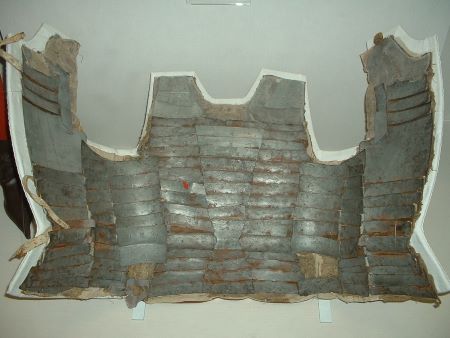
Photograph by Gaius Cornelius at the Royal Armoury, Leeds. Photo source.
How It Was Worn
Brigandine was normally worn over a gambeson and hauberk (mail shirt) although it could also be worn with a gambeson with mail voiders. Starting in the mid-15th century the gambeson was replaced with the arming doublet. There are several medieval depictions of brigandine paired with plate limb armor.
It was common across all social classes. Yeomen wore it because it was effective and affordable. Noblemen wore it because they could choose a fancy fabric for the outside. Brigandine was also popular because it did not require a squire to put it on since it normally buckled in the front and because the individual plates allowed for greater movement than plate armor. It was worn by many of the archers during the Hundred Year’s War and they had to have the range of motion to draw a bow.
I have worn brigandine and had no problem shooting a longbow or running in it. I suggest watching Shadiversity’s video here for more information.
Weight
An example of 16th century Italian brigandine in the collection of the Philadelphia Museum of Art tips the scales at 23.4 pounds (10.6 kg). [2] My guess is that this number is probably a good indication of the average weight. [3]
Cost
According to the British historian David Nicolle in his book “French Armies of the Hundred Years War,” a young nobleman would have to spend 125 to 250 livres to fully equipment himself in the best gear. That sum represented eight to sixteen months of wages for an ordinary man-at-arms. He then goes on to say “Salets were valued at between 3 and 4 livres tournois, a jacque, corset or brigandine at 11 livres.” [4] This means a brigandine would cost an ordinary man-at-arms less than a month’s wages. That explains why we see it depicted so commonly in contemporary artwork, like this 15th century painting of the Battle of Agincourt in which all the archers are wearing brigandine beneath their tabards.

Effectiveness and Vulnerabilities
Brigandine armor was effective against most types of attacks although not as protective as plate. Since it is made up of individual plates instead of a solid piece of metal, a person attacking someone wearing brigandine had a higher chance (although probably still not that good) of penetrating between the plates. Also, the plates would flex under a crushing blow although not as much as mail.
I hope this was helpful. Let me know if you have any questions or suggestions by using the Contact Me form on my website or writing a comment. I post every Friday and would be grateful if you would share my content.
If you want my blog delivered straight to your inbox every month along with exclusive content and giveaways please sign up for my email list.
Let’s get writing!
Copyright © 2020 Rebecca Shedd. All rights reserved.
[1] https://en.wikipedia.org/wiki/Brigandine
[2] https://www.philamuseum.org/collections/permanent/71388.html
[3] https://www.philamuseum.org/collections/permanent/71388.html
[4] https://armstreet.com/news/the-cost-of-plate-armor-in-modern-money
The Writer’s Guide to Plate Armor
Posted on October 2, 2020 99 Comments

This week is the third part in my series about common types of medieval armor. As in my previous posts, I will be pointing out misconceptions.
As always, magic is the exception to the rules. Because magic.
Introduction
Plate is probably the most iconic type of armor from medieval Europe, conjuring up images of the “knight in shining armor” from fairy tales. Full plate armor had its golden age from the late 15th to the early 16th century. There were multiple styles of plate armor that varied across time and regions and it was not uncommon for soldiers to wear partial suits either to limit the weight or because they could not afford all the pieces.
An early transitional style of armor known as a coat of plate was worn from the 12th to the 14th century and was a rudimentary breastplate made of large metal plates riveted to the inside of a cloth or leather garment and worn over mail. [2] The development of flintlock muskets in the 17th century, which could punch through plate armor at a considerable distance, lead to a decline in its use. The breastplate was the last piece to be employed and was worn by soldiers in the Napoleonic wars to protect them against shrapnel. [1]
Pieces
The base layer underneath plate armor was an arming doublet and thick woolen hosen or padded legs called cuisses. A full suit of plate armor was made up of the following pieces.
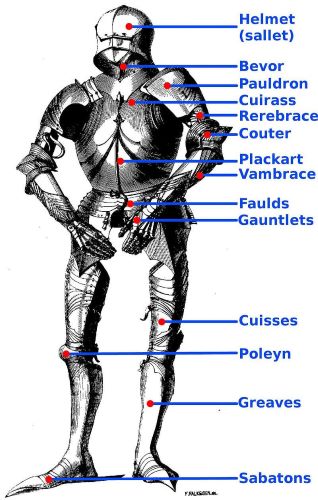
A helmet which could either completely enclose the head such as a bassinet, barbute, armet or close helm, cover only the upper part of the face such as a sallet or be open faced like a burgonet.
The neck was protected by a gorget worn over a bishop’s mantle of mail. If a sallet was being worn it was paired with a bevor that protected the jaw and neck.
A breastplate, also known as a cuirass, protected the chest and historically did not always include the backplate. Bands known as faulds could be attached to the bottom of the breastplate to shield the front of the hips. Bands attached to the bottom of the backplate were known as culets.
Spaulders covered the shoulder and upper arm but not the armpit. The gap could be filled by an extra piece such as a gardbrace, basagew or rondel. A different option was pauldrons, which did cover the armpit and sometimes part of the back and chest.
The elbow was protected by couters and the space between them and the bottom of the shoulder armor was filled by a rarebrace, brassart or upper cannon.
The forearms were covered by the vambraces or lower cannons.
Gauntlets protected the hands and could be a mitten style or have individually articulated fingers. The legs were covered by the cuisse on the thigh, poleyn on the knee and greave on the lower leg. The feet were protected by sabatons or sollerets. For additional protection, armor plates known as tassets could be suspended from the bottom of the breastplate. [3]
Effectiveness and Vulnerabilities
The biggest misconceptions about plate armor are the weight and the effectiveness. I tackled this myth in my introduction to medieval armor which you can find here. Plate armor was highly effective against most medieval weapons although there was some success in developing a heavier bodkin arrowhead that could punch through the thinner plates and in using a heavy bludgeoning weapon to crush in the armor.
There are three main points of vulnerability in a suit of plate: the eye slit, the armpit and the back of the knee. The eye slit on most helmets (unless it’s open face) was quite narrow and usually required either a near-impossible archery shot or being close enough to stab a knife through.
The armpit was vulnerable because it couldn’t be completely protected by armor or the wearer wouldn’t have the range of motion needed to swing a sword. If the person is using a shield and a one-handed arming sword their right armpit is the most vulnerable because it’s not protected by the shield and they expose it every time they raise their arm for a strike.
The back of the knee, like the armpit, is unarmored for freedom of movement. A great literary example of this vulnerability is Pippin stabbing the Witch King in the back of the knee in Tolkien’s “Return of the King.”
Another problem with plate armor is the smoothness of the surface which makes it is more likely to get stuck in mud. There are accounts from the Battle of Agincourt in the Hundred’s Year War of a number of unhorsed knights becoming so mired in the mud that they could not get back up and some even drowned in their helmets.
Writer’s Tip: Knowing the vulnerabilities of plate armor is a great way to injure your character even when your reader thinks they’re safe because they’re wearing armor.

Cost
The cost of plate varied according to the complexity as well as over time. For example, a total suit of armor owned by a knight in 1374 was valued at £16 6s 8d while that owned by Thomas of Woodstock, duke of Gloucester, in 1397 was worth £103. [4] For a more comprehensive list, I suggest the Medieval Price List.
I hope this was helpful. Let me know if you have any questions or suggestions by using the Contact Me form on my website or writing a comment. I post every Friday and would be grateful if you would share my content.
If you want my blog delivered straight to your inbox every month along with exclusive content and giveaways please sign up for my email list.
Let’s get writing!
Copyright © 2020 Rebecca Shedd. All rights reserved.
[1] https://en.wikipedia.org/wiki/Plate_armour
[2] https://en.wikipedia.org/wiki/Coat_of_plates
[3] https://en.wikipedia.org/wiki/Components_of_medieval_armour
[4] Standards of Living in the Later Middle Ages, Christopher Dyer, Cambridge University Press, 1989.
The Writer’s Guide to Chainmail
Posted on September 25, 2020 11 Comments

This week is the second part in my series about common types of medieval armor. As in my first post, I will be pointing out misconceptions with each type.
As always, magic is the exception to the rules. Because magic.
Introduction
Chainmail is a type of armor made up of small metal rings linked together and either butted, welded, or riveted closed. The earliest example is from a 3rd century Slovakian burial and it continued to be used on the battlefield in Europe into the 14th century. Chainmail or mail as it was called in medieval Europe, was also used in the Middle East, India, China, Japan, and central and western Asia. In the Ottoman Empire, it was worn by the Janissaries until the 18th century. [1]
Types and Weight
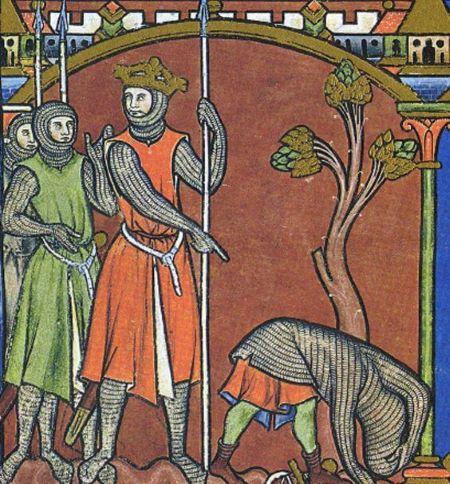
Mail was fashioned into shirts called hauberks in Europe, which could have sleeves of varying lengths or be sleeveless. Their weight depends on the length, the pattern, and the material. The Wallace Collection in London has several hauberks ranging in weight from 9.9 pounds (4.5 kg) for a short sleeved 14th century example to 19.8 pounds (9 kg) for a 15th century long sleeved hauberk. The examples ranged in length from 25 inches (64 cm) to 29 inches (74 cm). Mail was also used to make coifs, which protected the head and neck, and bishop’s mantles, which covered the shoulders. Mail leg armor was known as chausses and could cover the whole leg or just come to the knee and were attached to the arming belt. An example in the Wallace Collection weighs 14 pounds (6.4 kg).
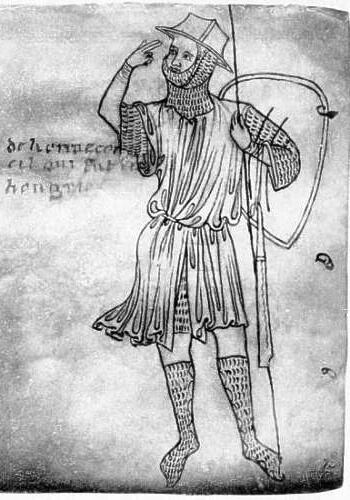
Photo courtesy of Wikipedia. Photo source.
How It Was Worn
Mail was usually worn over a gambeson, which provided protection against chaffing as well as cushioning against bludgeoning or crushing blows. Arming caps were normally worn under coifs and woolen leggings under chausses. In medieval paintings warriors wearing mail coifs have a distinctive “bubblehead” look that is caused by the padding from their arming caps. Chainmail was normally never worn directly over clothing or against the skin because it chafes, snags hair and cloth and the oils used to keep it from rusting rub off onto whatever it is resting against. Early on mail was the primary piece of armor but later into the Middle Ages it was paired with brigandine and pieces of plate armor, such as a breastplate or limb armor.
Putting on Mail
Putting on a hauberk is like putting on a sweatshirt, although obviously it’s a lot heavier. First you get your arms into the sleeves then either bend over or lift the hauberk overhead, getting your head through the opening. As long as it doesn’t get caught it will slide into place. Removing it is a bit trickier. The easiest way is to bend over and pull it over your head, letting it slide off onto the ground. The hauberk will usually end up inside out but thankfully there really isn’t a right side out with a hauberk.
Cost
Since mail is so durable, it was common to pass it down through families. If you did need to buy it, below is a list of what people have paid through history from www.ironskin.com.
11th century Germany: Mail armor is 820 silver coins. A cheap cow is 100.
12th century England: Mail is 100 shillings. A warhorse is 50, a cow 10.
1322 England: A hauberk is 10 marks. A mantle is 1 mark. [2]
Weaves
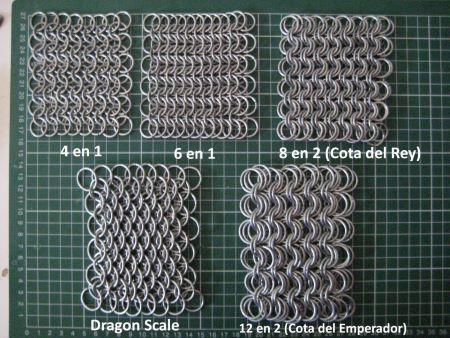
The most common pattern of chainmail in medieval Europe was a 4-in-1 weave, meaning one ring was connected to four more, creating a mesh that you can see through. There were however other patterns such as king’s mail, a 9-in-1 or 8-in-2 weave that produces a solid piece. The rings ranged in thickness from 18 to 14 gauge (1.02–1.63 mm diameter).
Effectiveness
Chainmail is effective against slashes and most stabs, depending on the closure style, material, weave density and ring thickness. Weapons with thin points such as the spike at the top of a halberd or a bodkin-tipped arrow were specifically designed to punch through chainmail. This type of armor was also vulnerable to crushing or bludgeoning strikes because of its flexibility.
Earlier chainmail was heavier since it was the primary protection while chainmail from later centuries was lighter because it was often used in conjunction with plate or brigandine. Early chainmail could be heavy enough to withstand a shot from a crossbow. Check out this video of a reproduction 13th century hauberk deflecting a bolt from a crossbow with a 440-pound (200 kg) draw weight! The chainmail weighs 41 pounds (18.7 kg) and the thick rings are made of 2 mm (12 gauge) wire, the thinner rings of 1.5 mm (roughly 14 gauge) wire.
Writer’s Tip: I think it would be fun to have a character get shot with a crossbow bolt and have your readers think they are finished only to have the bolt be deflected.
Special thanks to my friend, Jesse Driskill, for sharing his knowledge.
I hope this was helpful. Let me know if you have any questions or suggestions by using the Contact Me form on my website or writing a comment. I post every Friday and would be grateful if you would share my content.
If you want my blog delivered straight to your inbox every month along with exclusive content and giveaways please sign up for my newsletter.
Let’s get writing!
Copyright © 2020 Rebecca Shedd. All rights reserved.
[1] https://en.wikipedia.org/wiki/Chain_mail
[2] https://www.ironskin.com/faq-chainmail-weight-and-cost/
 Rebecca Shedd - Author