
The Writer’s Guide to Brigandine Armor
Posted on October 9, 2020 8 Comments

This week is my fourth and final installment in my series on common medieval armor.
As always, magic is the exception to the rules. Because magic.
Writer’s Tip: Even though brigandine armor was common in medieval Europe it is rarely depicted in literary. Including “brig” into your book would be an interesting way to stand out in the plate armor crowd.
Introduction
Brigandine is a type of torso armor composed of small rectangular metal plates or bands riveted to an outer layer of heavy cloth, canvas, or leather. It usually has an inner lining. It is generally sleeveless although there is medieval artwork showing brigandine with pauldrons (shoulder armor) and vambraces (forearm armor).
This type of armor is a more refined version of the earlier coat of plates which was worn from the 12th to the 14th century. It followed the same construction of metal pieces riveted between two layers of cloth, canvas, or leather but the plates were much larger. Brigandine came into use during the 14th century and was popular and widely used throughout the 15th and 16th centuries. [1]
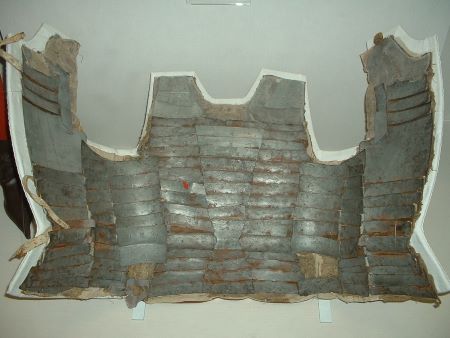
Photograph by Gaius Cornelius at the Royal Armoury, Leeds. Photo source.
How It Was Worn
Brigandine was normally worn over a gambeson and hauberk (mail shirt) although it could also be worn with a gambeson with mail voiders. Starting in the mid-15th century the gambeson was replaced with the arming doublet. There are several medieval depictions of brigandine paired with plate limb armor.
It was common across all social classes. Yeomen wore it because it was effective and affordable. Noblemen wore it because they could choose a fancy fabric for the outside. Brigandine was also popular because it did not require a squire to put it on since it normally buckled in the front and because the individual plates allowed for greater movement than plate armor. It was worn by many of the archers during the Hundred Year’s War and they had to have the range of motion to draw a bow.
I have worn brigandine and had no problem shooting a longbow or running in it. I suggest watching Shadiversity’s video here for more information.
Weight
An example of 16th century Italian brigandine in the collection of the Philadelphia Museum of Art tips the scales at 23.4 pounds (10.6 kg). [2] My guess is that this number is probably a good indication of the average weight. [3]
Cost
According to the British historian David Nicolle in his book “French Armies of the Hundred Years War,” a young nobleman would have to spend 125 to 250 livres to fully equipment himself in the best gear. That sum represented eight to sixteen months of wages for an ordinary man-at-arms. He then goes on to say “Salets were valued at between 3 and 4 livres tournois, a jacque, corset or brigandine at 11 livres.” [4] This means a brigandine would cost an ordinary man-at-arms less than a month’s wages. That explains why we see it depicted so commonly in contemporary artwork, like this 15th century painting of the Battle of Agincourt in which all the archers are wearing brigandine beneath their tabards.

Effectiveness and Vulnerabilities
Brigandine armor was effective against most types of attacks although not as protective as plate. Since it is made up of individual plates instead of a solid piece of metal, a person attacking someone wearing brigandine had a higher chance (although probably still not that good) of penetrating between the plates. Also, the plates would flex under a crushing blow although not as much as mail.
I hope this was helpful. Let me know if you have any questions or suggestions by using the Contact Me form on my website or writing a comment. I post every Friday and would be grateful if you would share my content.
If you want my blog delivered straight to your inbox every month along with exclusive content and giveaways please sign up for my email list.
Let’s get writing!
Copyright © 2020 Rebecca Shedd. All rights reserved.
[1] https://en.wikipedia.org/wiki/Brigandine
[2] https://www.philamuseum.org/collections/permanent/71388.html
[3] https://www.philamuseum.org/collections/permanent/71388.html
[4] https://armstreet.com/news/the-cost-of-plate-armor-in-modern-money
The Writer’s Guide to Plate Armor
Posted on October 2, 2020 99 Comments

This week is the third part in my series about common types of medieval armor. As in my previous posts, I will be pointing out misconceptions.
As always, magic is the exception to the rules. Because magic.
Introduction
Plate is probably the most iconic type of armor from medieval Europe, conjuring up images of the “knight in shining armor” from fairy tales. Full plate armor had its golden age from the late 15th to the early 16th century. There were multiple styles of plate armor that varied across time and regions and it was not uncommon for soldiers to wear partial suits either to limit the weight or because they could not afford all the pieces.
An early transitional style of armor known as a coat of plate was worn from the 12th to the 14th century and was a rudimentary breastplate made of large metal plates riveted to the inside of a cloth or leather garment and worn over mail. [2] The development of flintlock muskets in the 17th century, which could punch through plate armor at a considerable distance, lead to a decline in its use. The breastplate was the last piece to be employed and was worn by soldiers in the Napoleonic wars to protect them against shrapnel. [1]
Pieces
The base layer underneath plate armor was an arming doublet and thick woolen hosen or padded legs called cuisses. A full suit of plate armor was made up of the following pieces.
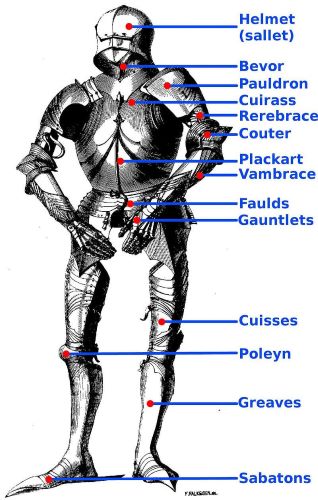
A helmet which could either completely enclose the head such as a bassinet, barbute, armet or close helm, cover only the upper part of the face such as a sallet or be open faced like a burgonet.
The neck was protected by a gorget worn over a bishop’s mantle of mail. If a sallet was being worn it was paired with a bevor that protected the jaw and neck.
A breastplate, also known as a cuirass, protected the chest and historically did not always include the backplate. Bands known as faulds could be attached to the bottom of the breastplate to shield the front of the hips. Bands attached to the bottom of the backplate were known as culets.
Spaulders covered the shoulder and upper arm but not the armpit. The gap could be filled by an extra piece such as a gardbrace, basagew or rondel. A different option was pauldrons, which did cover the armpit and sometimes part of the back and chest.
The elbow was protected by couters and the space between them and the bottom of the shoulder armor was filled by a rarebrace, brassart or upper cannon.
The forearms were covered by the vambraces or lower cannons.
Gauntlets protected the hands and could be a mitten style or have individually articulated fingers. The legs were covered by the cuisse on the thigh, poleyn on the knee and greave on the lower leg. The feet were protected by sabatons or sollerets. For additional protection, armor plates known as tassets could be suspended from the bottom of the breastplate. [3]
Effectiveness and Vulnerabilities
The biggest misconceptions about plate armor are the weight and the effectiveness. I tackled this myth in my introduction to medieval armor which you can find here. Plate armor was highly effective against most medieval weapons although there was some success in developing a heavier bodkin arrowhead that could punch through the thinner plates and in using a heavy bludgeoning weapon to crush in the armor.
There are three main points of vulnerability in a suit of plate: the eye slit, the armpit and the back of the knee. The eye slit on most helmets (unless it’s open face) was quite narrow and usually required either a near-impossible archery shot or being close enough to stab a knife through.
The armpit was vulnerable because it couldn’t be completely protected by armor or the wearer wouldn’t have the range of motion needed to swing a sword. If the person is using a shield and a one-handed arming sword their right armpit is the most vulnerable because it’s not protected by the shield and they expose it every time they raise their arm for a strike.
The back of the knee, like the armpit, is unarmored for freedom of movement. A great literary example of this vulnerability is Pippin stabbing the Witch King in the back of the knee in Tolkien’s “Return of the King.”
Another problem with plate armor is the smoothness of the surface which makes it is more likely to get stuck in mud. There are accounts from the Battle of Agincourt in the Hundred’s Year War of a number of unhorsed knights becoming so mired in the mud that they could not get back up and some even drowned in their helmets.
Writer’s Tip: Knowing the vulnerabilities of plate armor is a great way to injure your character even when your reader thinks they’re safe because they’re wearing armor.

Cost
The cost of plate varied according to the complexity as well as over time. For example, a total suit of armor owned by a knight in 1374 was valued at £16 6s 8d while that owned by Thomas of Woodstock, duke of Gloucester, in 1397 was worth £103. [4] For a more comprehensive list, I suggest the Medieval Price List.
I hope this was helpful. Let me know if you have any questions or suggestions by using the Contact Me form on my website or writing a comment. I post every Friday and would be grateful if you would share my content.
If you want my blog delivered straight to your inbox every month along with exclusive content and giveaways please sign up for my email list.
Let’s get writing!
Copyright © 2020 Rebecca Shedd. All rights reserved.
[1] https://en.wikipedia.org/wiki/Plate_armour
[2] https://en.wikipedia.org/wiki/Coat_of_plates
[3] https://en.wikipedia.org/wiki/Components_of_medieval_armour
[4] Standards of Living in the Later Middle Ages, Christopher Dyer, Cambridge University Press, 1989.
The Writer’s Guide to Chainmail
Posted on September 25, 2020 11 Comments

This week is the second part in my series about common types of medieval armor. As in my first post, I will be pointing out misconceptions with each type.
As always, magic is the exception to the rules. Because magic.
Introduction
Chainmail is a type of armor made up of small metal rings linked together and either butted, welded, or riveted closed. The earliest example is from a 3rd century Slovakian burial and it continued to be used on the battlefield in Europe into the 14th century. Chainmail or mail as it was called in medieval Europe, was also used in the Middle East, India, China, Japan, and central and western Asia. In the Ottoman Empire, it was worn by the Janissaries until the 18th century. [1]
Types and Weight
Mail was fashioned into shirts called hauberks in Europe, which could have sleeves of varying lengths or be sleeveless. Their weight depends on the length, the pattern, and the material. The Wallace Collection in London has several hauberks ranging in weight from 9.9 pounds (4.5 kg) for a short sleeved 14th century example to 19.8 pounds (9 kg) for a 15th century long sleeved hauberk. The examples ranged in length from 25 inches (64 cm) to 29 inches (74 cm). Mail was also used to make coifs, which protected the head and neck, and bishop’s mantles, which covered the shoulders. Mail leg armor was known as chausses and could cover the whole leg or just come to the knee and were attached to the arming belt. An example in the Wallace Collection weighs 14 pounds (6.4 kg).
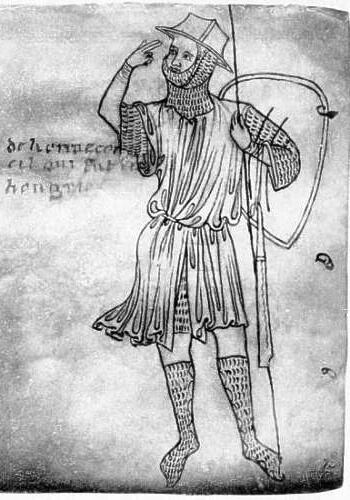
Photo courtesy of Wikipedia. Photo source.
How It Was Worn
Mail was usually worn over a gambeson, which provided protection against chaffing as well as cushioning against bludgeoning or crushing blows. Arming caps were normally worn under coifs and woolen leggings under chausses. In medieval paintings warriors wearing mail coifs have a distinctive “bubblehead” look that is caused by the padding from their arming caps. Chainmail was normally never worn directly over clothing or against the skin because it chafes, snags hair and cloth and the oils used to keep it from rusting rub off onto whatever it is resting against. Early on mail was the primary piece of armor but later into the Middle Ages it was paired with brigandine and pieces of plate armor, such as a breastplate or limb armor.
Putting on Mail
Putting on a hauberk is like putting on a sweatshirt, although obviously it’s a lot heavier. First you get your arms into the sleeves then either bend over or lift the hauberk overhead, getting your head through the opening. As long as it doesn’t get caught it will slide into place. Removing it is a bit trickier. The easiest way is to bend over and pull it over your head, letting it slide off onto the ground. The hauberk will usually end up inside out but thankfully there really isn’t a right side out with a hauberk.

Cost
Since mail is so durable, it was common to pass it down through families. If you did need to buy it, below is a list of what people have paid through history from www.ironskin.com.
11th century Germany: Mail armor is 820 silver coins. A cheap cow is 100.
12th century England: Mail is 100 shillings. A warhorse is 50, a cow 10.
1322 England: A hauberk is 10 marks. A mantle is 1 mark. [2]
Weaves
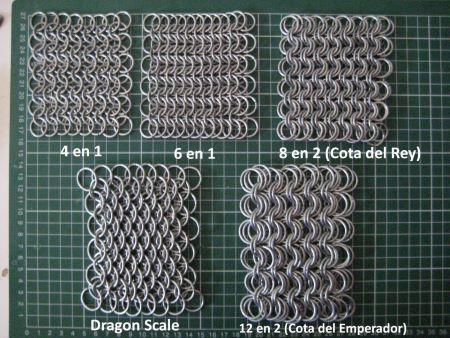
The most common pattern of chainmail in medieval Europe was a 4-in-1 weave, meaning one ring was connected to four more, creating a mesh that you can see through. There were however other patterns such as king’s mail, a 9-in-1 or 8-in-2 weave that produces a solid piece. The rings ranged in thickness from 18 to 14 gauge (1.02–1.63 mm diameter).
Effectiveness
Chainmail is effective against slashes and most stabs, depending on the closure style, material, weave density and ring thickness. Weapons with thin points such as the spike at the top of a halberd or a bodkin-tipped arrow were specifically designed to punch through chainmail. This type of armor was also vulnerable to crushing or bludgeoning strikes because of its flexibility.
Earlier chainmail was heavier since it was the primary protection while chainmail from later centuries was lighter because it was often used in conjunction with plate or brigandine. Early chainmail could be heavy enough to withstand a shot from a crossbow. Check out this video of a reproduction 13th century hauberk deflecting a bolt from a crossbow with a 440-pound (200 kg) draw weight! The chainmail weighs 41 pounds (18.7 kg) and the thick rings are made of 2 mm (12 gauge) wire, the thinner rings of 1.5 mm (roughly 14 gauge) wire.
Writer’s Tip: I think it would be fun to have a character get shot with a crossbow bolt and have your readers think they are finished only to have the bolt be deflected.
Special thanks to my friend, Jesse Driskill, for sharing his knowledge.
I hope this was helpful. Let me know if you have any questions or suggestions by using the Contact Me form on my website or writing a comment. I post every Friday and would be grateful if you would share my content.
If you want my blog delivered straight to your inbox every month along with exclusive content and giveaways please sign up for my newsletter.
Let’s get writing!
Copyright © 2020 Rebecca Shedd. All rights reserved.
[1] https://en.wikipedia.org/wiki/Chain_mail
[2] https://www.ironskin.com/faq-chainmail-weight-and-cost/
The Writer’s Guide to Gambesons
Posted on September 18, 2020 111 Comments

As promised this week I will be covering types of armor that were common in medieval Europe, starting with gambesons and continuing over the next three weeks with chainmail, plate armor and brigantine. I will also be doing some myth busting with each type of armor. I want to point out that just because I’m covering four types of armor that these were not the only types of armor used in Europe during the Middle Ages. I am merely focusing on the most common ones. There were also other designs and transition styles that were combinations of types of armor.
As always, magic is the exception to the rules. Because magic.
Introduction
The gambeson or padded jack was a quilted jacket that usually extended to the knees, fastening up the front with lacing, ties, buttons, or buckles. It was commonly stuffed with fabric or horsehair. Since it was easy and economical to make, the gambeson was quite commonly used on its own for protection. It provided decent defense against slashes and bludgeoning. One way to provide more protection when the gambeson was worn alone was the use of jack chains. They were sections of metal that were stitched, tied, or laced to the outside of the gambeson’s sleeves to provide more protection. [1]


How It Was Worn
Gambesons were also the vital first layer under chainmail and plate mail armor, providing cushioning and shock absorption and protecting against chaffing from any of the armor’s edges. They usually had arming points, ties for attaching armor, which helped with the weight distribution. Some gambesons had sections of chainmail attached to the sleeves and armpits called goussets or voiders. This provided more protection, especially to areas that could not be covered with plate armor. [2]
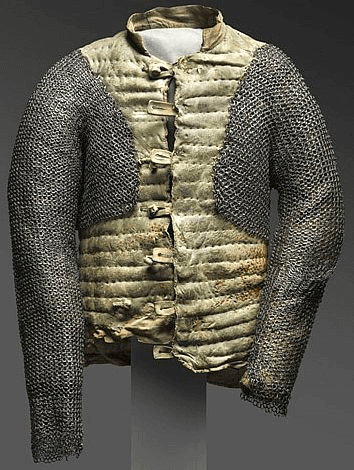
Photo source.
In the mid-15th century the gambeson evolved into the arming doublet, a tightly fitted garment ending at the hips that replaced the arming belt and caused the weight of the leg armor to be carried on the hips and waist rather than the shoulders. [3]
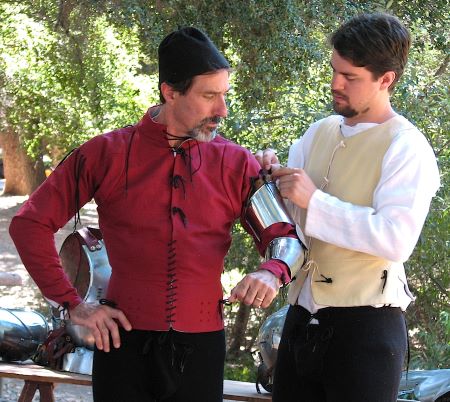
There was also a padded coif or arming cap that was worn on the head underneath chainmail or helmets although it could also be worn alone. The downside to wearing a gambeson was how warm it could become because of its insulating properties.
Cost
I was unable to find any recorded prices for gambesons. However, a freeman in late 12th century England who owned goods valued at less than 10 marks (1 mark = 13s 4d) was required by law to own a helmet, spear, and gambeson. [4] This implies they were relatively cheap. By comparison, a modern gambeson will run you between $115 to $350.
Depictions
Even though gambesons were quite common in the Middle Ages and an essential first layer under armor, they are rarely depicted in television shows or movies or mentioned in historical or fantasy novels. One of the exceptions was Netflix’s “Outlaw King.”
Writer’s Tip: Including rarely depicted armor like gambesons is a great way to show the social standing of your character.
I hope this was helpful. Let me know if you have any questions or suggestions by using the Contact Me form on my website or writing a comment. I post every Friday and would be grateful if you would share my content.
If you want my blog delivered straight to your inbox every month along with exclusive content and giveaways please sign up for my email list.
Let’s get writing!
Copyright © 2020 Rebecca Shedd. All rights reserved.
[1] https://en.wikipedia.org/wiki/Gambeson
[2] https://its-spelled-maille.tumblr.com/post/175518038999/what-is-a-gambeson-its-a-mystery-gambesons
[3] http://myarmoury.com/talk/viewtopic.php?p=86991
[4] http://medieval.ucdavis.edu/120D/Money.html
English Weapons & Warfare, 449-1660, A. V. B. Norman and Don Pottinger, Barnes & Noble, 1992 (orig. 1966)
The Writer’s Guide to Medieval Armor: Part 2
Posted on September 11, 2020 3 Comments

I hope you enjoyed last week’s post on armor myths because I am covering some more this week.
As always, magic is the exception to the rules. Because magic.
Leather Armor
Fantasy seems to be in love with leather armor. You can see it from “Vikings” to “The Lord of the Rings” to Dungeons & Dragons. But how prevalent was it during the Middle Ages? An extremely heated debated is raging online.
What we do know is that boiled leather was quite common in medieval Europe and was used to make protective cases for books and delicate instruments such as astrolabes. As for its use in making armor, there are multiple examples of leather limb armor but few of leather torso armor. There are reports of starving soldiers eating their shields and other leather kit like Josephus’ account from the Siege of Jerusalem in 70 AD and advice from a medieval Arab author on coating leather armor with crushed minerals mixed with glue to made it tougher. It is believed the term “cuirass,” referring to armor covering the torso, comes from the French term cuir bouilli, meaning boiled leather. We have few physical examples of medieval leather torso armor but there is uncertainty whether that is due to its scarcity or because they rotted away.
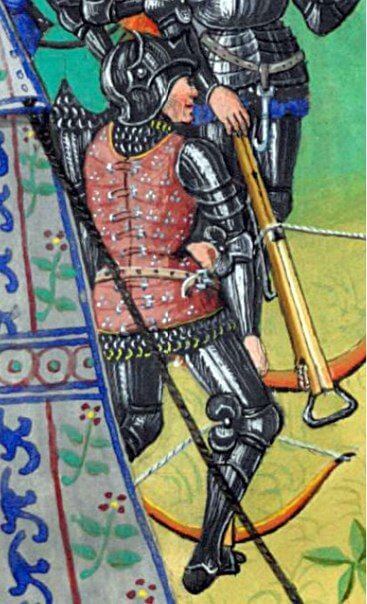
Compounding the problem is a lot of misidentification of armor in medieval paintings. Much of what is thought to be leather or studded leather is in fact brigandine, a type of armor made up of small metal bands or plates riveted to an outer layer of cloth, canvas or leather. In short, the debate still rages. [1]

Expense
The price of armor of course depended on the type, quality, and time period. I will be detailing cost of specific types of armor in their own posts. I will however provide you with some highlights to give you an idea.
Mail during the 12th century cost around 100s. [2] A complete set of knight’s armor in 1374 was valued at £16 6s 8d. Armor owned by the Duke of Gloucester in 1397 was worth £103. [3] A suit of ready-made Milanese armor (meaning it wasn’t tailored) in 1441 was priced at £8 6s 8d while squire’s armor cost £5-6 16s 8d. [4] In 1590, a cuirass of proof (indicating it had been tested against the strongest weapons of the time) with pauldrons would run you 40s while one that had not been proofed would cost 26s 8d. For comparison, a cuirass of pistol-proof with pauldrons in 1624 was priced at £1 6s. [5] For more information as well as medieval prices for many other items, I recommend this website.
Social Class Limitations
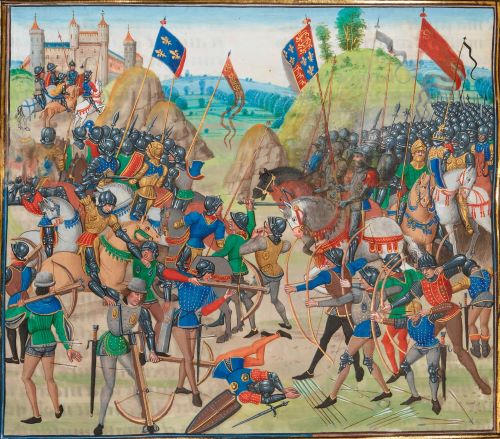
There is a common belief that only knights wore armor. Obviously, the cost would limit who could acquire certain types but we have evidence of non-knightly people owning various types of armor. In fact, it was sometimes the law. In England in 1181 it was mandatory for every freeman who owned goods valued at 10 marks (1 mark = 13s 4d) to have a mail shirt, helmet, and spear. Any freeman poorer than that was required to own a spear, helmet, and gambeson. During the 15th and 16th centuries, soldiers in full plate made up 60-70% of the French army and the percentages were probably similar in other countries. [6] Brigandine was popular with outlaws and highwaymen because it was cheap and easy to make and repair. We also have a lot of artwork from the medieval period showing soldiers in various forms of armor. As you can see in the painting below depicting the 15th century Battle of Crécy, everyone is wearing armor, including the English archers who were commoners and weren’t even worth enough to ransom.
I hope this was helpful. Let me know if you have any questions or suggestions by using the Contact Me form on my website or writing a comment. I post every Friday and would be grateful if you would share my content.
If you want my blog delivered straight to your inbox every month along with exclusive content and giveaways please sign up for my newsletter.
Let’s get writing!
Copyright © 2020 Rebecca Shedd. All rights reserved.
[1] https://en.wikipedia.org/wiki/Boiled_leather
[2] The Knight in History, Frances Gies, Harper & Row, New York, 1984
[3] Standards of Living in the Later Middle Ages, Christopher Dyer, Cambridge University Press, 1989
[4] English Weapons & Warfare, 449-1660, A. V. B. Norman and Don Pottinger, Barnes & Noble, 1992 (orig. 1966)
[5] The Armourer and his Craft from the XIth to the XVIth Century, Charles ffoulkes, Dover, 1988 (orig. 1912)
[6] https://en.wikipedia.org/wiki/Plate_armour
The Writer’s Guide to Medieval Armor: Part 1
Posted on September 4, 2020 50 Comments

I hope you have been enjoying my posts on swords and other medieval weapons. This week we are moving on to armor myths because, o boy! are there a lot of them. The armor worn in medieval Europe varied across time, region, and social standing. I will be covering common types of armor later.
As always, magic is the exception to the rules. Because magic.
Effectiveness
Obviously, the effectiveness of armor depends heavily on the type of armor and how well it was made. What amazes me is the number of times in movies, TV shows and video games I have seen someone stab straight through armor, include more protective armor like plate mail, without a problem. If armor were that ineffective against a knife stab or a sword slice nobody in the Middle Ages would have bothered wearing it. Plate mail is designed to take an enormous amount of abuse while still protecting the wearer. Chainmail is effective at guarding against slices. If you want to see firsthand how much abuse armor can take, I suggest finding footage of Battle of the Nations, an international medieval combat championship, or watching an episode of History’s “Knight Fight.”
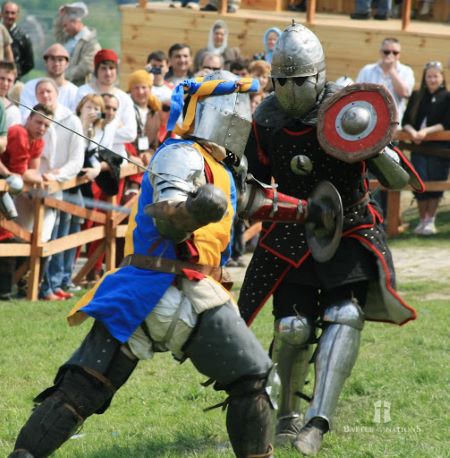
This is not to say however that armor could ward off any blow. For every advance in armor technology there was an advance in weaponry to counter it. When plate armor was developed, a thicker version of the bodkin arrowhead was created that increased the chances of penetrating plate in thinner spots. Usually the only shots that made it through were lucky ones that found the proverbal “clink in the armor.” YouTuber Tod Todeschini of Tod’s Workshop has a fantastic video here about arrows versus armor.
Writer Tip: Your character taking a hit to the armor and shrugging it off could be a great opportunity for them to be thankful they spent the extra money on good armor.
Weight
When most people think of medieval European armor usually their first mental image is of a knight being winched onto his horse because he can’t manage it in his armor on his own. “A Knight’s Tale” has a perfect example of this trope. However, a complete harness of plate armor usually tipped the scales at 33- pounds (15-27 kg). [1] By contrast, an American soldier in World War II was carrying up to 75 pounds (34 kg), which is why so many of them drowned during the D-Day landing. [2] Jousting armor was made substantially heavier to provide as much protection as possible and since the wearer didn’t need to move freely. It could weigh up to 110 pounds (50 kg). Below is a table that shows the average weight of 135 armors from 21 museums. Here is the link to the entire study.

Mobility
The weight of medieval armor was distributed across the body. In the case of plate and brigantine, the pieces were articulated to give the wearer full range of motion. The armor worn on the upper body was suspended from the shoulders and that worn on the lower body from a wide arming belt (or an arming doublet from the mid-15th century onward), causing the waist and hips to carry the weight. Plate was buckled or laced into the gambeson or arming doublet at multiple places to connect it snugly with the wearer, distribute the weight, and make it easier to move. Most armor was custom fit so there was no unnecessary extra weight and the armor conformed to the body. An armored warrior, including on in full plate, could run, jump, fight, and mount his horse unassisted. [3]

I hope this was helpful. Let me know if you have any questions or suggestions by using the Contact Me form on my website or writing a comment. I post every Friday and would be grateful if you would share my content.
If you want my blog delivered straight to your inbox every month along with exclusive content and giveaways please sign up for my newsletter.
Let’s get writing!
Copyright © 2020 Rebecca Shedd. All rights reserved.
[1] Warrior Race: A History of the British at War. James, Lawrence (2003). St. Martin’s Press. P. 119. ISBN 0-312-30737-3.
[2] https://www.popularmechanics.com/military/research/a25644619/soldier-weight/
[3] https://en.wikipedia.org/wiki/Plate_armour
The Writer’s Guide to Medieval Self-Defense Weapons
Posted on August 28, 2020 4 Comments

This week we continue our exploration of common medieval weapons other than the sword with a focus on day-to-day use and self-defense. For those who could afford them, swords were the most popular choice for a self-defense weapon because they are portable, effective, and can be used in close quarters. However, some cities had laws against the wearing of swords above a certain length during times of peace and some people could not afford them. Of course, in pinch, just about anything can be used as a weapon.
Daggers and Knives
Knives, usually defined as short single edged slicing blades, were commonly carried by all social classes in medieval Europe. They were a handy everyday tool for eating, preparing food and trimming quill pens.
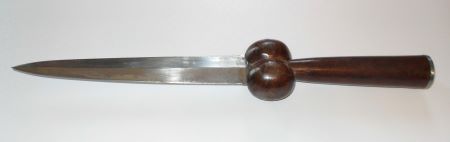
Daggers, being double-edged stabbing weapons, were more closely tied to knights and the nobility because the cruciform shape of the weapon matched the shape and style of most arming swords of the period. The earliest depiction of the cross-hilted dagger is from 1120 AD in the “Guido relief” inside the Grossmünster of Zürich. [1] However, as the Middle Ages progressed other versions of the dagger were developed by the lower classes such as the bollock dagger, the ancestor of the Scottish dirk.
Writer’s Tip: It was common for people to carry their eating utensils with them, meaning if you were having a dinner party you were invited a group of armed people into your house. This could be a great start to a medieval whodunit.

Axes and Hatchets
As I mentioned in my previous article, small axes and hatchets were household tools used for cutting wood. Although many men-at-arms carried them into battle, they were also common self and home defense weapons because they were so handy.
Staffs
A basic and easily made weapon also known as a short staff or quarterstaff. Usually fashioned of hardwood and between six to nine feet (1.8 to 2.7 m) in length, the staff was popular across the social spectrum. Swordsmen such as George Silver in the 16th century and Joseph Swetman in the 17th century praised the staff as being among the best, if not the best, of all hand weapons. [2]
Farm Implements
Many tools for farming could be used for self-defense in a pinch. Most were long-handled and were modified over time into polearms. For example, the threshing flail has a long handle with a short heavy wood head with an articulated attachment such as a strap, rope or chain. Originally used to thresh grain, it was brutally effective against people. Another example is the bill hook. Consisting of a curved wide hook sharpened on the inside edge on a haft, it was originally used to trim tree limbs but was good at unhorsing riders. Other examples include pitchforks, scythes, and sickles.

Photo courtesy of Shutterstock.

Courtesy of Shutterstock.
I hope this was helpful. Let me know if you have any questions or suggestions by using the Contact Me form on my website or writing a comment. I post every Friday and would be grateful if you would share my content.
If you want my blog delivered straight to your inbox every month along with exclusive content and giveaways please sign up for my email list. To celebrate my first newsletter I will be giving away a copy of “Build Your Author Platform” by Carole Jelen and Michael McCallister, a book that has been invaluable in helping me build my platform. The deadline to sign up to be entered in the drawing is Aug. 30th.
Let’s get writing!
Copyright © 2020 Rebecca Shedd. All rights reserved.
[1] https://en.wikipedia.org/wiki/Dagger
[2] https://en.wikipedia.org/wiki/Quarterstaff
The Writer’s Guide to Medieval Battlefield Weapons
Posted on August 21, 2020 5 Comments

I hope you have enjoyed my previous posts on sword myths. Today we will be moving on to other common medieval weapons with a focus on those used on the battlefield. Although swords are synonymous with fantasy and a lot of historical fiction, they were not used excessively in battle during the Middle Ages. There were several other weapons that were more effective than the sword, although quite a few soldiers carried them as a back-up weapon.
Writer’s Tip: Including weapons other than swords in your novel is a great way to expand your fantasy or historical arsenal, include weapons that are vastly under-represented in fiction, give an indication of social standing, use military tactics other than sword stances and inject some realism.
Polearms
Polearm is the name for a class of weapons with a long wood pole. The most basic and common polearm is the spear. Starting in ancient times as a sharpened stick, the spear was improved first with a chipped stone head then bronze, iron and steel. Differently shaped heads were developed, often adapted from farm implements, resulting in the military fork, trident, partisan, pole-ax, glaive, bill, halberd and hammer, all of which had multiple variations. Polearms have the advantage of reach, ranging from the height of a person to about 16 feet (4.8 m) in the case of 17th century pikes. Also, infantry armed with polearms can be tightly packed into multiple ranks, creating a virtual hedge of protection. [1]

Clubs, Maces and Picks
The club is probably the first purposely created weapon. On the Bayeux tapestry, William the Conqueror is depicted several times carrying a club. [2] Over the centuries, the club has been improved upon and by the Middle Ages there were flails, maces, picks, and war hammers.
Axes
Throughout most of human history, an axe with a common household tool, necessary for cutting wood for the fire. As a result, it became a handy weapon. Archers during the Hundred Year’s War carried axes on their belts to be used for cutting sharpened stakes for protection as well as self-defense if they were attacked by infantry. [3]
Bows
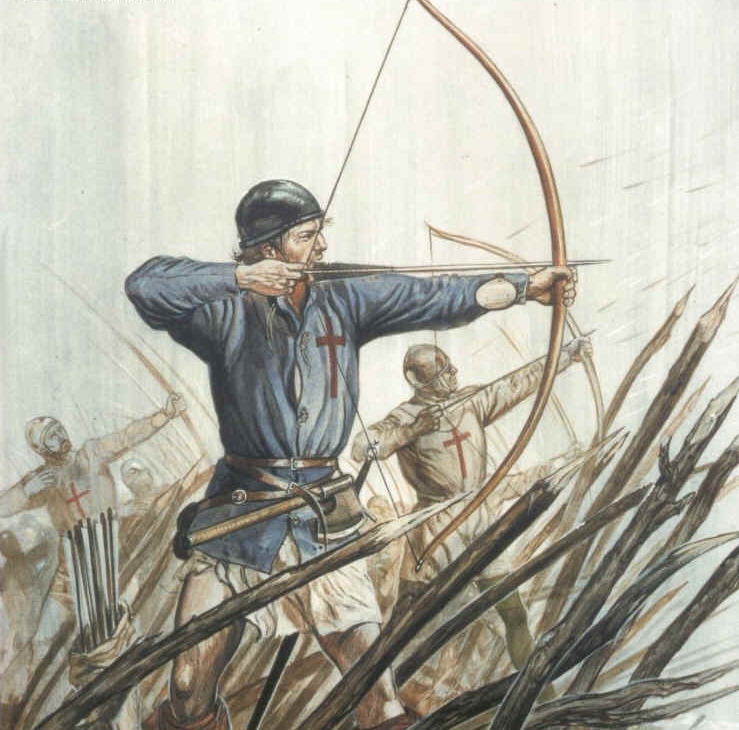
Originally developed for hunting, the bow was used to great effect in medieval warfare in such battles as Agincourt and Crécy during the 15th century. It was a common weapon that was not that expensive to buy nor too difficult to make. Most of the bowmen in a medieval army were yeoman, free commoners or part of the lower end of the middleclass. I will be delving deeper into archery myths in future posts.
I hope this was helpful. Let me know if you have any questions or suggestions by using the Contact Me form on my website or writing a comment. I post every Friday and would be grateful if you would share my content.
If you want my blog delivered straight to your inbox every month along with exclusive content and giveaways please sign up for my email list. To celebrate my first newsletter I will be giving away a copy of “Build Your Author Platform” by Carole Jelen and Michael McCallister, a book that has been invaluable in helping me build my platform. The deadline to sign up to be entered in the drawing is Aug. 30th.
Let’s get writing!
Copyright © 2020 Rebecca Shedd. All rights reserved.
[1] Weapons: An International Encyclopedia from 5000 B.C. to 2000 A.D.. The Diagram Group (1980). Diagram Visual. p. 56-62. ISBN 0-312-03950-6.
[2] Weapons: An International Encyclopedia from 5000 B.C. to 2000 A.D.. The Diagram Group (1980). Diagram Visual. p. 14-15. ISBN 0-312-03950-6.
[3] https://imgur.com/gallery/RswSL
The Writer’s Guide to Medieval Swords: Part 2
Posted on August 14, 2020 7 Comments

I hope you enjoyed my last blog post on swords. If you have not read it you can find it here. Today we will be tackling three more common pieces of misinformation regarding swords. As in my first post I will be focusing on medieval European swords since most fantasy is inspired by this period and region.
As always, magic is the exception to the rules. Because magic.
Sword Through the Belt
I have seen this trope in multiple video games, movies, and television shows. If a sword is sharp the motion of putting it through the belt or pulling it out will likely cut through the belt, not to mention the high likelihood of the person cutting themselves. You can only get away with this if the sword is dull. Medieval swords were normally kept in a scabbard when not in use. The scabbard protected the blade from moisture and dulling of the edge. The scabbard was usually hung from the belt by a frog, which caused the sword to hang at the level of the hip and at the forward slant, making it easier to draw.

Cast Off (aka You’re Not Walking Off that Battlefield Clean)
If you’ve ever watched CSI or any other crime scene investigation show you already know that melee weapons are messy. After the first hit, any movement of the weapon will produce cast off. This means that anyone walking away from melee combat such as a battle will likely be quite grimy. Yet I’ve seen a number of medieval and fantasy movies and shows where the hero is spotless after a battle. Thankfully, several recent productions have tried to show how gruesome medieval melee combat can be, most notably “Game of Thrones” and Netflix’s “Outlaw King.”
Writer Tip: The grisly stain of battle can be an opening for your character to reflect on the brutality of war or the people they lost, especially as they literally clean the blood off their clothes and equipment.

Cleaning Your Sword
I admit it. I shudder every time I see a character finish up a battle and slide their sword back into their scabbard without cleaning it. The problem is that once debris has been introduced to the scabbard it’s pretty much impossible to get out. Also, if there is any moisture it will cause the blade to rust. If a sword is left in a contaminated scabbard too long it can actually “glue” the blade inside the scabbard, making it impossible to draw.
I hope this was helpful. Let me know if you have any questions or suggestions by using the Contact Me form on my website or writing a comment. I post every Friday and would be grateful if you would share my content.
If you want my blog delivered straight to your inbox every month along with exclusive content and giveaways please sign up for my email list. To celebrate my first newsletter I will be giving away a copy of “Build Your Author Platform” by Carole Jelen and Michael McCallister, a book that has been invaluable in helping me build my platform. The deadline to sign up to be entered in the drawing is Aug. 30th.
Let’s get writing!
Copyright © 2020 Rebecca Shedd. All rights reserved.
The Writer’s Guide to Medieval Swords: Part 1
Posted on August 7, 2020 8 Comments

Swords are almost synonymous with the fantasy genre, from Sting to Excalibur to Ice. Yet because they are not an item most people encounter anymore, there is a lot of misconceptions. Unfortunately, this misinformation is repeated in movies, books, and television shows until the producers and their audiences all think it to be correct. I will be focusing on medieval European swords since most fantasy is inspired by this period and region and it’s where the bulk of my experience lies.
As always, magic is the exception to the rules. Because magic.
The “Sheath of Shing”
You probably already know what I’m talking about. Someone pulls their sword from the scabbard with a loud dramatic “shing!” I admit it: this is one of my pet peeves. Most swords from the Middle Ages had scabbards made of wood covered in leather although there were some all leather scabbards. A sword drawn from one of these hardly makes a sound.
Of course, there are exceptions. Military swords from 19th century Europe commonly were either all metal, wood covered in metal or, if they were all wood or leather construction, had a metal throat. A sword drawn from a metal scabbard will produce the iconic “shing.” The sound can also be produced by any scabbard with a metal throat that touches the blade, although it won’t be as dramatic. I recommend watching Schola Gladiotora’s video here. [1]
Writer Tip: Ask yourself why you want to include the “shing” in your scene. Is it to build tension and drama? Is there another way you could achieve the same effect? Also, consider the dramatic opportunities of a sword being drawn without a sound.

Photo courtesy of Shutterstock.
Weight
One of the common misconceptions about swords is the weight, especially if you’re referring to a larger sword such as a claymore or a German zweihänder. I’ve seen claims of medieval swords weighing 10-15 pounds (4.5-7 kg). The average medieval sword weighed between 2 ½ to 3 ½ pounds (1 to 1.5 kg). The average zwaihänder had a weight of 4 ½ pounds (2 kg) and claymores tipped the scales at 5 ½ pounds (2.5 kg). For more information, I suggest ARMA’s article by J. Clements here [2]. The thing to remember about swords is a person had to be able to wield one for up to hours at a time. For example, the Battle of Hastings lasted for nine hours. Imagine swinging a ten-pound sword for that long!
Balance
The other factor to keep in mind with swords is balance. The balance point is the physical place on the blade where the weight is equally distributed between the blade and the handle, usually located 2-3 inches (5-7.5 cms) up the blade from the hilt. You literally can balance a sword on the edge of your hand at the balance point. The reason balance is so important is because it prevents fatigue and effects speed. If a sword is blade heavy it will take more effort to swing it and the swing will be slower.[3]

I hope this was helpful. Let me know if you have any questions or suggestions by using the Contact Me form on my website or writing a comment. I post every Friday and would be grateful if you would share my content.
If you want my blog delivered straight to your inbox every month along with exclusive content and giveaways please sign up for my email list. To celebrate my first newsletter I will be giving away a copy of “Build Your Author Platform” by Carole Jelen and Michael McCallister, a book that has been invaluable in helping me build my platform. The deadline to sign up to be entered in the drawing is Aug. 30th.
Let’s get writing!
Copyright © 2020 Rebecca Shedd. All rights reserved.
[1] https://youtu.be/0xAjpdkO-6o
[2] http://www.thearma.org/essays/weights.htm#.XwiuJShKjIU
[3] https://www.sword-buyers-guide.com/sword-terminology.html
 Rebecca Shedd - Author