The Writer’s Guide to Chainmail


This week is the second part in my series about common types of medieval armor. As in my first post, I will be pointing out misconceptions with each type.
As always, magic is the exception to the rules. Because magic.
Introduction
Chainmail is a type of armor made up of small metal rings linked together and either butted, welded, or riveted closed. The earliest example is from a 3rd century Slovakian burial and it continued to be used on the battlefield in Europe into the 14th century. Chainmail or mail as it was called in medieval Europe, was also used in the Middle East, India, China, Japan, and central and western Asia. In the Ottoman Empire, it was worn by the Janissaries until the 18th century. [1]
Types and Weight
Mail was fashioned into shirts called hauberks in Europe, which could have sleeves of varying lengths or be sleeveless. Their weight depends on the length, the pattern, and the material. The Wallace Collection in London has several hauberks ranging in weight from 9.9 pounds (4.5 kg) for a short sleeved 14th century example to 19.8 pounds (9 kg) for a 15th century long sleeved hauberk. The examples ranged in length from 25 inches (64 cm) to 29 inches (74 cm). Mail was also used to make coifs, which protected the head and neck, and bishop’s mantles, which covered the shoulders. Mail leg armor was known as chausses and could cover the whole leg or just come to the knee and were attached to the arming belt. An example in the Wallace Collection weighs 14 pounds (6.4 kg).
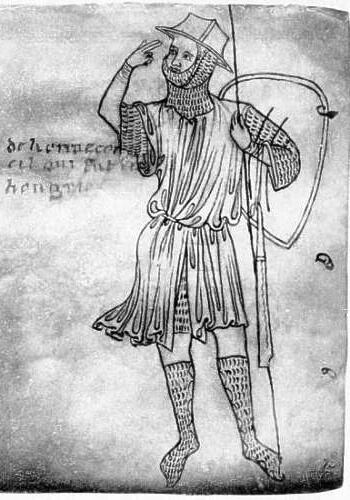
Photo courtesy of Wikipedia. Photo source.
How It Was Worn
Mail was usually worn over a gambeson, which provided protection against chaffing as well as cushioning against bludgeoning or crushing blows. Arming caps were normally worn under coifs and woolen leggings under chausses. In medieval paintings warriors wearing mail coifs have a distinctive “bubblehead” look that is caused by the padding from their arming caps. Chainmail was normally never worn directly over clothing or against the skin because it chafes, snags hair and cloth and the oils used to keep it from rusting rub off onto whatever it is resting against. Early on mail was the primary piece of armor but later into the Middle Ages it was paired with brigandine and pieces of plate armor, such as a breastplate or limb armor.
Putting on Mail
Putting on a hauberk is like putting on a sweatshirt, although obviously it’s a lot heavier. First you get your arms into the sleeves then either bend over or lift the hauberk overhead, getting your head through the opening. As long as it doesn’t get caught it will slide into place. Removing it is a bit trickier. The easiest way is to bend over and pull it over your head, letting it slide off onto the ground. The hauberk will usually end up inside out but thankfully there really isn’t a right side out with a hauberk.

Cost
Since mail is so durable, it was common to pass it down through families. If you did need to buy it, below is a list of what people have paid through history from www.ironskin.com.
11th century Germany: Mail armor is 820 silver coins. A cheap cow is 100.
12th century England: Mail is 100 shillings. A warhorse is 50, a cow 10.
1322 England: A hauberk is 10 marks. A mantle is 1 mark. [2]
Weaves
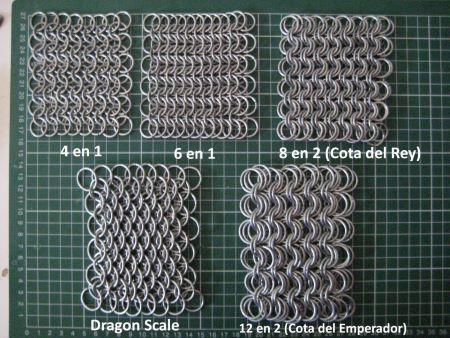
The most common pattern of chainmail in medieval Europe was a 4-in-1 weave, meaning one ring was connected to four more, creating a mesh that you can see through. There were however other patterns such as king’s mail, a 9-in-1 or 8-in-2 weave that produces a solid piece. The rings ranged in thickness from 18 to 14 gauge (1.02–1.63 mm diameter).
Effectiveness
Chainmail is effective against slashes and most stabs, depending on the closure style, material, weave density and ring thickness. Weapons with thin points such as the spike at the top of a halberd or a bodkin-tipped arrow were specifically designed to punch through chainmail. This type of armor was also vulnerable to crushing or bludgeoning strikes because of its flexibility.
Earlier chainmail was heavier since it was the primary protection while chainmail from later centuries was lighter because it was often used in conjunction with plate or brigandine. Early chainmail could be heavy enough to withstand a shot from a crossbow. Check out this video of a reproduction 13th century hauberk deflecting a bolt from a crossbow with a 440-pound (200 kg) draw weight! The chainmail weighs 41 pounds (18.7 kg) and the thick rings are made of 2 mm (12 gauge) wire, the thinner rings of 1.5 mm (roughly 14 gauge) wire.
Writer’s Tip: I think it would be fun to have a character get shot with a crossbow bolt and have your readers think they are finished only to have the bolt be deflected.
Special thanks to my friend, Jesse Driskill, for sharing his knowledge.
I hope this was helpful. Let me know if you have any questions or suggestions by using the Contact Me form on my website or writing a comment. I post every Friday and would be grateful if you would share my content.
If you want my blog delivered straight to your inbox every month along with exclusive content and giveaways please sign up for my newsletter.
Let’s get writing!
Copyright © 2020 Rebecca Shedd. All rights reserved.
[1] https://en.wikipedia.org/wiki/Chain_mail
[2] https://www.ironskin.com/faq-chainmail-weight-and-cost/
 Rebecca Shedd - Author
I think other web site proprietors should take this web site as an model, very clean and great user friendly style and design, let alone the content. You’re an expert in this topic!
LikeLike
Wow! Thank you so much!
LikeLike
Today, while I was at work, my cousin stole my iPad and tested to see if it can survive a forty foot drop, just so she can be a youtube sensation. My apple ipad is now destroyed and she has 83 views. I know this is entirely off topic but I had to share it with someone!
LikeLike
I am often to blogging and i really appreciate your content. The article has really peaks my interest. I am going to bookmark your site and keep checking for new information.
LikeLike
Hello There. I discovered your blog using msn. This is an extremely well written article. I will be sure to bookmark it and come back to read extra of your helpful information. Thanks for the post. I?ll certainly return.
LikeLike
Hello There. I found your blog the use of msn. This is an extremely neatly written article. I?ll be sure to bookmark it and come back to learn extra of your helpful information. Thanks for the post. I will definitely comeback.
LikeLike
magnificent points altogether, you simply gained a new reader. What would you recommend in regards to your post that you made some days ago? Any positive?
LikeLike
very good publish, i definitely love this website, keep on it
LikeLike
hello there and thank you for your info ? I?ve definitely picked up something new from right here. I did however expertise several technical points using this website, since I experienced to reload the web site a lot of times previous to I could get it to load properly. I had been wondering if your hosting is OK? Not that I’m complaining, but sluggish loading instances times will often affect your placement in google and could damage your high-quality score if ads and marketing with Adwords. Anyway I am adding this RSS to my email and could look out for a lot more of your respective exciting content. Ensure that you update this again very soon..
LikeLike
The subsequent time I read a blog, I hope that it doesnt disappoint me as much as this one. I imply, I do know it was my option to read, however I actually thought youd have one thing attention-grabbing to say. All I hear is a bunch of whining about something that you could fix if you happen to werent too busy in search of attention.
LikeLike
Pingback: What armour did the Knights Templar wear? - The Templar Knight