The Writer’s Guide to Horse Basics


Humans and horses have a long history together so it’s no wonder we include them so much in our stories. Even Brandon Sanderson put them in the Stormlight Archive when he included no other real world animals. Unfortunately, there is so much misinformation about them. I am going to be starting with the basics today.
As always, magic is the exception to the rules. Because magic.
Body Parts
I’m going to spend very little time on this. Please reference the diagram below for the names of specific body parts.

Colors & Markings
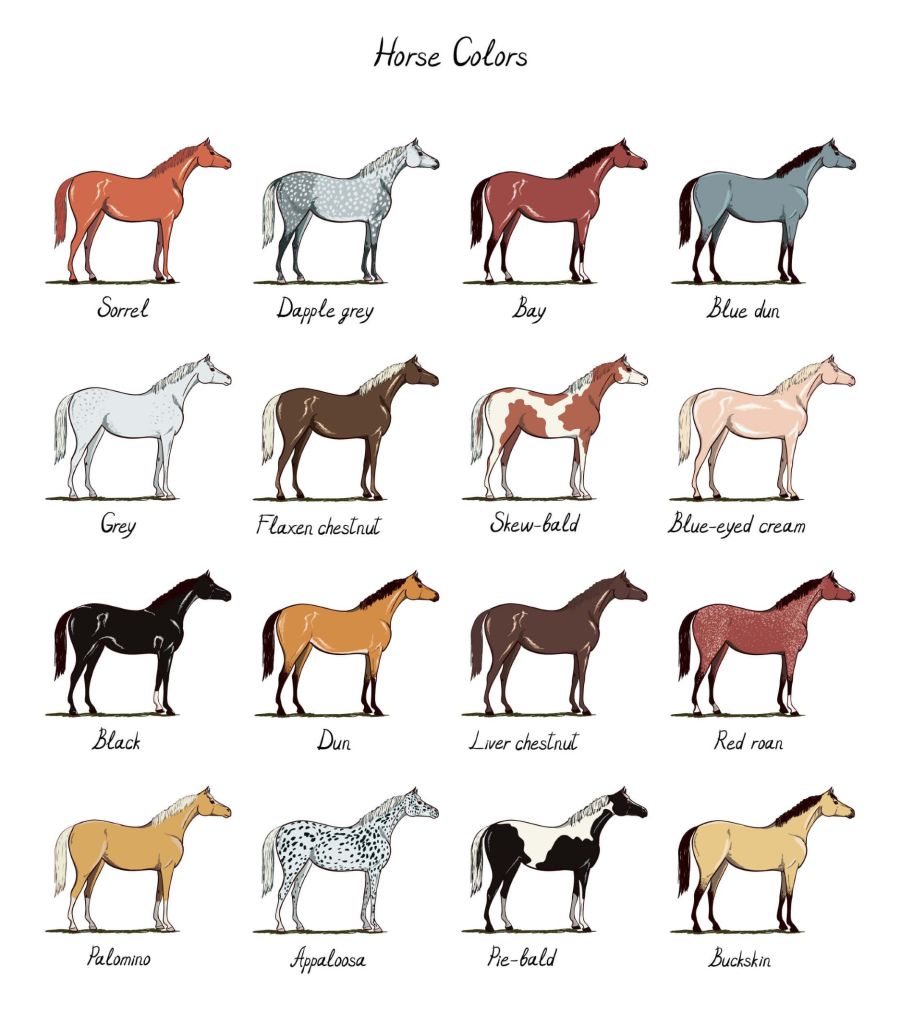
The names of horse colors have their own idiosyncrasies. Some of them make sense and others can be quite foreign. Since I’m familiar with them it always makes me winch when I see a horse given the wrong color name. No, Master Dennet from Dragon Age: Inquisition that Fereldan Forder is a bay not a chestnut.
Unless otherwise noted, the following colors would have brown eyes.
Black – Just what you’d expect.
Bay – A brown body with a black mane and tail and black legs.
Chestnut or Sorrel– A brown body with a matching brown mane and tail. This is the most common color among horses. A liver chestnut is a darker brown. A flaxen chestnut has a brown body with a tan or cream mane and tail.
Grey – This one is tricky. The color is judged by the color of the skin, not the hair. Obviously, a horse with a grey coat, mane and tail is a grey. However, one with a white coat, mane, and tail but with grey or black skin, which will be visible at the nose and around the eyes, is considered a grey. I know most of the time a horse with this coloring is called white but technically in the horse world white horses don’t exist. A fleabitten grey has a white coat with small grey or black dots. A dappled grey has a pattern of dark grey rings over a coat of lighter grey or white.
Albino – A horse with a genetic lack of pigment giving it a white coat, mane, and tail with pink skin. It’s also common for them to have blue or hazel eyes.
Cream or Cremello – A horse with a cream-colored body, mane, and tail and normally blue or light brown eyes. This color is caused by a dilution gene.
Dun – A tan or dark gold body with a black mane, tail, and legs. There are also red dun, black dun, blue dun, and bay dun depending on the genetics. The color commonly comes with a dark dorsal stripe and is the most primitive color according to prehistoric cave paintings.
Roan – A coat pattern with a mixing of colored and white hair. The mane, tail and lower legs are usually a solid color. There are multiple variations including red roan, blue roan, and strawberry roan.
Palomino – A light gold body with a white mane and tail.
Buckskin – A horse with a golden tan body and black mane, tail, and lower legs.
Pinto – A horse with large patches of white and another color. There are multiple variations such as piebald and skewbald.
Appaloosa – A breed as well as a color identified by their colorful spotted coats. The spotting can be over the whole animal or confined to a white patch.
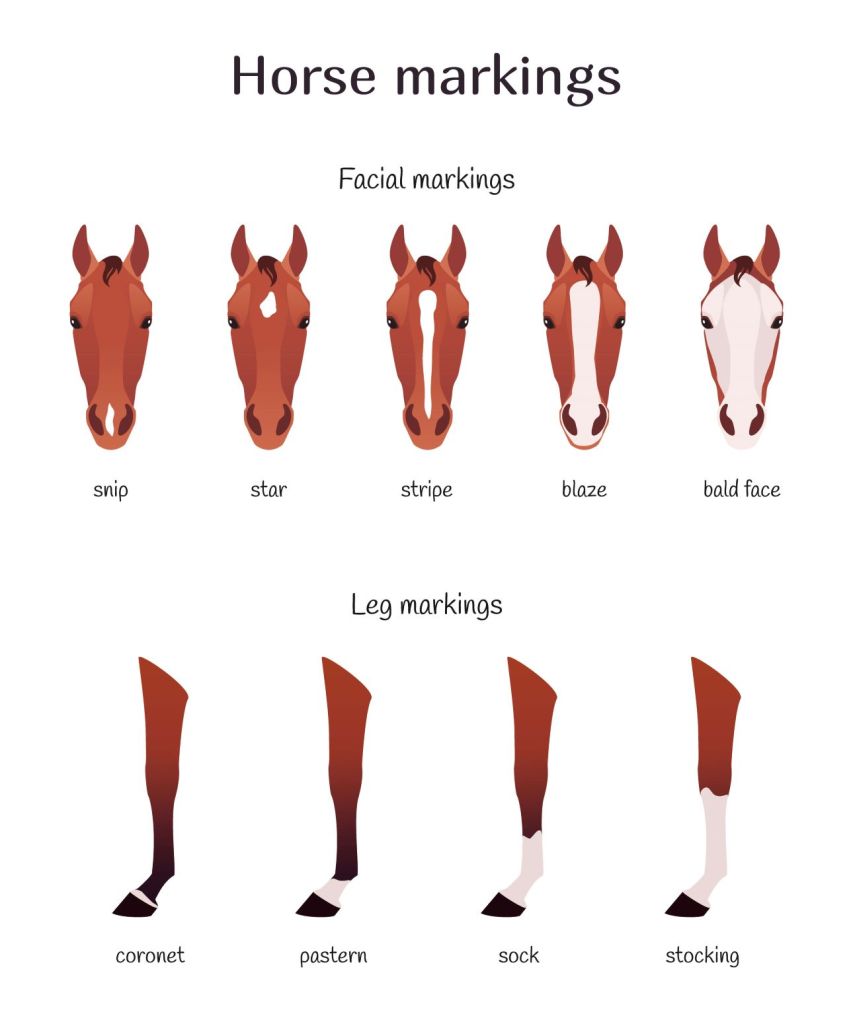
There are more colors than I listed above but I’ve covered the most common ones. The remainder are rarer. Horses also come with a variety of leg and face markings. Please reference the diagram below.
Genders
Stallion – An adult intact male horse.
Gelding – An adult nurtured or gelded male horse.
Mare – An adult female horse.
Foal – A baby horse of any gender under one year of age.
Colt – A male foal.
Filly – A female foal.
Yearling – A horse of either gender between the ages of one and two years old. After two, horses are referred to by their adult gender names.
Measuring Height
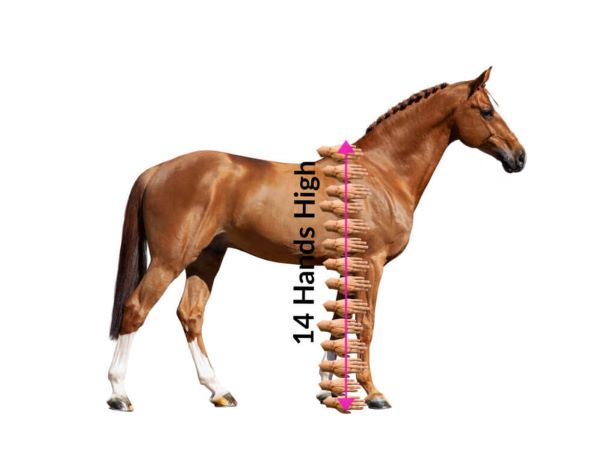
A height of a horse is measured from the ground, up the front leg to the withers, the bony bump where the neck meets the back. Horses are not measured to the top of the head. Traditionally, people used their flat palm, counting the number of “hands.” Today horses are still measured in hands, which has been standardized to four inches (10.16 cms).
A horse is 14.2 hands and taller while a pony is under 14.2 hands.
There has been debate about the size of medieval horses with some historians claiming them to be as tall as 18 hands. A review of literary, visual, and archaeological sources done by the Museum of London puts the average between 14-15 hands (56-60 in, 142-152 cms).
I hope this was helpful. Let me know if you have any questions or suggestions by using the Contact Me form on my website or writing a comment. I post every Friday and would be grateful if you would share my content.
If you want my blog delivered straight to your inbox every month along with exclusive content and giveaways please sign up for my email list.
Let’s get writing!
Copyright © 2020 Rebecca Shedd. All rights reserved.
 Rebecca Shedd - Author
Thanks in support of sharing such a pleasant thought, paragraph is good, thats why i have read
it entirely
my website: yd
LikeLike
Howdy! This is my 1st comment here so I just wanted to give a quick shout out and say
I really enjoy reading your articles. Can you suggest any other blogs/websites/forums that go
over the same subjects? Thanks a ton!
LikeLike
Hi, I think your site might be having browser compatibility issues. When I look at your website in Safari, it looks fine but when opening in Internet Explorer, it has some overlapping. I just wanted to give you a quick heads up! Other then that, fantastic blog!
LikeLike
I am now not certain where you are getting your information, however great topic. I needs to spend a while studying more or understanding more. Thanks for excellent information I used to be on the lookout for this information for my mission.
LikeLike
Keep onn working, great job!
LikeLike
Pretty! Thhis has been ann increddibly winderful article.
Thawnks for supplying tbis information.
LikeLiked by 1 person
I?ll immediately grab your rss feed as I can not find your e-mail subscription link or newsletter service. Do you’ve any? Please let me understand so that I may just subscribe. Thanks.
LikeLike
This information is magnificent. I simply have to tell you that your blogs are really valuable. I truly appreciate this post. Interesting content.
LikeLike
I?m impressed, I must say. Really rarely do I encounter a blog that?s each educative and entertaining, and let me inform you, you might have hit the nail on the head. Your concept is excellent; the issue is something that not enough people are speaking intelligently about. I’m very completely happy that I stumbled throughout this in my search for something referring to this.
LikeLike
great publish, very informative. I’m wondering why the other experts of this sector don’t realize this. You must continue your writing. I’m confident, you have a huge readers’ base already!
LikeLike
I found your post incredibly informative and helpful for anyone seeking to incorporate horses into their writing. Understanding the fundamental aspects of horses is crucial for creating authentic and believable portrayals. One aspect to consider is the best calming supplement for horses. As writers, it’s essential to delve into the emotional and behavioral aspects of horses, and incorporating a realistic portrayal of their reactions and responses is key. Including the best calming supplement for horses in your writing can add depth to the characters and situations, allowing for a more nuanced understanding of their behavior and the impact it may have on the story. Thank you for sharing this valuable guide, and for highlighting the significance of considering the best calming supplement for horses in creating compelling and authentic equine characters. Your insights will undoubtedly enrich the writing experiences of many authors.
LikeLike