The Writer’s Guide to 1820s Women’s Fashion

With the death of King George III of England in 1820 and the coronation of George IV, the Regency era was over. Bright saturated colors and patterns came into vogue. Rows of trim and tucks, fluttering ribbons and shimmering gauzes and bobbin lace were used with abandon. After years under the rule of an old and mentally unstable king, fashion embraced the youthful exuberance of a new monarch.
For an overview of fashion for the entire 19th century, please read my Writer’s Guide to 19th Century Fashion.
So Romantic
This decade was a transitory period between the classical Regency styles and the more structured Victorian styles which started in 1837 with the coronation of Queen Victoria. It was part of the Georgian era, which lasted from 1714 to 1837 and covered the reign of Britain’s King Georges I-IV.
This decade saw the abandonment of the classically inspired fashions of the first two decades of the 19th century. Instead, the Romantic Movement was all the rage. The influence of this movement impacted not only fashion but literature, art, and music. It placed importance on personal emotions and expression. Clothing of this decade draws a large amount of influence from an idealized version of the past, especially the Middle Ages. [1]

Undergarments
A chemise or shift was still the first layer worn by all classes of women. Increasingly, it was made of cotton even though linen breathed better and didn’t stick to the body. But linen has a long and time-consuming manufacturing process. The processing of cotton had been dramatically shortened by the invention of the cotton gin in 1793 and various spinning machines in 1760s and 1770s.
Stays began to fade out of use and the corset began more prominent. The corset originally had only soft cording for structure while stays had more rigid boning. As the waistline began to drop, stays and corsets lengthened from the previous decade. While the main job of the garment during the Regency era was to hoist and separate the girls, the focus during this decade was to slim the waist and emphasis the curves. [2] The metal eyelet, first used on corsets in 1828, allowed them to take the strain of tight lacing. Before this invention, the fabric around thread-enforced eyelets would tear if laced too severely. [3]
A small bustle pad was worn on the rump to fill out the back of the skirt. Over this were several layers of petticoats. [4]

Dresses
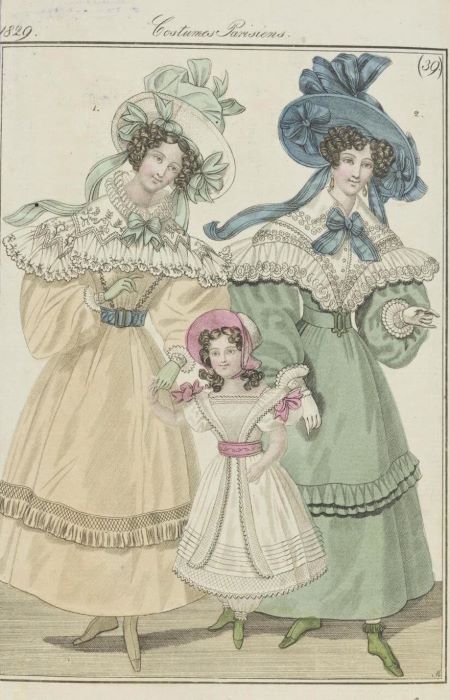
While waistlines started high at the beginning of the decade, they began to drop. By 1825, it was almost at the natural waist. [5] The skirts began to widen with the use of gores. By the end of the decade, they had become so voluminous that the excess fabric had to be pleated in at the waistband. The applied trim and decoration of the previous decade continued with lace, ruffles, flounces, puffs, and rouleaux, stuffed tubes of fabric. The weight of these decorations caused the hemlines to be raised above the floor. [6]
However, it was with sleeves that they really went crazy. Sleeves began to widen until “the upper arm appeared to be quite double the size of the waist” [7] These styles were known as gigot or leg-o-mutton since they resembled a leg of lamb. One of the few narrow styles was the “Marie” sleeve, which had a series of puffs going down the arm and evokes a romanticized medieval style. Slashing, puffs, and other elements that conjured the 16th and 17th century were also popular. Sleeves were usually long for daytime but short for evening although long sleeves of sheer netting were stylish. [8]
Necklines could be high for daytime or filled in with a chemisette. Wide collars known as pelerines became popular and covered the chest and shoulders. They often had decorative edges such as “vandyck points,” a reference to the 17th century artist, Anthony van Dyck. [9] For evening, necklines were frequently low and open. Ruffs at the neck were another design element that recalled historical styles.
The pelisse-robe, a type of coat-dress, was often worn for walking in the morning. [10]
Color overtook white in popularity, especially deep saturated tones such as chrome yellow and Turkish red. [11] Patterns such as checks and plaids also became all the rage. The popularity of plaid mirrored the appeal of the romantic writings of Sir Walter Scott. [12]

Outwear
The shawl was still the reigning outer garment although cloaks and coats were worn in cold and/or wet weather.
Hairstyles and Headwear
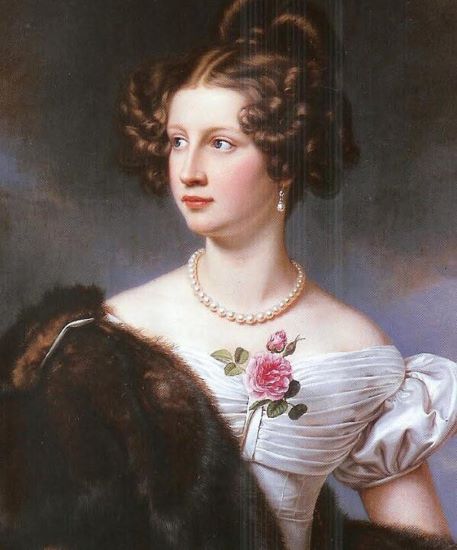
Hairstyles at the beginning of the decade continued the “spaniel curls” and center parts of the 1810s. By the middle of the decade, the Apollo knot, several large loops of hair at the top of the head, had become the fad. It was usually paired with sausage curls at the temples. Another style was à la Chinoise, which came into fashion at the end of the decade. It was an arrangement of braids and knots with curls at the temples decorated with long pins. [13]
Caps were worn by older and conservative women both indoors and under bonnets. They tied under the chin and were usually heavily adorned with pleats, lace, ribbons, feathers, flowers, and jewels.
The bonnets of the previous decade widened along with everything else with the brims and crowns increasing in width and height. Decoration also exploded, with ribbons, feathers, greenery, and flowers being attached to the outside and the underside of the brim. [14]
Turbans were also worn and were as heavily adorned as other headwear styles. They were considered exotic. [15]

Footwear
The slipper was still the fashionable shoe. In the late 1820’s, the first high shoe was introduced and was popular with both men and women. It had a three-inch (7.62 cms) cloth upper that laced on the inside and a square toe. [16]
Accessories
Reticules continued to be popular accessories since most of the fashions of the decade did not feature integrated pockets. Fans and parasols were also common.
I hope this was helpful. Let me know if you have any questions or suggestions by using the Contact Me form on my website or writing a comment. I post every Friday and would be grateful if you would share my content.
If you want my blog delivered straight to your inbox every month along with exclusive content and giveaways please sign up for my email list here.
Let’s get writing!
Copyright © 2021 Rebecca Shedd. All rights reserved.
[1] Tortora, Phyllis G. and Keith Eubank. Survey of Historic Costume, 5th ed. New York: Fairchild Books, 2010 p. 328.
Laver, James. Costume and Fashion: A Concise History, 5th ed. London: Thames & Hudson, Ltd, 2012 p. 163.
[3] Lynn, Eleri. Underwear: Fashion in Detail. London: V&A Publishing, 2010 p. 84.
Bruna, Denis, ed. Fashioning the Body: An Intimate History of the Silhouette. New Haven: Yale University Press, 2015 p. 160-161.
[2] http://www.frockflicks.com/metal-grommets/#:~:text=When%20metal%20grommets%20were%20first,popular%20in%20the%20Victorian%20era.
[4] Byrde, Penelope. Nineteenth Century Fashion. London: Batsford, 1992 p. 36.
[5] Byrde, Penelope. Nineteenth Century Fashion. London: Batsford, 1992 p. 35.
[6] Byrde, Penelope. Nineteenth Century Fashion. London: Batsford, 1992 p 36.
Cunnington, C. Willett. English Women’s Clothing in the Nineteenth Century: A Comprehensive Guide with 1,117 Illustrations. Mineola, NY: Dover Publications, 1990 p. 34.
Johnston, Lucy, Marion Kite, Helen Persson, Richard Davis, and Leonie Davis. Nineteenth Century Fashion in Detail. London: V&A Publications, 2005 p. 223.
[7] Cunnington, C. Willett. English Women’s Clothing in the Nineteenth Century: A Comprehensive Guide with 1,117 Illustrations. Mineola, NY: Dover Publications, 1990 p. 74.
[8] Byrde, Penelope. Nineteenth Century Fashion. London: Batsford, 1992 p. 35-36.
[9] Bassett, Lynne Z. Gothic to Goth: Romantic Era Fashion and Its Legacy. Hartford: Connecticut Wadsworth Antheneum Museum of Art, 2016 p. 20.
[10] Tarrant, Naomi E. A. The Rise and Fall of the Sleeve: 1825-1840. Edinburgh: Royal Scottish Museum, 1983 p. 13.
Cunnington, C. Willett. English Women’s Clothing in the Nineteenth Century: A Comprehensive Guide with 1,117 Illustrations. Mineola, NY: Dover Publications, 1990 p. 75.
[11] Tarrant, Naomi E. A. The Rise and Fall of the Sleeve: 1825-1840. Edinburgh: Royal Scottish Museum, 1983 p. 13.
Cunnington, C. Willett. English Women’s Clothing in the Nineteenth Century: A Comprehensive Guide with 1,117 Illustrations. Mineola, NY: Dover Publications, 1990 p. 75.
[12] Mackrell, Alice. Art and Fashion: The Impact of Art on Fashion and Fashion on Art. London: B T Batsford, 2005 p. 71.
[13] Cunnington, C. Willett. English Women’s Clothing in the Nineteenth Century: A Comprehensive Guide with 1,117 Illustrations. Mineola, NY: Dover Publications, 1990 p. 95.
Tortora, Phyllis G. and Keith Eubank. Survey of Historic Costume, 5th ed. New York: Fairchild Books, 2010 p. 334.
[14] Cunnington, C. Willett. English Women’s Clothing in the Nineteenth Century: A Comprehensive Guide with 1,117 Illustrations. Mineola, NY: Dover Publications, 1990 p. 95-96.
[16] Warren, Geoffrey (1987). Fashion Accessories Since 1500. London: Unwin Hyman. p. 93.
[15] Wilcox, Turner R. (1958). The Mode in Costume. New York, NY: Charles Scribner's Sons. p. 248.
 Rebecca Shedd - Author
I was just seeking this info for some time. After six hours of continuous Googleing, finally I got it in your site. I wonder what’s the lack of Google strategy that don’t rank this kind of informative sites in top of the list. Usually the top web sites are full of garbage.
LikeLike
We are a group of volunteers and starting a new scheme in our community. Your site offered us with valuable information to work on. You’ve done a formidable job and our entire community will be thankful to you.
LikeLike
Excellent read, I just passed this onto a colleague who was doing a little research on that. And he actually bought me lunch because I found it for him smile Therefore let me rephrase that: Thanks for lunch!
LikeLike
Hi, Neat post. There is a problem with your site in internet explorer, may test this? IE still is the marketplace chief and a good part of other folks will omit your great writing due to this problem.
LikeLike
We’re a group of volunteers and opening a new scheme in our community. Your website offered us with valuable information to work on. You have done a formidable job and our entire community will be grateful to you.
LikeLike
Hi, i think that i saw you visited my website thus i came to ?return the favor?.I am trying to find things to enhance my web site!I suppose its ok to use some of your ideas!!
LikeLike
You actually make it seem so easy with your presentation but I find this topic to be really something that I think I would never understand. It seems too complex and very broad for me. I’m looking forward for your next post, I?ll try to get the hang of it!
LikeLike
I?ve been exploring for a little bit for any high-quality articles or blog posts in this kind of house . Exploring in Yahoo I eventually stumbled upon this site. Studying this information So i?m happy to exhibit that I’ve an incredibly excellent uncanny feeling I discovered exactly what I needed. I so much definitely will make sure to don?t disregard this site and provides it a glance on a relentless basis.
LikeLike
Someone essentially help to make seriously articles I would state. This is the first time I frequented your web page and thus far? I surprised with the research you made to make this particular publish extraordinary. Magnificent job!
LikeLike
You really make it seem so easy with your presentation but I find this matter to be really something which I think I would never understand. It seems too complex and extremely broad for me. I am looking forward for your next post, I will try to get the hang of it!
LikeLike
I haven?t checked in here for a while as I thought it was getting boring, but the last several posts are great quality so I guess I?ll add you back to my everyday bloglist. You deserve it my friend 🙂
LikeLike
Magnificent site. Plenty of helpful info here. I?m sending it to some pals ans additionally sharing in delicious. And naturally, thanks on your sweat!
LikeLike
Thanks for the sensible critique. Me and my neighbor were just preparing to do some research on this. We got a grab a book from our area library but I think I learned more clear from this post. I’m very glad to see such wonderful information being shared freely out there.
LikeLike
Hi there, I discovered your website by way of Google even as searching for a related topic, your web site got here up, it appears to be like good. I’ve bookmarked it in my google bookmarks.
LikeLike