The Writer’s Guide to 1820s Women’s Fashion
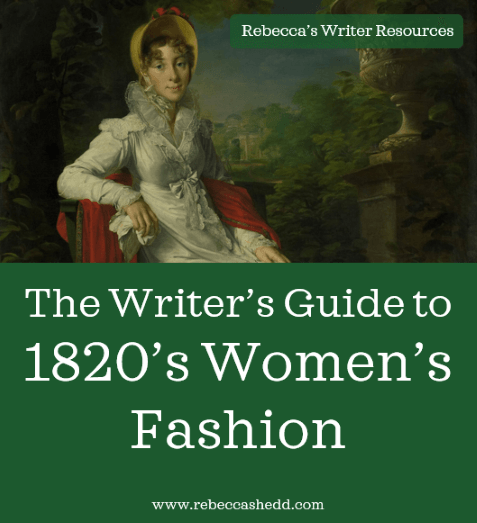

With the death of King George III of England in 1820 and the coronation of George IV, the Regency era was over. Bright saturated colors and patterns came into vogue. Rows of trim and tucks, fluttering ribbons and shimmering gauzes and bobbin lace were used with abandon. After years under the rule of an old and mentally unstable king, fashion embraced the youthful exuberance of a new monarch.
For an overview of fashion for the entire 19th century, please read my Writer’s Guide to 19th Century Fashion.
So Romantic
This decade was a transitory period between the classical Regency styles and the more structured Victorian styles which started in 1837 with the coronation of Queen Victoria. It was part of the Georgian era, which lasted from 1714 to 1837 and covered the reign of Britain’s King Georges I-IV.
This decade saw the abandonment of the classically inspired fashions of the first two decades of the 19th century. Instead, the Romantic Movement was all the rage. The influence of this movement impacted not only fashion but literature, art, and music. It placed importance on personal emotions and expression. Clothing of this decade draws a large amount of influence from an idealized version of the past, especially the Middle Ages. [1]

Undergarments
A chemise or shift was still the first layer worn by all classes of women. Increasingly, it was made of cotton even though linen breathed better and didn’t stick to the body. But linen has a long and time-consuming manufacturing process. The processing of cotton had been dramatically shortened by the invention of the cotton gin in 1793 and various spinning machines in 1760s and 1770s.
Stays began to fade out of use and the corset began more prominent. The corset originally had only soft cording for structure while stays had more rigid boning. As the waistline began to drop, stays and corsets lengthened from the previous decade. While the main job of the garment during the Regency era was to hoist and separate the girls, the focus during this decade was to slim the waist and emphasis the curves. [2] The metal eyelet, first used on corsets in 1828, allowed them to take the strain of tight lacing. Before this invention, the fabric around thread-enforced eyelets would tear if laced too severely. [3]
A small bustle pad was worn on the rump to fill out the back of the skirt. Over this were several layers of petticoats. [4]

Dresses
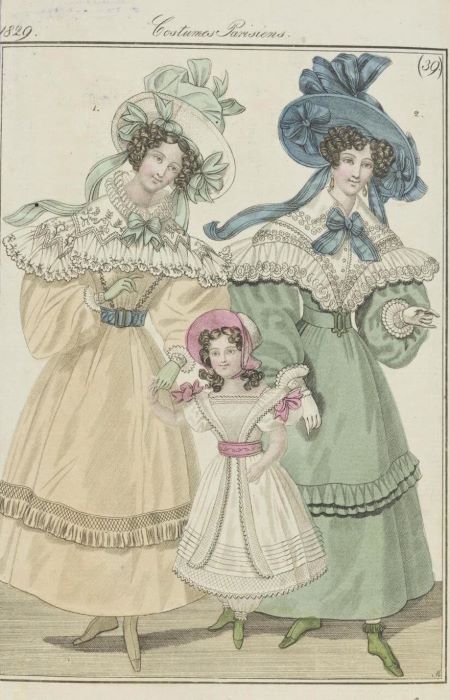
While waistlines started high at the beginning of the decade, they began to drop. By 1825, it was almost at the natural waist. [5] The skirts began to widen with the use of gores. By the end of the decade, they had become so voluminous that the excess fabric had to be pleated in at the waistband. The applied trim and decoration of the previous decade continued with lace, ruffles, flounces, puffs, and rouleaux, stuffed tubes of fabric. The weight of these decorations caused the hemlines to be raised above the floor. [6]
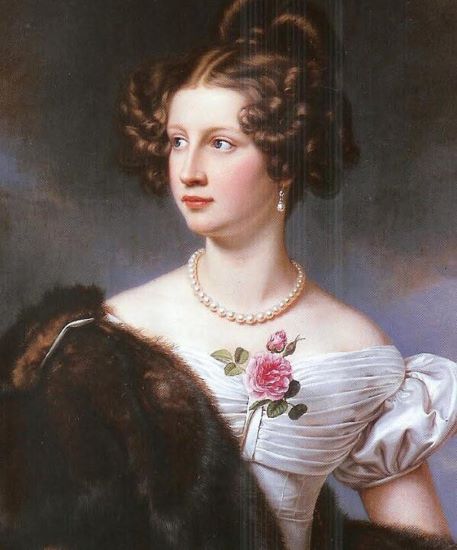
However, it was with sleeves that they really went crazy. Sleeves began to widen until “the upper arm appeared to be quite double the size of the waist” [7] These styles were known as gigot or leg-o-mutton since they resembled a leg of lamb. One of the few narrow styles was the “Marie” sleeve, which had a series of puffs going down the arm and evokes a romanticized medieval style. Slashing, puffs, and other elements that conjured the 16th and 17th century were also popular. Sleeves were usually long for daytime but short for evening although long sleeves of sheer netting were stylish. [8]
Necklines could be high for daytime or filled in with a chemisette. Wide collars known as pelerines became popular and covered the chest and shoulders. They often had decorative edges such as “vandyck points,” a reference to the 17th century artist, Anthony van Dyck. [9] For evening, necklines were frequently low and open. Ruffs at the neck were another design element that recalled historical styles.
The pelisse-robe, a type of coat-dress, was often worn for walking in the morning. [10]
Color overtook white in popularity, especially deep saturated tones such as chrome yellow and Turkish red. [11] Patterns such as checks and plaids also became all the rage. The popularity of plaid mirrored the appeal of the romantic writings of Sir Walter Scott. [12]

Outwear
The shawl was still the reigning outer garment although cloaks and coats were worn in cold and/or wet weather.
Hairstyles and Headwear
Hairstyles at the beginning of the decade continued the “spaniel curls” and center parts of the 1810s. By the middle of the decade, the Apollo knot, several large loops of hair at the top of the head, had become the fad. It was usually paired with sausage curls at the temples. Another style was à la Chinoise, which came into fashion at the end of the decade. It was an arrangement of braids and knots with curls at the temples decorated with long pins. [13]
Caps were worn by older and conservative women both indoors and under bonnets. They tied under the chin and were usually heavily adorned with pleats, lace, ribbons, feathers, flowers, and jewels.
The bonnets of the previous decade widened along with everything else with the brims and crowns increasing in width and height. Decoration also exploded, with ribbons, feathers, greenery, and flowers being attached to the outside and the underside of the brim. [14]
Turbans were also worn and were as heavily adorned as other headwear styles. They were considered exotic. [15]

Footwear
The slipper was still the fashionable shoe. In the late 1820’s, the first high shoe was introduced and was popular with both men and women. It had a three-inch (7.62 cms) cloth upper that laced on the inside and a square toe. [16]
Accessories
Reticules continued to be popular accessories since most of the fashions of the decade did not feature integrated pockets. Fans and parasols were also common.
I hope this was helpful. Let me know if you have any questions or suggestions by using the Contact Me form on my website or writing a comment. I post every Friday and would be grateful if you would share my content.
If you want my blog delivered straight to your inbox every month along with exclusive content and giveaways please sign up for my email list here.
Let’s get writing!
Copyright © 2021 Rebecca Shedd. All rights reserved.
[1] Tortora, Phyllis G. and Keith Eubank. Survey of Historic Costume, 5th ed. New York: Fairchild Books, 2010 p. 328.
Laver, James. Costume and Fashion: A Concise History, 5th ed. London: Thames & Hudson, Ltd, 2012 p. 163.
[3] Lynn, Eleri. Underwear: Fashion in Detail. London: V&A Publishing, 2010 p. 84.
Bruna, Denis, ed. Fashioning the Body: An Intimate History of the Silhouette. New Haven: Yale University Press, 2015 p. 160-161.
[2] http://www.frockflicks.com/metal-grommets/#:~:text=When%20metal%20grommets%20were%20first,popular%20in%20the%20Victorian%20era.
[4] Byrde, Penelope. Nineteenth Century Fashion. London: Batsford, 1992 p. 36.
[5] Byrde, Penelope. Nineteenth Century Fashion. London: Batsford, 1992 p. 35.
[6] Byrde, Penelope. Nineteenth Century Fashion. London: Batsford, 1992 p 36.
Cunnington, C. Willett. English Women’s Clothing in the Nineteenth Century: A Comprehensive Guide with 1,117 Illustrations. Mineola, NY: Dover Publications, 1990 p. 34.
Johnston, Lucy, Marion Kite, Helen Persson, Richard Davis, and Leonie Davis. Nineteenth Century Fashion in Detail. London: V&A Publications, 2005 p. 223.
[7] Cunnington, C. Willett. English Women’s Clothing in the Nineteenth Century: A Comprehensive Guide with 1,117 Illustrations. Mineola, NY: Dover Publications, 1990 p. 74.
[8] Byrde, Penelope. Nineteenth Century Fashion. London: Batsford, 1992 p. 35-36.
[9] Bassett, Lynne Z. Gothic to Goth: Romantic Era Fashion and Its Legacy. Hartford: Connecticut Wadsworth Antheneum Museum of Art, 2016 p. 20.
[10] Tarrant, Naomi E. A. The Rise and Fall of the Sleeve: 1825-1840. Edinburgh: Royal Scottish Museum, 1983 p. 13.
Cunnington, C. Willett. English Women’s Clothing in the Nineteenth Century: A Comprehensive Guide with 1,117 Illustrations. Mineola, NY: Dover Publications, 1990 p. 75.
[11] Tarrant, Naomi E. A. The Rise and Fall of the Sleeve: 1825-1840. Edinburgh: Royal Scottish Museum, 1983 p. 13.
Cunnington, C. Willett. English Women’s Clothing in the Nineteenth Century: A Comprehensive Guide with 1,117 Illustrations. Mineola, NY: Dover Publications, 1990 p. 75.
[12] Mackrell, Alice. Art and Fashion: The Impact of Art on Fashion and Fashion on Art. London: B T Batsford, 2005 p. 71.
[13] Cunnington, C. Willett. English Women’s Clothing in the Nineteenth Century: A Comprehensive Guide with 1,117 Illustrations. Mineola, NY: Dover Publications, 1990 p. 95.
Tortora, Phyllis G. and Keith Eubank. Survey of Historic Costume, 5th ed. New York: Fairchild Books, 2010 p. 334.
[14] Cunnington, C. Willett. English Women’s Clothing in the Nineteenth Century: A Comprehensive Guide with 1,117 Illustrations. Mineola, NY: Dover Publications, 1990 p. 95-96.
[16] Warren, Geoffrey (1987). Fashion Accessories Since 1500. London: Unwin Hyman. p. 93.
[15] Wilcox, Turner R. (1958). The Mode in Costume. New York, NY: Charles Scribner's Sons. p. 248.
 Rebecca Shedd - Author
There may be noticeably a bundle to learn about this. I assume you made certain good points in options also.
LikeLike
I have recently started a website, the information you provide on this website has helped me tremendously. Thanks for all of your time & work.
LikeLike
I will immediately snatch your rss feed as I can’t to find your e-mail subscription link or newsletter service. Do you have any? Please allow me realize so that I may subscribe. Thanks.
LikeLike
excellent submit, very informative. I ponder why the opposite experts of this sector don’t notice this. You must proceed your writing. I’m sure, you’ve a great readers’ base already!
LikeLike
I appreciate, cause I found just what I was looking for. You have ended my 4 day long hunt! God Bless you man. Have a nice day. Bye
LikeLike
I was very pleased to search out this internet-site.I needed to thanks in your time for this glorious read!! I positively having fun with each little bit of it and I have you bookmarked to check out new stuff you weblog post.
LikeLike
WONDERFUL Post.thanks for share..extra wait .. ?
LikeLike
Hello there, just became aware of your blog through Google, and found that it is really informative. I?m gonna watch out for brussels. I will be grateful if you continue this in future. Lots of people will be benefited from your writing. Cheers!
LikeLike
Hello, you used to write fantastic, but the last several posts have been kinda boring? I miss your tremendous writings. Past few posts are just a little bit out of track! come on!
LikeLike
Good ? I should definitely pronounce, impressed with your site. I had no trouble navigating through all tabs as well as related information ended up being truly simple to do to access. I recently found what I hoped for before you know it at all. Quite unusual. Is likely to appreciate it for those who add forums or anything, site theme . a tones way for your client to communicate. Nice task..
LikeLike
Hello just wanted to give you a quick heads up and let you know a few of the pictures aren’t loading properly. I’m not sure why but I think its a linking issue. I’ve tried it in two different browsers and both show the same results.
LikeLike
I’ve been absent for some time, but now I remember why I used to love this web site. Thanks , I?ll try and check back more frequently. How frequently you update your site?
LikeLike
Magnificent website. A lot of useful info here. I?m sending it to several friends ans also sharing in delicious. And obviously, thanks for your sweat!
LikeLike
I have been browsing online more than three hours today, yet I never found any interesting article like yours. It is pretty worth enough for me. Personally, if all site owners and bloggers made good content as you did, the internet will be much more useful than ever before.
LikeLike
I?ve been exploring for a bit for any high quality articles or weblog posts on this sort of house . Exploring in Yahoo I at last stumbled upon this site. Studying this info So i am glad to exhibit that I have an incredibly just right uncanny feeling I discovered just what I needed. I most without a doubt will make sure to do not omit this website and give it a look on a constant basis.
LikeLike
Thank you a lot for sharing this with all of us you really recognize what you’re talking approximately! Bookmarked. Kindly also discuss with my website =). We will have a hyperlink trade contract between us!
LikeLike
I have been surfing online more than three hours today, yet I never found any interesting article like yours. It?s pretty worth enough for me. In my opinion, if all webmasters and bloggers made good content as you did, the internet will be much more useful than ever before.
LikeLike
Pretty component of content. I simply stumbled upon your web site and in accession capital to assert that I acquire actually loved account your blog posts. Any way I will be subscribing for your feeds and even I achievement you get admission to persistently fast.
LikeLike
I was suggested this web site by my cousin. I’m not sure whether this post is written by him as no one else know such detailed about my difficulty. You’re wonderful! Thanks!
LikeLike
There are actually lots of details like that to take into consideration. That is a nice point to convey up. I provide the ideas above as basic inspiration but clearly there are questions like the one you bring up the place a very powerful thing will probably be working in sincere good faith. I don?t know if finest practices have emerged around issues like that, however I’m positive that your job is clearly identified as a good game. Each girls and boys really feel the affect of only a second?s pleasure, for the rest of their lives.
LikeLike
I discovered your weblog website on google and check a few of your early posts. Proceed to maintain up the very good operate. I simply additional up your RSS feed to my MSN Information Reader. In search of ahead to reading extra from you afterward!?
LikeLike
Oh my goodness! an amazing article dude. Thank you Nonetheless I am experiencing concern with ur rss . Don?t know why Unable to subscribe to it. Is there anyone getting equivalent rss downside? Anyone who is aware of kindly respond. Thnkx
LikeLike
obviously like your website however you have to test the spelling on several of your posts. Many of them are rife with spelling problems and I find it very troublesome to tell the truth then again I will certainly come back again.
LikeLike
very good publish, i actually love this web site, carry on it
LikeLike
Great paintings! That is the kind of information that are supposed to be shared across the web. Shame on Google for now not positioning this publish higher! Come on over and seek advice from my site . Thank you =)
LikeLike
Once I originally commented I clicked the -Notify me when new comments are added- checkbox and now each time a comment is added I get four emails with the identical comment. Is there any means you’ll be able to take away me from that service? Thanks!
LikeLike
Hi, Neat post. There’s a problem with your web site in internet explorer, would check this? IE still is the market leader and a large portion of people will miss your great writing because of this problem.
LikeLike
Throughout this grand pattern of things you’ll secure a B+ for effort. Exactly where you actually confused me ended up being in the specifics. As as the maxim goes, the devil is in the details… And it could not be much more correct here. Having said that, let me tell you what exactly did give good results. Your authoring is certainly very powerful which is possibly why I am taking an effort in order to comment. I do not really make it a regular habit of doing that. Next, while I can easily see the jumps in reason you come up with, I am not convinced of exactly how you appear to unite your details that help to make your final result. For the moment I will, no doubt subscribe to your point but hope in the future you link the facts much better.
LikeLike
Magnificent beat ! I wish to apprentice even as you amend your web site, how can i subscribe for a weblog site? The account aided me a appropriate deal. I were tiny bit acquainted of this your broadcast provided vibrant transparent concept
LikeLike
There’s noticeably a bundle to know about this. I assume you made sure nice points in features also.
LikeLike
This website is really a walk-by means of for the entire information you needed about this and didn’t know who to ask. Glimpse here, and you’ll undoubtedly discover it.
LikeLike
I’m extremely impressed with your writing skills as well as with the layout on your blog. Is this a paid theme or did you modify it yourself? Anyway keep up the excellent quality writing, it?s rare to see a great blog like this one nowadays..
LikeLike
You can certainly see your enthusiasm in the work you write. The world hopes for even more passionate writers like you who aren’t afraid to say how they believe. Always go after your heart.
LikeLike
hello!,I love your writing very much! percentage we keep up a correspondence more approximately your post on AOL? I need a specialist on this area to unravel my problem. Maybe that’s you! Taking a look ahead to peer you.
LikeLike
Fantastic beat ! I would like to apprentice while you amend your web site, how can i subscribe for a blog site? The account aided me a acceptable deal. I had been tiny bit acquainted of this your broadcast provided bright clear idea
LikeLike
I have not checked in here for a while since I thought it was getting boring, but the last several posts are good quality so I guess I will add you back to my everyday bloglist. You deserve it my friend 🙂
LikeLike
There are certainly loads of details like that to take into consideration. That is a nice point to deliver up. I offer the ideas above as normal inspiration however clearly there are questions like the one you convey up where the most important factor will likely be working in sincere good faith. I don?t know if best practices have emerged around things like that, however I’m certain that your job is clearly recognized as a good game. Each girls and boys really feel the influence of just a second?s pleasure, for the rest of their lives.
LikeLike
I’m so happy to read this. This is the type of manual that needs to be given and not the random misinformation that’s at the other blogs. Appreciate your sharing this best doc.
LikeLike
My brother recommended I would possibly like this web site. He was once totally right. This publish actually made my day. You can not imagine just how so much time I had spent for this information! Thanks!
LikeLike
It?s really a nice and useful piece of info. I am glad that you shared this helpful info with us. Please keep us up to date like this. Thanks for sharing.
LikeLike
As I web site possessor I believe the content material here is rattling great , appreciate it for your hard work. You should keep it up forever! Best of luck.
LikeLike
Excellent post. I used to be checking continuously this blog and I’m impressed! Extremely useful information specially the ultimate part 🙂 I care for such info much. I was seeking this certain information for a very lengthy time. Thanks and best of luck.
LikeLike
very nice post, i actually love this website, carry on it
LikeLike
I will right away grab your rss feed as I can not find your e-mail subscription link or e-newsletter service. Do you’ve any? Please let me know in order that I could subscribe. Thanks.
LikeLike
I?ll right away take hold of your rss as I can not in finding your email subscription link or newsletter service. Do you have any? Please let me understand so that I could subscribe. Thanks.
LikeLike
Hi there, You’ve done an incredible job. I?ll certainly digg it and personally recommend to my friends. I am confident they’ll be benefited from this web site.
LikeLike
I’ve been surfing on-line more than 3 hours as of late, but I never discovered any interesting article like yours. It?s lovely price enough for me. In my opinion, if all webmasters and bloggers made good content material as you probably did, the internet shall be much more helpful than ever before.
LikeLike
Terrific work! This is the type of information that should be shared around the internet. Shame on Google for not positioning this post higher! Come on over and visit my web site . Thanks =)
LikeLike
I liked as much as you’ll obtain performed proper here. The comic strip is attractive, your authored subject matter stylish. nevertheless, you command get got an edginess over that you would like be handing over the following. unwell no doubt come more until now once more as exactly the same just about a lot continuously inside of case you defend this hike.
LikeLike
I like the helpful information you supply for your articles. I?ll bookmark your blog and check again right here regularly. I am somewhat certain I?ll be informed a lot of new stuff proper right here! Best of luck for the next!
LikeLike