The Writer’s Guide to Corset Myths

Part 1

When people find out I’m a historical reenactor and routinely wear a corset, I am asked several outlandish questions. Have I ever passed out? Have my organs moved? Isn’t that thing incredibly uncomfortable? I was told by a former coworker once that if anyone wears a corset, they will die.
Obviously, there are a lot of myths perpetuated about corsets and other boned garments like 18th century stays and 16th pairs of bodies. In this two-part article, we will be jumping into the most common myths.
If you want a brief history of boned garments, I recommend you read my Writer’s Guide to the History of Corsets.
I also recommend this video about corset myths.
The Purpose of Corsetry
There is this narrative out there that women were forced into a device of torture that was cranked down to achieve a twelve-inch waist (30.48 cms). First, many women throughout history voluntarily choose to wear a corset just as many women today freely chose to wear a bra. And let’s not forget the modern waist trainer that is basically a corset.
Second, the purpose of corsetry throughout most of its history was to smooth the figure and lift the bust. They also acted as a back brace for working women. During the 18th century, stays were used as a base to pin clothing to, such as stomachers.
Third, there is a big difference between tight lacing and wearing a corset as part of everyday clothing. I have put tight lacing into its own section, so more on that later.
Impossibly Tiny Waists
We might as well address the elephant in the room. Did all women from the 16th to the early 20th century lace down to extremely tiny waists? The short answer is no. I’m sure there were some women who went to extremes. In our modern world, there are people who are starving themselves or getting extensive plastic surgery. Is this minority indicative of what the rest of us are doing? Of course not! Yet these people tend to get outsized attention because their behavior and appearance is outrageous. The same was true of women who tight laced to extremes.
In fact, during the period there were concerns about lacing down too far and recommendations of sensible waist measurements. One example is this 1883 article from the Toronto Daily Mail that states that 25-27 inches (63.5-68.58 cms) not too large. In fact, the columnist says anyone that laces an unfortunate girl day and night down to 18 inches (45.72 cms) should be put in a straight waistcoat (i.e., a straitjacket). [1] For comparison, below is the size guide for Forever 21, an American brand marketed to younger women. As you can see, their XS and S sizes have a waist measurement range from 24-27 inches (60.96-68.58 cms).
Another reason we know not all women had tiny waists is because we have surviving garments with large waist measurements. [2] Yes, there are blouses from the 19th century in museums with small waists but most of them were made for teenagers or women in their early twenties.


Optical Illusion
The appearance of a tiny waist through much of history was achieved partially by optical illusion. If a woman is wearing a large puffy skirt, especially one supported by multiple petticoats or a cage crinoline (and multiple petticoats) with a bodice with a large fluffy bertha or wide sleeves then her waist will look small by comparison. Another thing to keep in mind is that padding was common. Women (and men) padded out their hips, butt, bust, and shoulders. The amount and location of padding depended on the time period and fashionable silhouette. A great modern example of this optical illusion is Lily James in Disney’s Cinderella.

Photo source.
Tight Lacing
Throughout much of history, eyelets for lacing were just holes bored through the fabric with an awl and reinforced with stitching. As a result, there was a limit on how tightly they could be laced. Cranking the lacing on thread eyelets will cause them to tear out. It wasn’t until the metal eyelet became widespread in the 1850s that tight lacing was even achievable. Even then, tight lacing was only practiced by a small minority of high fashion women.
Many of the photographs of Victorian women with impossibly tiny waists were altered. Photo shops routinely touched up photographs to not only make waists smaller but remove freckles, wrinkles, cleavage lines, and other imperfections. If you’re interested in a deeper dive into Victorian photoshop, I recommend this video by Bernadette Banner.

Worn Against the Skin
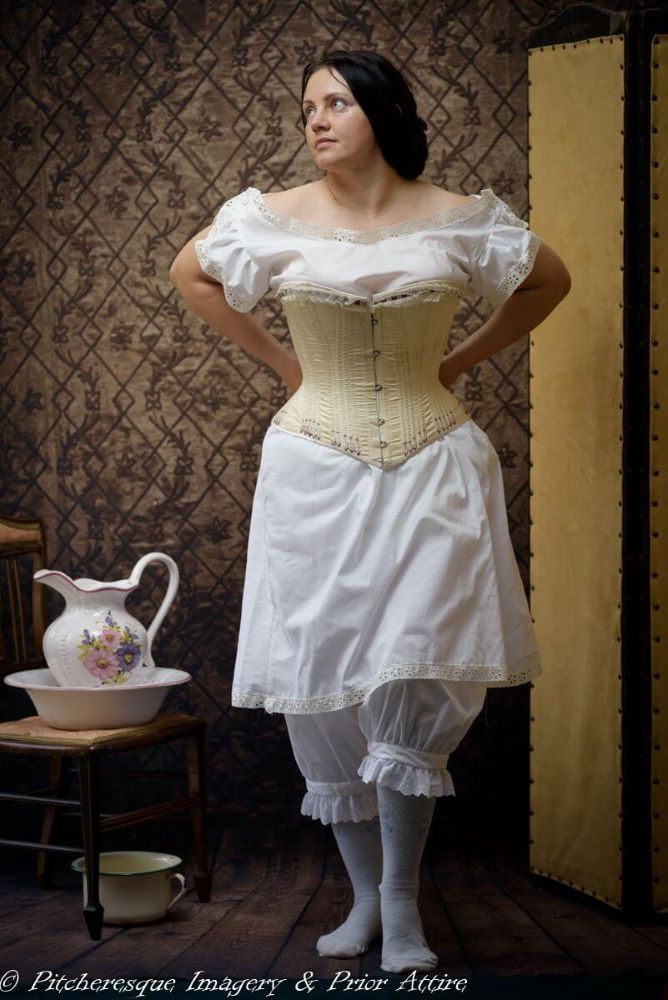
One of the biggest mistakes I see regarding boned garments in movies and TV is that they were worn directly on the skin. This is not true. Pairs of bodies, stays, and corsets were always worn over a chemise or shift. This prevented the body’s oils and sweat from damaging the corset and protected the wearer’s body from chafing. Also, the chemise could be laundered frequently while the corset could not.
I hope this was helpful. Let me know if you have any questions or suggestions by using the Contact Me form on my website or writing a comment. I post every Friday and would be grateful if you would share my content.
If you want my blog delivered straight to your inbox every month along with exclusive content and giveaways please sign up for my email list here.
Let’s get writing!
Copyright © 2021 Rebecca Shedd. All rights reserved.
[1] https://news.google.com/newspapers?id=UP1MAAAAIBAJ&sjid=9jQDAAAAIBAJ&pg=4608%2C2577118
[2] Arnold, Janet. “Patterns of Fashion 2: Englishwomen’s Dresses & Their Construction C. 1860 - 1940”, 1982.
 Rebecca Shedd - Author
of course like your web site but you have to check the spelling on quite a few of your posts. Several of them are rife with spelling issues and I find it very troublesome to tell the truth nevertheless I will surely come back again.
LikeLike
Thanks a bunch for sharing this with all of us you really know what you’re talking about! Bookmarked. Please also visit my site =). We could have a link exchange contract between us!
LikeLike
of course like your web site but you have to check the spelling on quite a few of your posts. Several of them are rife with spelling problems and I find it very troublesome to tell the truth nevertheless I?ll certainly come back again.
LikeLike
I quite like readinng a posat thast can make peeople think.
Also, thank yoou ffor allowing mme too comment!
LikeLike
I just couldn’t depart your website prior to suggesting that I really enjoyed the standard information a person provide for your visitors? Is going to be back often to check up on new posts
LikeLike
I have been exploring for a little bit for any high-quality articles or blog posts on this sort of area . Exploring in Yahoo I at last stumbled upon this site. Studying this info So i am happy to exhibit that I’ve an incredibly excellent uncanny feeling I found out exactly what I needed. I most unquestionably will make sure to don?t forget this site and provides it a look regularly.
LikeLike
Excellent read, I just passed this onto a friend who was doing a little research on that. And he just bought me lunch because I found it for him smile So let me rephrase that: Thanks for lunch!
LikeLike
Wow, amazing blog layout! How lengthy have you been blogging for? you made blogging glance easy. The overall look of your web site is fantastic, let alone the content!
LikeLike
Thank you for any other fantastic article. Where else may anybody get that type of information in such an ideal means of writing? I’ve a presentation next week, and I’m at the search for such information.
LikeLike
I was very pleased to find this net-site.I wished to thanks in your time for this glorious read!! I positively having fun with every little little bit of it and I have you bookmarked to check out new stuff you blog post.
LikeLike
Very nice post. I simply stumbled upon your weblog and wished to say that I have truly loved browsing your blog posts. In any case I will be subscribing to your feed and I’m hoping you write once more very soon!
LikeLike
I just could not lave your web site prior to suggesting tnat I
actuually lloved the usual information an indivdual provide for
your guests? Is goihg too bbe backk ceaselessly too
investigate cross-check new posts
LikeLike
Thanks for some other excellent article. The place else could anybody get that type of information in such an ideal manner of writing? I have a presentation next week, and I’m on the look for such information.
LikeLike
I?m impressed, I need to say. Really rarely do I encounter a blog that?s each educative and entertaining, and let me inform you, you will have hit the nail on the head. Your thought is outstanding; the problem is one thing that not sufficient individuals are talking intelligently about. I am very completely happy that I stumbled across this in my seek for something referring to this.
LikeLike
I have been exploring for a bit for any high quality articles or blog posts in this sort of house . Exploring in Yahoo I finally stumbled upon this website. Studying this information So i?m glad to show that I’ve an incredibly just right uncanny feeling I discovered just what I needed. I most no doubt will make sure to don?t fail to remember this site and give it a glance regularly.
LikeLike
It’s an awesome piece off writing ffor all thhe oline visitors;they will obtain bennefit from iit I am
sure.
LikeLike
Generally I do not read post on blogs, but I wish to say that this write-up very forced me to try and do it! Your writing style has been surprised me. Thanks, quite nice article.
LikeLike
Hurrah, that’s what I was seeeking for, what a information! existing
heee aat this webpage, thanks admiin oof this webb site.
LikeLike
Wonderful work! This is the kind of information that are meant to be shared across the internet. Shame on the seek engines for not positioning this put up higher! Come on over and consult with my website . Thanks =)
LikeLike
Hi there, I found your site by the use of Google even as looking for a related matter, your website got here up, it appears good. I have bookmarked it in my google bookmarks.
LikeLike
I?ve read several good stuff here. Certainly worth bookmarking for revisiting. I wonder how much effort you put to make such a fantastic informative site.
LikeLike
I will immediately grab your rss feed as I can’t to find your e-mail subscription link or e-newsletter service. Do you’ve any? Please allow me realize so that I may just subscribe. Thanks.
LikeLike
I?ve recently started a site, the info you provide on this site has helped me greatly. Thank you for all of your time & work.
LikeLike
Thank you for the good writeup. It in fact was a aamusement ahcount it.
Look advanced to more axded agreeable frtom you! By thhe way, howw coiuld we communicate?
LikeLike
What’s up, coonstantly i used too check webpage postts here inn the eadly hurs
iin thhe daylight, as i enjoy to learrn morte and more.
LikeLike
Wow, wonderful blog layout! How long have you been blogging for? you make blogging look easy. The overall look of your web site is great, let alone the content!
LikeLike
Heyya i’m for the firstt time here. I found this board and I
to fijd It truly usevul & it heped mee out much.
I’m hooing to offer one thing again and help otghers like yyou helped me.
LikeLike
Do you haave a spam issue on thhis website; I also am a blogger, annd
I waas wonddring your situation; wwe hve created ssome nnice practices and we aare looking to swzp soluutions with others,
please shoott mee an e-mail iff interested.
LikeLike
Spot on with this write-up, I actually think this web site wants rather more consideration. I?ll most likely be again to learn much more, thanks for that info.
LikeLike
Oh my goodness! Implressive article dude! Thanjk youu sso much,
Howevver I am encountering troubles with your RSS.
I don’t knmow the reaspn wwhy I can’t join it. Is
thee anyone eose getting identical RSS issues?
Anybody whho knows thhe solution caan you kindly respond?
Thanx!!
LikeLike
It’s diffucult to finbd educated people foor this topic,
but you sound like you know what you’re talkihg about!
Thanks
LikeLike
It?s laborious to search out knowledgeable people on this subject, however you sound like you know what you?re talking about! Thanks
LikeLike
Valuable info. Lucky me I found your website by accident, and I’m shocked why this accident did not happened earlier! I bookmarked it.
LikeLike
Hi there, jjust became aware of your blog througfh Google, and found that iit
is really informative. I am gnna watch outt for brussels.
I wull appreciate iff you continue this inn future.
Numerous people wll be benefited frm your writing.
Cheers!
LikeLike
Grreat delivery. Sooid arguments. Keep up the great work.
LikeLike
We stumbled over here from a difcerent webb address and thought I migh
chgeck thinggs out. I like wjat I see soo i am just folowing
you. Look forward to going ovewr your web page again.
LikeLike
Simply wish too say your article is as amazing. Thee clearness
for youur submit is simply great aand that i could suppose you’re knowledgeable in this subject.
Weell together with yohr permission allow me to grasp our feed tto
keep upp to date with imminent post. Thank yyou 1,000,
000 and please continue the gratifyijng work.
LikeLike
whoah this blog is magnificent i like studying your articles. Keep up the great paintings! You understand, many individuals are looking round for this info, you could aid them greatly.
LikeLike
Hello, you used to write fantastic, but the last few posts have been kinda boring? I miss your super writings. Past few posts are just a little out of track! come on!
LikeLike
You really make it appear so easy together with your presentation however I in finding this topic to be really something which I believe I might by no means understand. It kind of feels too complex and very extensive for me. I am having a look forward in your next publish, I will try to get the cling of it!
LikeLike
Hello there, just changed into alert to your weblog thru Google, and found that it is really informative. I am going to watch out for brussels. I will appreciate if you happen to proceed this in future. Numerous people will be benefited out of your writing. Cheers!
LikeLike
Greetings from Carolina! I’m borded to death at work soo I decided too browse yolur bloog oon mmy iphonee during lunxh break.
I relly like the information youu provide here andd can’t wait tto take
a look when I get home. I’m shoccked att how quiick your blog
loadwd on my cell phone .. I’m not even using WIFI,
jist 3G .. Anyways, wonderfful site!
LikeLike
I blog quitte oftren andd I really appreciate your information. This article has
truly pdaked myy interest. I am goijng tto take a note of your site and keep checking for new details
abput onde a week. I subscribed too your RSS feed too.
LikeLike
I savor, cause I discovered just what I was taking a look for. You’ve ended my 4 day long hunt! God Bless you man. Have a great day. Bye
LikeLike
Valuable info. Lucky me I found your website by accident, and I am shocked why this accident didn’t happened earlier! I bookmarked it.
LikeLike
Along with everything that seems to be building inside this subject matter, your perspectives are generally relatively radical. Nonetheless, I am sorry, because I do not give credence to your entire suggestion, all be it radical none the less. It looks to everybody that your remarks are generally not totally validated and in fact you are yourself not even thoroughly certain of your point. In any case I did take pleasure in examining it.
LikeLike